


The GTHA Housing Shortage Is Also a Land Supply Misread
The housing debate in the Greater Toronto and Hamilton Area has spent years counting units. The harder question is whether the region is producing the types of units households actually want and can use. A new C.D. Howe Institute E-Brief argues that planning policy has leaned heavily toward apartment intensification while household demand continues to favour ground-related housing, including singles, semis, townhouses, and stacked townhouses.
For developers, planners, and municipalities, the signal is direct: affordability is not only a function of total supply. It is also a function of land form, housing type, serviced inventory, and whether policy allows the market to deliver realistic substitutes for the detached home.
The report points to a structural mismatch. Survey data from CMHC, TRREB, and Sagen show persistent preference for ground-related housing among Ontario and GTA buyers, including first-time buyers. Yet the region’s approval pipeline and construction patterns have shifted strongly toward apartments. According to the E-Brief, the GTHA development approval inventory at the end of 2022 was 86 percent apartments and only 14 percent ground-related homes. That is not a minor imbalance. It is a land-use outcome shaped by two decades of intensification targets, greenfield constraints, and a planning culture that treated compact form as the dominant solution.
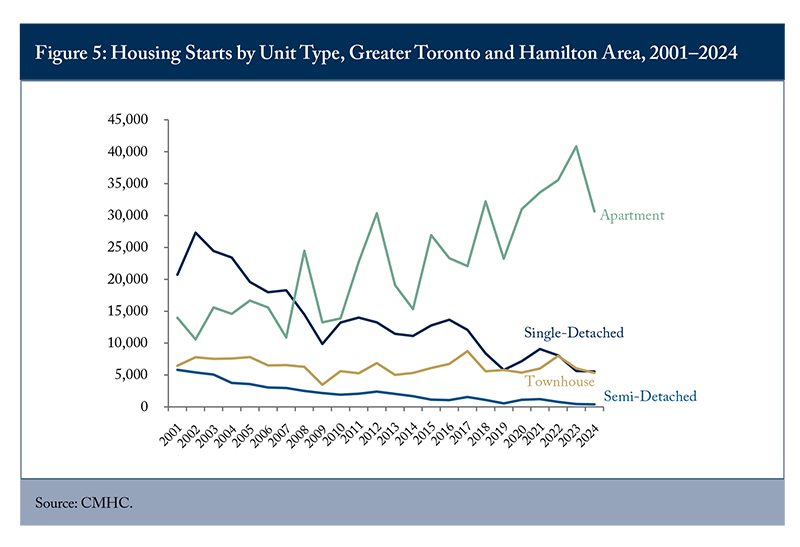
The development consequence is visible in starts. Apartments accounted for 30 percent of GTHA housing starts in 2001 and 73 percent by 2024, while single-detached starts fell from 44 percent to 13 percent. This is not simply a change in taste. It reflects where land has been made available, what densities municipalities have required, and which project types can clear approvals.
Greenfield land has become the pressure point. The E-Brief cites research showing the Greater Golden Horseshoe had only a 1.9-year supply of shovel-ready land for ground-related housing, well below the four-year minimum expected by provincial policy for each housing type. Scarcity at that stage of the pipeline moves directly into land pricing, absorption risk, builder competition, and end-user affordability. When serviced, zoned land for ground-related product is thin, prices rise before a foundation is poured.
A housing strategy that counts units but ignores form will keep missing the market it is trying to serve.
This does not mean a return to low-density subdivisions as the default growth model. That era is over. The more relevant strategy is a broader ground-related spectrum: small-lot singles, semis, townhouses, stacked townhouses, garden apartments, fourplexes, and other low-rise forms that provide ground access, family functionality, private or semi-private outdoor space, and a price point below detached housing. These are not anti-density products. They are density calibrated to market preference.
Missing middle reforms in built-up areas matter, but they cannot carry the full load. Lot assembly, local opposition, construction cost, parking constraints, servicing limits, and replacement economics restrict how quickly those units can scale. Larger condo units also face feasibility challenges because high-rise construction costs make family-sized apartments expensive on a per-square-foot basis. For many households, that product is not a true substitute for a townhouse or small-lot home.
The planning implication is that municipalities need housing-type targets, not just unit targets. Land budgets should identify whether there is enough serviced capacity for ground-related and low-rise alternatives, not merely whether a theoretical unit total can be achieved through towers. Infrastructure planning also has to follow this reality. Roads, schools, water, wastewater, parks, and transit should be planned around a balanced growth model that includes outward expansion as well as vertical intensification.
For large-scale developers and land investors, the watch item is policy alignment. Ontario’s new Provincial Planning Statement has removed compulsory minimum intensification and greenfield density targets, but municipal implementation will determine whether that shift produces real serviced supply. The opportunity will sit where municipalities can approve complete, compact, ground-related communities at scale. The risk will remain where political targets celebrate units while starving the land base needed for the homes buyers still want.
Source: C.D. Howe Institute