



In real estate, the most expensive property is not always the most valuable investment. Price can reflect many things, including construction cost, temporary demand, or simple marketing ambition. A trophy asset, by contrast, earns its status through a much narrower and more powerful set of qualities: true scarcity, prime location, prestige, architectural distinction, and a level of buyer demand that tends to endure across market cycles. These are the properties that wealthy families, entrepreneurs, executives, and long-term investors pursue not merely for lifestyle reasons, but because they represent a rare form of defensible real asset exposure.
Table Of Content
- What Is a Trophy Asset in Luxury Real Estate?
- Why Trophy Assets Can Build Wealth
- Luxury Is Not the Same as Trophy
- Key Characteristics of a Strong Trophy Asset
- Current Market Trends Shaping Trophy Asset Investing
- Canadian Trophy Assets: Opportunity Under Policy Constraints
- Case Study Framework: What Successful Trophy Investments Tend to Have in Common
- Case Study 1: Prime Urban Penthouses in Global Gateway Cities
- Case Study 2: Coastal Estates in Florida and California
- Case Study 3: Canadian Urban and Recreational Trophy Markets
- How to Evaluate a Trophy Asset Like an Investor
- The Risks Investors Should Not Ignore
- Who Should Consider Trophy Asset Investing?
- Final Thoughts: Prestige Matters, but Scarcity Matters More
The investment case for trophy assets in luxury real estate is often misunderstood. To some observers, these homes are little more than status symbols. In practice, the top tier of luxury housing can serve a deeper financial purpose. Trophy properties can function as a store of value, a source of portfolio diversification, a hedge against the commoditization seen in mainstream housing stock, and a long-duration wealth preservation tool. Their value lies not only in what they are, but in how difficult they are to replicate. An irreplaceable waterfront parcel, a landmark penthouse in an elite district, or a legacy estate in a supply-constrained neighborhood carries an intrinsic scarcity that ordinary luxury inventory cannot match.
That distinction matters even more in today’s market. Across Canada and North America, luxury housing is becoming increasingly segmented. It no longer moves in step with average home prices, and it should not be analyzed as if it does. Recent market reporting suggests that performance now varies sharply by city, price threshold, property type, and buyer profile. In Canada, lower-threshold luxury markets such as Calgary and Montreal have shown stronger movement than the most expensive urban centers, while premium segments in Toronto and Vancouver have faced more friction tied to affordability, inventory, tax sensitivity, and buyer caution. In the United States, luxury thresholds continue to rise, and global wealth expansion remains supportive of prime market demand.
This article examines what makes a trophy asset different from a standard luxury home, how these properties contribute to wealth-building, what trends are shaping the sector, and what investors can learn from successful case studies. The goal is not to romanticize luxury real estate. It is to assess it with the same discipline one would apply to any significant capital decision.
Core principle: A trophy asset is not simply expensive. It is rare, difficult to substitute, and supported by a durable base of affluent buyers who value location, privacy, architecture, and legacy.
What Is a Trophy Asset in Luxury Real Estate?
Not all luxury homes are trophy assets. This is the first distinction serious investors need to make. Many properties occupy the luxury tier because they are large, newly built, well-finished, or located in desirable neighborhoods. Yet if a similar home can be developed nearby, if its layout is generic, or if its value depends mainly on a cyclical burst of local enthusiasm, it may be expensive without being irreplaceable. Trophy assets occupy a narrower category. They tend to sit at the top of the market because they possess characteristics that are difficult, and in some cases impossible, to reproduce.
These characteristics typically include elite location, land scarcity, architectural pedigree, exceptional views, privacy, legacy ownership appeal, and enduring social or cultural prestige. In North America, that often means irreplaceable waterfront estates, signature penthouses in globally recognized cities, landmark homes in established wealth enclaves, or exceptional recreational properties in tightly held markets. The common thread is that supply is inherently constrained. There may be only one lot with a particular view corridor, one building with a certain level of provenance, or one street that combines security, prestige, and generational cachet.
Trophy assets also differ from conventional investment real estate because their value is shaped by both financial logic and emotional demand. Wealthy buyers do not make decisions based solely on cap rate style thinking when acquiring primary or legacy residences. They also buy exclusivity, identity, privacy, lifestyle, and permanence. For the investor, this matters because emotional demand can strengthen pricing power when paired with true scarcity. A buyer may delay upgrading in an average market. They are often less willing to walk away from a singular asset that fits a highly specific personal brief.
That is why trophy real estate commands a scarcity premium. The premium is not just about luxury finishes or square footage. It reflects the reality that comparable alternatives are limited. When wealthy buyers compete for an asset that cannot be replicated, value becomes more resilient than it would for luxury homes that are plentiful or easy to substitute.
Why Trophy Assets Can Build Wealth
The wealth-building thesis behind trophy assets rests on a combination of capital preservation and selective appreciation. Unlike mass-market housing, which can be heavily influenced by mortgage affordability, broad employment conditions, and supply surges, trophy properties often draw from a more insulated buyer base. High-net-worth and ultra-high-net-worth buyers typically have greater flexibility, lower financing dependence, and a longer investment horizon. That does not make the segment immune to downturns, but it does mean price behavior can diverge significantly from the broader market.
One of the clearest advantages is store-of-value strength. Investors with substantial capital often seek hard assets that preserve purchasing power over long periods. Prime real estate has historically served that function well, especially when the underlying land is finite and the location is internationally or nationally recognized. A landmark penthouse in Manhattan, an oceanfront estate in Palm Beach, or a tightly held waterfront property in Vancouver carries a level of long-term defensibility that is difficult for more standardized assets to replicate.
A second advantage is portfolio diversification. Trophy residential property offers exposure to a real asset class whose demand drivers are not identical to those of equities, bonds, or commodity housing. Wealth transfer trends, private capital allocation, buyer migration, lifestyle shifts, and global status patterns all play a role. For affluent households, the inclusion of trophy property can balance portfolios otherwise concentrated in public markets, private operating businesses, or financial instruments that react more quickly to macro volatility.
A third advantage is compounding through scarcity. In ordinary housing, appreciation can be diluted when supply expands or nearby development creates abundant alternatives. In true trophy markets, constrained supply protects the best assets. This is especially true where zoning, geography, heritage restrictions, neighborhood opposition, shoreline limitations, or lot scarcity prevent meaningful replication. Over time, the gap between top-tier irreplaceable property and upper-tier but replaceable luxury stock can widen considerably.

Another important point is that trophy assets can align financial and personal utility in ways other investments cannot. A family that owns a prime city residence, a waterfront retreat, or a legacy estate may enjoy direct lifestyle benefits while also holding a strategically valuable asset. This dual-use dimension should not be confused with speculative investing. Rather, it reflects a more sophisticated form of capital allocation, where lifestyle consumption and wealth preservation can coexist, provided the acquisition is disciplined.
Still, trophy real estate should be viewed as a long-duration strategy. These are not ideal short-term trades. Transaction costs are high, buyer pools are narrower than in conventional housing, and optimal exits require timing and patience. The strongest outcomes typically come from investors who buy quality, understand the scarcity profile, maintain the asset well, and hold through multiple market phases.
Luxury Is Not the Same as Trophy
One of the most common misconceptions in high-end property investing is the assumption that every luxury home is a trophy asset. This is where many buyers overpay. A large new house in an affluent suburb can carry a luxury price tag, but if several comparable homes exist nearby, if the architecture lacks distinctiveness, or if the land itself is not exceptional, the investment case weakens. Such a property may still perform reasonably well, but it should not be valued as if it were irreplaceable.
The distinction becomes especially important in late-cycle or cautious markets. During strong periods, broad luxury inventory can rise together, masking differences in quality. When conditions tighten, the market starts to separate sharply. Ordinary luxury listings may sit longer, require price adjustments, or lose leverage. True trophy assets often continue to attract attention because buyers understand they may not see a comparable opportunity again for years.
Investors should therefore think in tiers. The first tier is mainstream housing, which is driven largely by affordability and broad demographic demand. The second tier is luxury housing, which includes expensive homes with quality finishes, good neighborhoods, and aspirational appeal. The third tier is trophy real estate, where scarcity, prestige, and irreplaceability take precedence over size alone. Appreciation potential, liquidity patterns, and downside resilience can differ materially across these tiers.
This framework helps investors avoid a common error: paying trophy pricing for non-trophy product. If an asset’s value depends more on temporary momentum than on lasting scarcity, its premium may prove vulnerable. The disciplined investor pays for what cannot easily be built again, not for features that can be copied at the next development cycle.
Key Characteristics of a Strong Trophy Asset
While no formula can fully capture the value of unique property, the best trophy investments often share a repeatable set of characteristics. Understanding them allows investors to distinguish a high-conviction acquisition from a merely expensive purchase.
- Irreplaceable location. The best trophy assets occupy a location that cannot be duplicated, whether because of waterfront access, skyline positioning, historic district placement, or adjacency to elite amenities such as private clubs, top schools, cultural institutions, and established wealth corridors.
- Land scarcity. In many cases, the land is the true prize. A modest house on exceptional land may outperform a grander structure on ordinary land over the long term because the underlying site carries enduring strategic value.
- Architectural quality and provenance. Design matters. Signature architecture, recognized architects, timeless materials, and coherent floorplans add defensibility because they elevate the asset beyond trend-driven luxury finishes.
- Privacy and security. Affluent buyers increasingly prioritize separation, discretion, and controlled access. Properties that deliver genuine privacy without sacrificing convenience often command stronger long-term demand.
- Buyer depth. A trophy asset still needs a credible future audience. The strongest investments are rare properties in markets with deep pools of affluent domestic and, where permitted, international buyers.
- Holding power. The owner must be able to support taxes, maintenance, insurance, staffing where relevant, and periodic upgrades. Trophy assets reward patience, and patience requires financial resilience.
When these attributes align, the result is a property with a defensible premium. The investment case is not that the home will rise every year in a straight line. It is that over long periods, exceptional assets tend to remain exceptional, while generic luxury stock becomes easier to substitute.
Current Market Trends Shaping Trophy Asset Investing
The luxury market in Canada and North America is evolving in a way that reinforces the need for asset-level analysis. Broad national averages tell only part of the story. Recent reporting indicates that high-end real estate is increasingly regional and segmented, with outcomes determined by local supply, local wealth creation, buyer mobility, regulatory friction, and property type. This trend is particularly important for trophy asset investors because the top end often behaves independently of average home sales activity.
In Canada, broader housing data has reflected a more cautious resale market, with national home sales in March 2026 reported at 38,709 units, down 2.3 percent from March 2025. Yet luxury activity has not moved in uniform step with that softness. High-end markets have shown resilience in several regions, and early 2025 reporting suggested that in 9 of 12 luxury markets examined, high-end sales were up year over year even while overall market activity remained subdued. This divergence highlights a core principle of trophy investing: wealthy buyer behavior is shaped by different constraints and motivations than those affecting the average homeowner.
Another major trend is the continued preference for space, privacy, and amenity-rich detached properties. This shift accelerated during the pandemic but remains relevant into 2025 and 2026. Buyers with capital continue to place a premium on larger homes, private outdoor space, waterfront access, wellness features, and flexible layouts that support family life, entertaining, and work-from-home convenience. In practical terms, this has strengthened demand for detached trophy estates and select low-density prestige properties.
A third trend is the growing role of intergenerational wealth transfer. Luxury outlooks in the United States have pointed to substantial wealth movement between generations, and global wealth data supports the view that the addressable pool of affluent buyers is expanding over time. This matters for trophy assets because they often appeal to buyers who are thinking in decades rather than quarters. The wealth transfer theme supports demand for legacy properties that families can occupy, preserve, and eventually pass on.
In Canada specifically, regulation is a critical part of the story. The federal ban on the purchase of residential property by non-Canadians has been extended to January 1, 2027. That changes the composition of demand, especially in cities where foreign capital once played a more visible role. The market for Canadian trophy residential assets is now shaped more heavily by domestic wealth, intergenerational capital, and local supply constraints. At the same time, structural tightness in ownership housing remains a relevant background factor, supporting the premium on rare, high-quality, well-located homes.
Finally, investors should note the divergence within Canadian luxury markets themselves. Reports have suggested that lower-threshold luxury markets such as Calgary and Montreal have supported stronger movement than top-end urban markets where benchmark prices above $1 million create more friction around mobility and activity. For trophy investors, this means there may be stronger relative opportunity in markets where wealth growth, migration, and limited premium supply intersect, rather than assuming the highest nominally priced city always offers the best risk-adjusted entry point.
Canadian Trophy Assets: Opportunity Under Policy Constraints
Canada presents a compelling but nuanced environment for trophy asset investing. On one hand, the country offers globally admired urban neighborhoods, exceptional waterfront settings, world-class recreational regions, and long-term structural supply constraints. On the other hand, policy and affordability concerns play a larger role than many investors fully appreciate. Foreign-buyer restrictions, tax policy, and public sensitivity around housing access create a regulatory backdrop that can materially affect demand patterns, liquidity, and market psychology.
That does not diminish the appeal of Canadian trophy assets. If anything, it changes how the best opportunities should be evaluated. Since the buyer base is more dependent on domestic wealth and resident capital, investors need to focus even more carefully on markets with strong local economic engines, persistent scarcity, and durable household balance sheets. A trophy residence in a prestigious Montreal enclave, a rare waterfront property in Vancouver, a landmark home in central Toronto, or an elite estate in a top recreational market can still command exceptional attention. The question is whether the asset is positioned to appeal to the most motivated and best-capitalized domestic buyers over time.
Supply conditions also support the case for select trophy holdings. Housing supply work has indicated that while some imbalances are easing, ownership housing remains structurally tight in many markets. For the trophy segment, this reinforces the scarcity thesis. If broad ownership supply is already constrained, the subset of truly irreplaceable high-end property is even narrower. In markets where land scarcity, zoning constraints, and neighborhood preservation limit new development, the premium on existing prime assets can deepen over time.
Still, Canadian investors must underwrite policy risk as seriously as they would location or condition. A property can be magnificent and still be vulnerable to shifts in taxation, usage restrictions, or political sentiment. Sophisticated wealth-building strategy requires acknowledging that premium residential property exists within a social and regulatory framework. Trophy investors should want clarity, not complacency.
Case Study Framework: What Successful Trophy Investments Tend to Have in Common
Because trophy assets are highly unique, case studies are most useful when viewed through patterns rather than as one-size-fits-all templates. Across North America, successful trophy investments often share a few strategic traits: disciplined entry, a focus on irreplaceability, patient holding periods, and selective improvements that preserve or elevate prestige without over-personalizing the asset.
Case Study 1: Prime Urban Penthouses in Global Gateway Cities
Consider the top-tier penthouse market in cities such as New York. These homes often command extraordinary pricing, yet the strongest performers are not simply the largest units in the tallest towers. The most compelling assets are those with unobstructed views, globally recognized addresses, elite services, architectural distinction, and meaningful privacy. In a market with significant luxury inventory, the true trophy units stand apart because they are few in number and impossible to reproduce exactly.
Investors who succeeded in this segment typically bought assets with long-term relevance, not passing novelty. Buildings with durable prestige, established neighborhoods, and international buyer recognition have generally held status better than trend-driven developments built around short-lived hype. When exit timing is favorable, these properties can attract buyers who are purchasing not just space, but a social and geographic position within one of the world’s most liquid ultra-prime markets.
Case Study 2: Coastal Estates in Florida and California
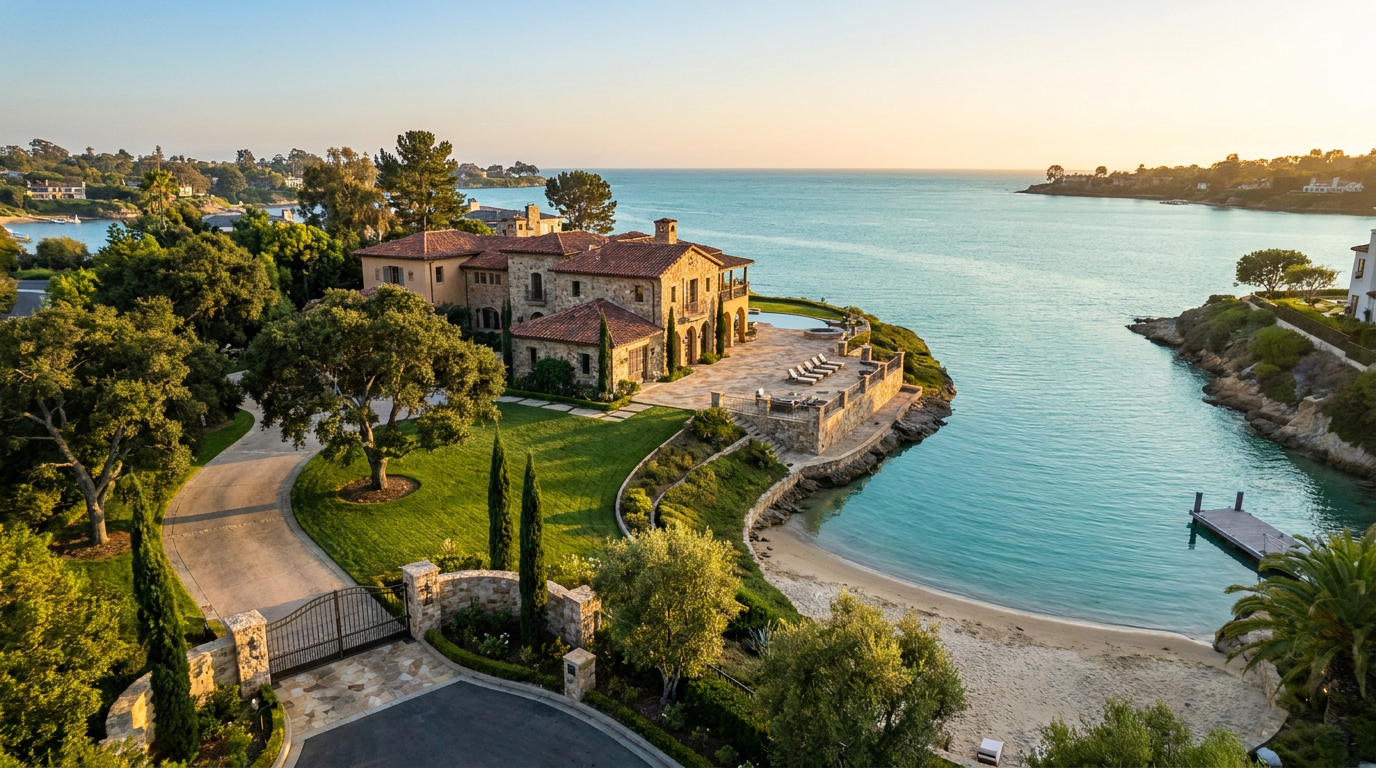
Waterfront and coastal properties in places such as Palm Beach, Miami, and select parts of coastal California illustrate the power of land scarcity. Shoreline inventory is finite by definition. Add elite demand, strong lifestyle appeal, favorable climate, and long-standing prestige, and the result is a trophy market supported by both domestic migration and global attention. These assets often outperform not because every luxury buyer wants a beach house, but because only a very small number of buyers can secure a truly premier one.
The strongest investments in this category usually involve a combination of irreplaceable frontage, privacy, zoning defensibility, and architectural quality. Renovation can add value, but the fundamental driver is the site itself. Investors who understand this do not overemphasize cosmetic trends. They focus on shoreline, orientation, elevation, access, and the long-term desirability of the micro-location.
Case Study 3: Canadian Urban and Recreational Trophy Markets
In Canada, successful trophy investments are increasingly linked to market selectivity. In Vancouver and Toronto, the best assets still command powerful long-term interest, but the broader luxury environment is more sensitive to affordability and policy friction. That means investors have to be even more disciplined about rarity. A standard high-end home may face slower turnover, while a singular estate, signature penthouse, or exceptional legacy property can still attract serious buyers because alternatives are so limited.
Montreal and Calgary provide a different angle. As lower-threshold luxury markets with stronger mobility and more active movement in recent reporting, they can present attractive entry points for investors seeking premium quality without paying the same absolute pricing as the most constrained top-tier cities. In these markets, investors who target the best streets, the best lots, and the most distinctive architecture may benefit from both value asymmetry and improving depth of affluent demand.
How to Evaluate a Trophy Asset Like an Investor
Emotion is unavoidable in trophy real estate, but it should never be unmanaged. A disciplined buyer can admire a property while still underwriting it rigorously. The process should begin with a simple question: What exactly makes this asset irreplaceable? If the answer is vague or relies mostly on finish level, the investment case is weaker than it appears.
Serious evaluation should include both quantitative and qualitative analysis. Investors should assess comparable sales, but with caution, because ordinary comps often fail to capture true scarcity. They should evaluate land value, restrictions on future competing supply, neighborhood prestige trajectory, tax burden, insurance trends, carrying costs, and likely buyer depth at resale. They should also examine whether the asset’s design is timeless or overly tied to current tastes.
It is also worth modeling multiple exit scenarios. Trophy properties can deliver excellent long-term outcomes, but liquidity is inherently lower than in mainstream housing. A prudent investor should know what happens if the ideal buyer does not appear quickly, if rates remain elevated, or if policy changes alter the pool of eligible purchasers. The right acquisition is one that remains strategically sound even when the exit timeline extends.

For many investors, the following checklist is useful:
- Is the location genuinely one of the best in the market, or merely expensive?
- Can the land, view, or setting be replicated nearby?
- Does the property appeal to a broad affluent audience, or only to a highly specific taste?
- What regulatory, tax, or ownership restrictions could affect future demand?
- Can the asset be held comfortably through a long cycle without forced selling?
- Is the premium justified by scarcity, or by temporary market sentiment?
These questions help keep the focus where it belongs: on durability of value rather than excitement of acquisition. Wealth is often built less by buying what is flashy and more by buying what is defensible.
The Risks Investors Should Not Ignore
Trophy assets are powerful wealth tools, but they are not risk-free. Their prestige can sometimes encourage complacency, especially among buyers who assume rarity alone guarantees appreciation. It does not. Even exceptional properties are affected by interest rates, tax changes, political sentiment, insurance costs, and shifts in where affluent buyers want to live. The difference is that true trophy assets often recover and reprice from a stronger base than replaceable luxury inventory.
Illiquidity is one of the most important risks. The pool of potential buyers is smaller, and sales cycles can be longer. In soft conditions, even top properties may take time to trade. Investors therefore need balance sheet strength and a willingness to hold. Forced selling is particularly dangerous in this segment because uniqueness cuts both ways: it creates pricing power when demand is present, but it can slow execution when buyers become selective.
Carrying costs can also be substantial. Property taxes, insurance, security, maintenance, staffing, landscaping, dock upkeep, amenity servicing, and periodic renovations add up quickly. These costs should be treated as part of the investment equation, not as incidental lifestyle spending. The right trophy asset is one where the owner can support the holding period comfortably enough to let the scarcity thesis play out.
Regulatory risk deserves specific attention in Canada. Foreign ownership restrictions already affect the market, and future adjustments to taxation or ownership rules cannot be dismissed. Even in the United States, local regulation, coastal exposure policy, and tax treatment can affect desirability. The strategic investor does not fear regulation blindly, but neither do they ignore it.
Finally, there is selection risk. The wrong luxury property can underperform for years if it lacks true scarcity or if it appeals to too narrow a buyer set. This is why the distinction between luxury and trophy matters so much. Paying a premium is only justified when the asset’s uniqueness is real, durable, and legible to future buyers.
Who Should Consider Trophy Asset Investing?
Trophy assets are best suited to investors with long time horizons, strong liquidity, and a preference for wealth preservation alongside appreciation potential. They are especially relevant for entrepreneurs who have generated concentrated business wealth, families seeking intergenerational real asset holdings, executives diversifying beyond public markets, and buyers who value both investment discipline and lifestyle utility.
They are less suitable for investors seeking rapid turnover, high cash yield, or low-maintenance exposure. Trophy properties are not designed to behave like standard income properties. Their value creation tends to come through selective capital appreciation, scarcity protection, and strategic ownership over time. For the right buyer, that can be extremely effective. For the wrong buyer, it can be frustrating and capital-intensive.
The strongest fit is usually someone who understands that wealth is often preserved through ownership of exceptional assets that remain desirable across generations. In that sense, trophy real estate resembles fine art, elite vineyards, or landmark commercial holdings more than it resembles ordinary housing stock. It belongs in the category of long-conviction holdings, where patience and selectivity matter at least as much as timing.
Final Thoughts: Prestige Matters, but Scarcity Matters More
Trophy assets occupy a rare space within luxury real estate. They are aspirational, but their true appeal goes beyond image. At their best, they offer a disciplined investor access to hard-asset scarcity, elite location, portfolio diversification, and long-term wealth preservation. They can serve as strategic tools for compounding family wealth, anchoring capital in real property, and holding assets that remain meaningful in both financial and personal terms.
Yet the opportunity only works when the buyer is clear-eyed. Trophy investing is not about chasing the highest price point or assuming every luxury listing deserves a scarcity premium. It is about identifying the small subset of properties that are genuinely irreplaceable and then acquiring them with patience, financial strength, and a strong exit framework. In a market where luxury is abundant but true rarity is not, that distinction defines performance.
For investors willing to think in decades, the right trophy asset can do more than signal success. It can help protect it, deepen it, and carry it forward.



No Comment! Be the first one.