



There are certain homes that seem to breathe. They welcome light without surrendering to glare, invite fresh air without exposing interiors to discomfort, and open gracefully toward gardens, courtyards, and sky. These are often the homes shaped by the logic of tropical architecture, a design approach that has long been admired for its beauty yet is even more compelling for its intelligence. Far from being a decorative trend, tropical architecture is a deeply considered response to climate, comfort, and the relationship between human life and the natural world.
Table Of Content
- What Is Tropical Architecture?
- Beyond the Resort Image: Why the Aesthetic Is Only the Surface
- The Defining Characteristics of Tropical Architecture
- Deep Overhangs and Generous Roofs
- Cross-Ventilation and Air Movement
- Shading Devices and Layered Facades
- Verandas, Breezeways, and Transitional Rooms
- Courtyards and Landscape Integration
- Material Intelligence and Durability
- The Science Behind the Beauty
- Why Tropical Architecture Matters Now
- Tropical Architecture in North America: Adaptation Rather Than Imitation
- Common Misconceptions to Leave Behind
- The Emotional Appeal of Tropical Living
- How to Bring Tropical Principles Into a Modern Home
- The Future of Tropical Architecture
- Conclusion: A Timeless Framework for Beautiful, Resilient Living
Tropical architecture is a climate-responsive design philosophy, not a fixed decorative style. It prioritizes shade, airflow, porosity, and careful orientation to reduce heat gain, manage humidity, and create comfortable living environments that feel both sheltering and open. Rather than sealing buildings tightly from the outdoors, it negotiates the outdoors wisely: deep roofs provide shelter and shade, walls become more permeable, openings are placed to harness prevailing breezes, and transitional spaces such as verandas, courtyards, and covered terraces become essential rather than optional. Because the tropical belt spans many climates and cultures, from monsoon Asia to the Caribbean, equatorial Africa, and coastal Latin America, there is no single tropical style; each region’s expression reflects its own rainfall patterns, sun exposure, wind conditions, and building traditions. What unites them is a shared commitment to environmental moderation over mechanical control, making the approach as much a functional strategy as an aesthetic one.
That distinction matters more than ever. As hotter summers, rising humidity, and extreme weather reshape how we think about housing, tropical architecture has gained renewed relevance far beyond the geographic tropics. Across North America, designers are revisiting passive cooling, shaded outdoor rooms, courtyards, breezeways, and operable facades not as nostalgic gestures, but as practical tools for resilience and beauty. What once seemed regionally specific now feels surprisingly universal in its lessons.
This is what makes tropical architecture so compelling today. It transcends the narrow definition of style and offers instead a refined framework for modern living. It allows homes to feel elegant without wasteful excess, open without carelessness, and environmentally responsive without sacrificing atmosphere. In the most successful examples, ecological intelligence becomes a form of luxury in itself.
In this introduction, we will explore what tropical architecture truly is, what defines it, why it remains so adaptable, and how it is shaping the future of residential design. Along the way, we will also address common misconceptions and look at why its principles are increasingly meaningful for homeowners, architects, and design lovers in warmer and mixed climates alike.
What Is Tropical Architecture?
One of the most important things to understand is that tropical architecture is not a single universal style. Contemporary architectural discourse has repeatedly emphasized that the term lacks one neat definition because the tropical belt contains many climates, cultures, building traditions, materials, and economic realities. A house designed for monsoon Asia will not be identical to one shaped by the Caribbean, equatorial Africa, northern Australia, or coastal Latin America. Each regional expression responds to different patterns of rainfall, sun, wind, labor, craft, and social life.
Still, these diverse traditions share a core sensibility. Tropical architecture tends to prioritize shade, porosity, airflow, orientation, and environmental moderation. It recognizes that in hot or humid climates, survival and comfort depend less on sealing a building tightly from the outdoors and more on negotiating the outdoors wisely. Roofs become devices for shelter and shade. Walls may become more permeable. Openings are carefully placed to harness breezes. Transitional spaces such as verandas, galleries, covered terraces, and courtyards become essential rather than optional.
Seen this way, tropical architecture belongs to the larger family of bioclimatic and climate-responsive design. It is not only concerned with visual identity, though it often produces extraordinary beauty. It is concerned with how buildings perform in real environmental conditions. That practical intelligence has been supported by professional guidance for decades. ASHRAE, for example, defines natural ventilation as airflow driven by wind and thermal pressure through intentional openings, while also noting that relying on it alone is not always practical in hot-humid climates. In other words, tropical architecture is neither romantic fantasy nor purely passive ideology. It is a sophisticated balancing act between nature, building form, and comfort expectations.
The U.S. Department of Energy similarly supports the idea that ventilation can be one of the least expensive and most energy-efficient ways to cool buildings, especially when combined with shading and heat-management strategies. This gives tropical architecture an unusually credible foundation. Its principles are not merely stylistic preferences inherited from picturesque traditions. They are rooted in measurable environmental performance and in a nuanced understanding of thermal comfort.
That nuance is crucial because comfort is never determined by air temperature alone. ASHRAE Standard 55 emphasizes that thermal comfort is affected by temperature, radiant heat, humidity, air speed, clothing, and activity. Tropical architecture, at its best, addresses several of these variables at once. It softens solar exposure, promotes air movement, reduces radiant heat from surfaces, and creates spaces where comfort feels atmospheric rather than mechanical.
Beyond the Resort Image: Why the Aesthetic Is Only the Surface
A common misconception is that tropical architecture is simply an aesthetic of island living. In popular imagination, it can be reduced to white drapery, ceiling fans, teak furniture, and a palette of greens and sand tones. There is nothing wrong with these elements when they are thoughtfully used, but they do not define the discipline. A decorative tropical look can exist without any real climate intelligence, just as a highly functional tropical house may appear restrained, urban, or even minimalist rather than overtly exotic.
The true elegance of tropical architecture lies in how function becomes form. Deep overhangs are beautiful because they cast changing bands of shadow and make facades appear layered and serene. Operable louvers are beautiful because they modulate light and privacy while allowing air to move. Courtyards are beautiful because they create moments of calm, vegetation, and sky within the shelter of the home. A veranda is beautiful not because it signals leisure alone, but because it thickens the threshold between inside and outside in a way that is socially generous and climatically wise.
In many of the finest examples, one notices a refined restraint. Surfaces are chosen for durability and tactility. Materials such as timber, stone, terracotta, lime plaster, concrete, woven fiber, and shaded glass are composed with a quiet confidence. The architecture often feels less like an object placed on land and more like a mediator between weather and daily life. It accommodates humidity, sunlight, rain, and vegetation rather than pretending they do not exist.
This is also why tropical architecture feels increasingly aligned with contemporary luxury. The highest expression of comfort today is not simply excess square footage or over-conditioned interiors. It is ease. It is the sensation that a home has been carefully tuned to its setting, that light falls softly, that breezes are welcomed, and that spaces can expand and contract with the rhythm of the day. Tropical design offers exactly that kind of sophistication.
The Defining Characteristics of Tropical Architecture
Although tropical architecture varies widely by region, several recurring characteristics appear again and again because they address the same environmental realities. Understanding these features helps reveal why the approach remains so relevant and so adaptable.
Deep Overhangs and Generous Roofs
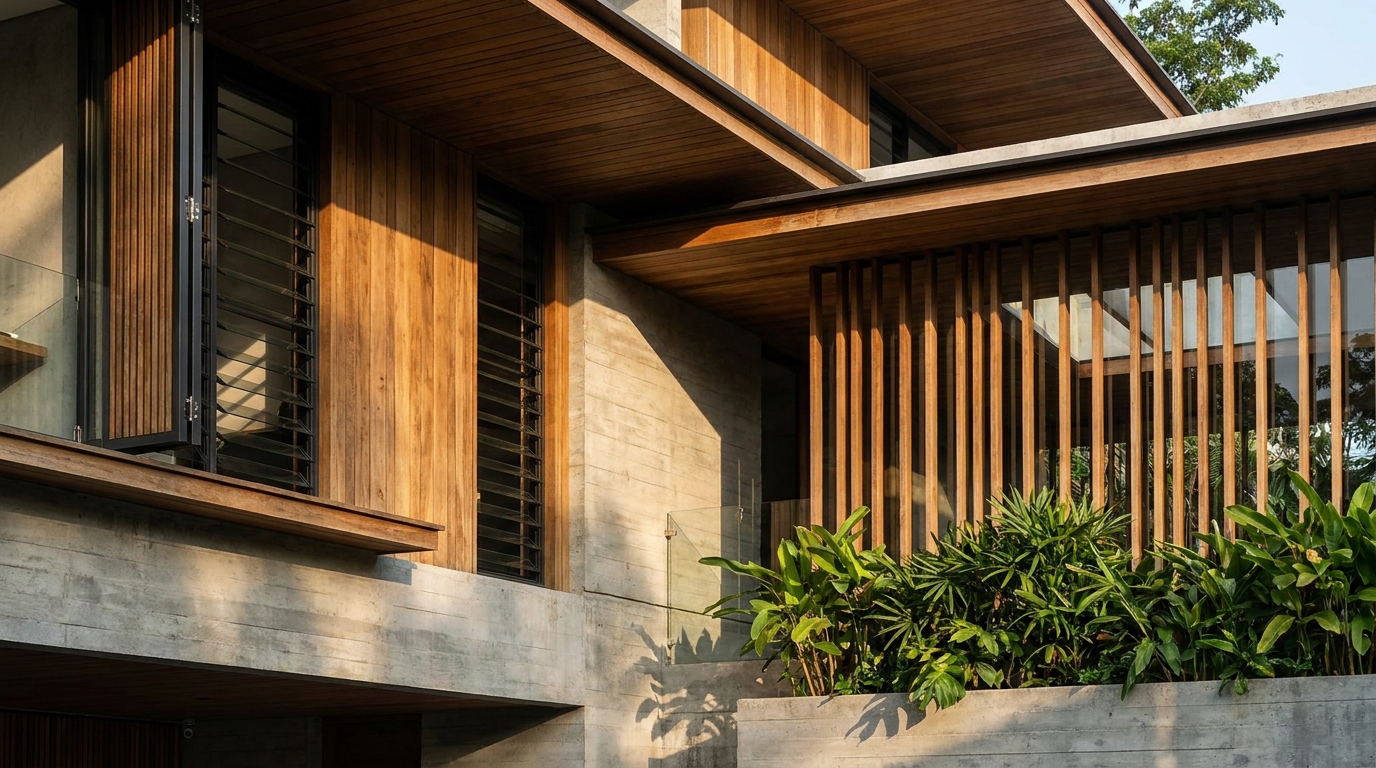
In warm climates, roofs do much more than cap a building. They shield walls and windows from harsh sun, protect circulation spaces from sudden rain, and create a softer transitional edge around the house. Deep overhangs reduce direct solar gain, which can significantly improve interior comfort and lower cooling demands. Visually, they also give tropical buildings an unmistakable sense of grace, often making the roofline feel almost like a floating canopy.
These extended roofs can transform how a home is lived in. A shaded perimeter allows windows to remain open more often, extends usable outdoor space, and helps preserve materials from weathering too quickly. In design terms, this creates a richer section and a more layered experience of movement from landscape to terrace to room.
Cross-Ventilation and Air Movement
Perhaps the most celebrated principle in tropical architecture is cross-ventilation. By placing openings on opposite or adjacent sides of a room, designers encourage breezes to pass through the interior. This movement of air can make spaces feel noticeably cooler, particularly when paired with ceiling fans or stack ventilation strategies that allow warmer air to rise and escape.
Natural ventilation remains one of the most powerful passive cooling tools available, and energy guidance continues to support its value. Yet there is an important caveat. In hot-humid climates, high moisture levels can limit how comfortable air movement alone can make a space feel. Since humidity reduces the body’s ability to cool itself through perspiration, many homes require mechanical support, dehumidification, or hybrid ventilation systems. Tropical architecture is at its strongest when it acknowledges this reality rather than pretending pure passivity is always enough.
Shading Devices and Layered Facades
Sunlight is both a gift and a challenge. Tropical architecture tends to treat it with precision rather than excess. Instead of large unprotected expanses of glass, many tropical buildings rely on exterior shading devices such as louvers, screens, fins, shutters, and brise-soleil. These elements cut glare and heat before it enters the building, which is far more effective than trying to manage it after the fact with blinds or cooling equipment.
Layered facades also add visual depth. They create an architecture of shadow that is constantly changing through the day, making the building feel alive to time and weather. This is one of the most poetic aspects of tropical design. Environmental logic becomes an aesthetic language of filtered light, moving air, and textured enclosure.
Verandas, Breezeways, and Transitional Rooms
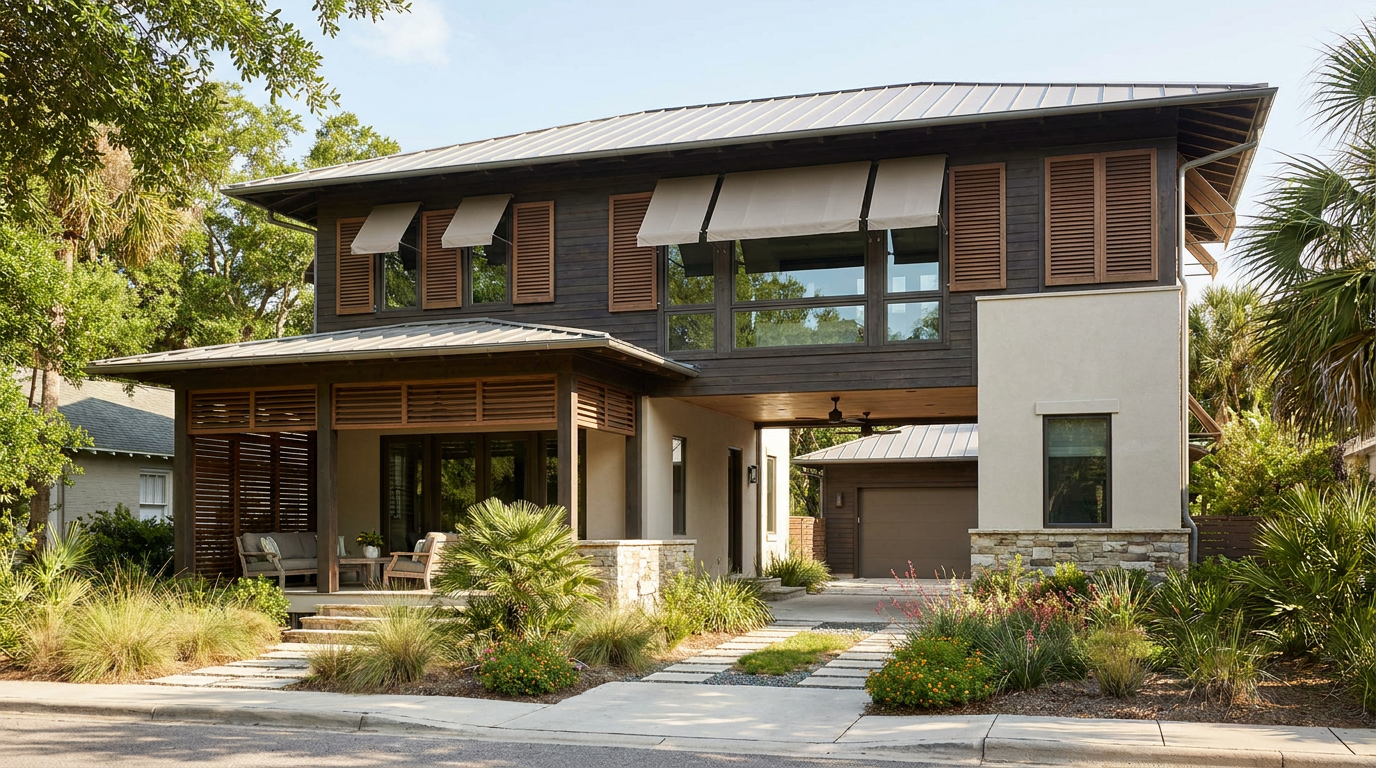
Tropical architecture rarely treats the boundary between indoors and outdoors as abrupt. It prefers thresholds, pauses, sheltered edges, and open circulation. Verandas, covered patios, breezeways, and outdoor galleries all serve this purpose. They provide shade, encourage social life, and create flexible living areas that can be used across changing conditions.
In warmer climates, these spaces are not secondary amenities. They are central to comfort and to how the home is inhabited. They allow everyday life to spill outward while maintaining protection from sun and rain. They also reduce the psychological need for more enclosed interior square footage, which can support more efficient and environmentally responsive planning.
Courtyards and Landscape Integration
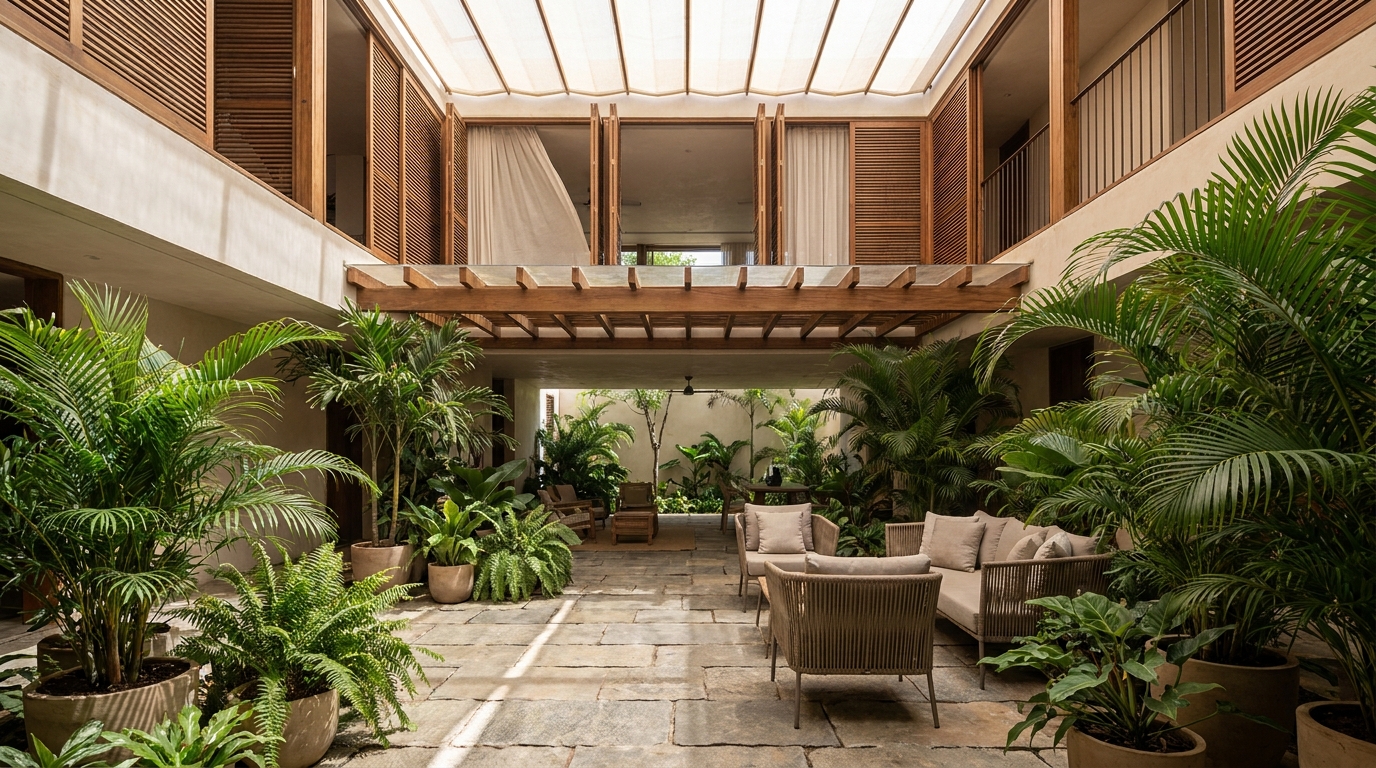
Courtyards have reappeared in contemporary design with renewed force, and for good reason. They allow buildings to pull light and air inward while also creating privacy, greenery, and calm. In tropical architecture, courtyards can help organize circulation, support cross-ventilation, and provide shaded microclimates that moderate surrounding rooms.
More broadly, tropical architecture tends to integrate landscape as part of the environmental system of the house. Trees can shade facades, planting can cool surrounding surfaces, and water management can become a visible design feature. Rather than treating landscape as ornament applied after construction, the best tropical homes choreograph architecture and site together from the beginning.
Material Intelligence and Durability
Materials in tropical architecture are selected not only for visual warmth but for performance under sun, moisture, and heavy weather. Timber, masonry, concrete, terracotta, and breathable finishes often appear because they can withstand local conditions when properly detailed. The goal is not simply to create a natural look, but to ensure longevity, easy maintenance, and thermal stability where appropriate.
Material choice is always local in the most thoughtful projects. This is one reason tropical architecture cannot be reduced to a universal formula. The best version of it emerges from regional availability, craft traditions, budget realities, and environmental demands. That local grounding is part of its sophistication.
The Science Behind the Beauty
What makes tropical architecture so persuasive is that its beauty is supported by building science. It is not an accidental style that later proved useful. Its forms evolved because they performed well under certain climatic pressures. As homes are asked to do more with less energy, that underlying logic becomes newly important.
Shading is a clear example. Exterior shading can substantially reduce solar heat gain, which lowers the indoor temperature burden before mechanical cooling ever begins. This means air-conditioning systems may run less intensely, spaces remain more comfortable near windows, and the building envelope suffers less thermal stress over time. A carefully shaded house feels calmer because it is experiencing less environmental aggression.
Ventilation offers another advantage. The Department of Energy has noted that ventilation can be the least expensive and most energy-efficient way to cool buildings, especially when paired with broader heat-management measures. This pairing matters. A home with excellent airflow but poor solar control may still feel hot. A home with shaded walls and little fresh air may feel stale or humid. Tropical architecture typically works through combination rather than through one isolated tactic.
Thermal mass can also play a supporting role in some climates, especially where nights cool down enough for stored heat to dissipate. However, this strategy must be used with care in hot-humid environments, where temperature swings are smaller and moisture management becomes more critical. Here again, the lesson is that tropical architecture is not simplistic. It depends on thoughtful calibration to local conditions, not on blindly repeating design clichés.
Humidity, in particular, deserves emphasis. High humidity affects comfort profoundly, reducing the body’s ability to cool itself. This is why many contemporary tropical homes use hybrid systems that combine passive design with mechanical ventilation, fans, dehumidification, or efficient air-conditioning. The most advanced projects are not anti-technology. They simply insist that technology should complement a climate-smart building form rather than compensate for its failures.
Why Tropical Architecture Matters Now
There is a reason tropical architecture feels especially timely in the present moment. Across many regions, heat is no longer an occasional inconvenience but a design condition that must be taken seriously. Urban heat islands intensify summer discomfort, power systems face increasing stress during extreme weather, and homeowners are more aware of both energy costs and environmental responsibility. Under these pressures, passive and low-energy cooling strategies are becoming less niche and more essential.
This shift has helped bring tropical principles into broader architectural conversations about resilience, climate action, and climate justice. Professional organizations and design institutions increasingly frame access to shade, healthy air, and thermal comfort as social as well as technical issues. Who gets a breezy, shaded home, and who is left in heat-vulnerable housing, are not neutral questions. They reveal how architecture distributes comfort, risk, and dignity.
In this context, tropical architecture offers more than pleasant imagery. It offers a language of adaptation. It reminds us that architectural elegance can emerge from environmental responsibility, and that a home designed for climate awareness can be every bit as aspirational as one designed for visual spectacle alone. In fact, the two often enrich each other.
The renewed interest in vernacular forms also reinforces this relevance. Courtyard houses, dogtrot layouts, raised dwellings, shaded porches, and breezeways are being reexamined not as relics, but as repositories of intelligence. In many cases, these traditional patterns solved thermal problems with remarkable economy and grace long before mechanical cooling became widespread. Contemporary architects are now translating those ideas into modern materials, cleaner lines, and higher-performance envelopes.
Tropical Architecture in North America: Adaptation Rather Than Imitation
For North American readers, the most useful way to think about tropical architecture is not as literal tropical mimicry, but as selective adaptation. Much of Canada and the United States does not sit within a tropical climate zone, yet many regions experience prolonged heat, seasonal humidity, strong sun, or heavy rain. This creates meaningful opportunities to reinterpret tropical design principles in ways that fit local weather, codes, and lifestyles.
In the hot-humid American South, for example, broad porches, elevated forms, operable windows, screened rooms, and shaded outdoor circulation remain deeply relevant. In parts of the Southwest, the emphasis may shift toward solar control, courtyards, thermal moderation, and carefully oriented openings. In dense urban environments, even modest interventions such as exterior shading, better cross-ventilation, heat-aware siting, and covered outdoor thresholds can significantly improve comfort and reduce energy demand.
In cooler mixed climates, tropical principles can still be used selectively. A home might incorporate operable shading devices, seasonal breezeways, protected outdoor rooms, or landscape strategies that temper summer heat, while also relying on tighter winter insulation and more controlled envelopes. This is where climate-responsive design becomes especially elegant. It does not force a single formula onto every place. It borrows the wisdom that suits a site and combines it with local performance needs.
This approach is also increasingly compatible with high-performance housing. Net-zero, low-carbon, and resilient home design do not have to look cold or overly technical. Tropical architecture demonstrates how climate-smart thinking can be warm, tactile, and emotionally generous. It can produce homes that are not only efficient, but atmospheric and deeply livable.
Common Misconceptions to Leave Behind
Because the term is so often romanticized, tropical architecture is surrounded by persistent myths. Clarifying them helps reveal the approach with much greater accuracy.
- It is only for tropical countries. In reality, its principles can be adapted far beyond the tropics. While not every strategy applies everywhere, ideas such as shading, cross-ventilation, verandas, courtyards, and heat-aware orientation are useful in many warm, humid, or seasonally hot regions.
- It is just a decorative style. Tropical architecture is not synonymous with resort decor or island motifs. Its foundation is performance. The aesthetic language emerges from climate logic, material response, and spatial generosity.
- Natural ventilation is always enough. This is one of the most misleading assumptions. In hot-humid climates, humidity can severely limit comfort. Many successful tropical buildings rely on hybrid systems that combine passive strategies with mechanical cooling or dehumidification.
- It is one fixed look. There is no single tropical style. The expression varies across cultures and climates, shaped by local craft, economics, weather patterns, and social customs.
Once these misconceptions fall away, tropical architecture becomes much richer. It is no longer a mood board but a serious design framework, one that bridges vernacular wisdom and contemporary innovation with unusual elegance.
The Emotional Appeal of Tropical Living
Beyond environmental logic, tropical architecture has a powerful emotional dimension. It tends to produce homes that feel calm, breathable, and sensorially layered. Light is filtered rather than harsh. Circulation is gradual rather than abrupt. Sound, shadow, breeze, and greenery become part of daily life. This atmospheric richness explains why so many people respond to tropical spaces immediately, even when they do not know the theory behind them.
There is also a subtle social quality to this architecture. Verandas encourage gathering. Courtyards create shared centers. Breezeways and open thresholds make movement through the house feel less isolated and more connected. In this sense, tropical design often supports a gentler rhythm of living, one that balances privacy with openness and enclosure with community.
For designers, this is an important reminder that sustainability is not only technical. A low-energy home that feels austere, sealed, and joyless may perform well on paper while failing to enrich daily experience. Tropical architecture offers a different proposition. It suggests that comfort, pleasure, and ecological responsibility can belong to the same spatial language.
The enduring allure of tropical architecture lies in its ability to make climate feel not like an obstacle, but like a collaborator in design.
How to Bring Tropical Principles Into a Modern Home
Not every project requires a full tropical vocabulary, yet many homes can benefit from its principles. Whether building new or renovating, the most effective move is to begin with climate analysis rather than style references. Study the path of the sun, prevailing breezes, seasonal humidity, views, and site obstructions. Good tropical design starts with orientation and environmental understanding, not with furniture selection.
Next, think in layers of comfort. Exterior shading should come before relying heavily on interior cooling. Operable windows should be placed to encourage airflow across occupied spaces. Covered terraces or porches can extend living areas while protecting the envelope. Courtyards or planted voids can introduce light and air where conventional layouts might create stagnant interiors. Durable, breathable, and regionally appropriate materials should shape the tactile identity of the home.
It is also wise to be honest about where passive design ends and mechanical support begins. In many warm climates, a mixed-mode approach is ideal. Ceiling fans, efficient HVAC, dehumidification, and thoughtful ventilation controls can coexist beautifully with passive cooling strategies. The goal is not doctrinal purity. The goal is a house that performs well, ages well, and feels deeply pleasurable to inhabit.
For homeowners drawn to the look of tropical interiors, this means prioritizing architecture before decoration. A room with filtered daylight, shaded openings, good airflow, and a connection to greenery will feel tropical in the most authentic sense, even if its furnishings are modern, restrained, or regionally specific. Atmosphere begins with space and climate, not accessory styling.
The Future of Tropical Architecture
Tropical architecture is likely to become even more influential as design culture continues to confront heat, carbon, and resilience. Its future will not be defined by the repetition of a picturesque image, but by increasingly rigorous and inventive interpretations of climate-responsive living. We can expect to see more operable facades, more hybrid ventilation systems, more shaded communal housing, more adaptation of vernacular forms, and more careful integration of landscape and water management into residential planning.
There is also reason to believe that the cultural conversation around tropical architecture will deepen. Recent writing has already moved beyond aesthetics to examine the politics of shade, air, labor, and access. This is a valuable evolution. It asks not only how tropical buildings look, but who they serve, whose knowledge they draw from, and how environmental comfort is distributed in a warming world. Such questions make the field more ethical as well as more intelligent.
For homeowners and design enthusiasts, this broader future is encouraging. It means tropical architecture is not a passing visual trend. It is part of a larger shift toward homes that are both emotionally resonant and environmentally literate. It invites a more graceful relationship with heat, weather, and landscape, while still accommodating contemporary standards of convenience and refinement.
Conclusion: A Timeless Framework for Beautiful, Resilient Living
To embrace tropical architecture is to embrace a way of thinking. It means understanding that architecture can respond elegantly to climate instead of resisting it blindly. It means valuing shade as much as sunshine, airflow as much as enclosure, and transitional space as much as formal rooms. Most of all, it means seeing beauty not as surface decoration, but as the visible expression of thoughtful environmental design.
This is why tropical architecture continues to captivate architects, homeowners, and aesthetes across regions and generations. It offers more than visual escape. It offers intelligence, softness, resilience, and an unusually humane model of domestic comfort. In a world that is becoming warmer and more uncertain, those qualities feel less like indulgences and more like necessities.
Whether expressed through a lush courtyard house, a shaded coastal residence, a porch-wrapped southern home, or a contemporary urban renovation with better airflow and solar control, tropical architecture remains a powerful lesson in design with the climate rather than against it. Its enduring message is simple and profound: a well-designed home can be open yet protected, luxurious yet responsible, and deeply connected to the atmosphere that surrounds it.
In that sense, tropical architecture does not belong only to the tropics. It belongs to any future in which we hope to live more beautifully, more comfortably, and more intelligently on the earth.


No Comment! Be the first one.