


Nano-materials have a way of sounding more complicated than they really are. In everyday construction terms, they are materials engineered or structured at an extremely small scale, usually about 1 to 100 nanometers. That size is hard to picture, so one of the most useful comparisons comes from the U.S. Environmental Protection Agency, which notes that a human hair is roughly 80,000 to 100,000 nanometers wide. Once you understand that scale, the main point becomes clearer: when materials are handled at that size, they can behave differently than they do in their normal bulk form.
Table Of Content
- What Nano-Materials Are and Why Size Changes Performance
- Why the Construction Industry Is Paying Attention
- The Most Common Nano-Material Applications in Construction
- Nano-Silica in Concrete and Cementitious Materials
- Nano-Titanium Dioxide in Self-Cleaning and Photocatalytic Coatings
- Carbon Nanotubes, Graphene, and Advanced Composites
- Nano-Enabled Coatings, Sealants, and Surface Treatments
- The Real Benefits: Performance, Cost, and Sustainability
- Common Misconceptions That Need Clearing Up
- Safety, Regulation, and Why They Matter in North America
- The Quality Control Problem: Why Measurement and Standardization Matter
- Where Nano-Materials Fit in Renovation Projects
- What Builders, Architects, and Owners Should Ask Before Choosing a Nano-Enabled Product
- The Future of Nano-Materials in Building Systems
- Final Takeaway
- Quick Reference: Main Points to Remember
That difference matters in construction because buildings are full of materials that live or die by their surface behavior, density, bonding, moisture resistance, and long-term durability. A small amount of a nano-scale ingredient can change how concrete hydrates, how a coating sheds dirt, how glass handles sunlight, or how a composite panel resists cracking. In many cases, the goal is not to reinvent construction from the ground up. The goal is to make existing systems perform better, last longer, and require less maintenance over time.
This is where nano-materials become practical instead of theoretical. Most homeowners, contractors, developers, and facility managers do not need a deep chemistry lesson. What they need is a straight answer about whether nano-enabled products actually help on real jobs. In many cases, they do, but the benefits depend on proper formulation, quality control, installation, and realistic expectations. Nano-materials are tools, not magic.
For modern construction and renovation, that practical view is the right place to start. Nano-materials are already showing up in concrete admixtures, coatings, sealants, glass treatments, insulation systems, and advanced composites. Research from agencies like NIST has helped move the subject beyond laboratory novelty and into infrastructure, damage-resistant materials, and additive manufacturing. At the same time, regulators in Canada and the United States continue to treat nanomaterials as a distinct area because the same chemical substance may behave differently at the nanoscale and may need different risk assessment and reporting.
This article breaks the topic down in plain language. We will look at what nano-materials actually are, where they are being used in construction today, what benefits they can offer, where the limitations are, and what builders and property owners should ask before choosing a nano-enabled product. The aim is simple: bridge the gap between advanced material science and practical building decisions.
The simplest way to think about nano-materials is this: they are often small-scale versions of familiar materials that can change performance in very useful ways, especially in durability, surface protection, and long-term maintenance.
What Nano-Materials Are and Why Size Changes Performance
A nanometer is one billionth of a meter. That number is too abstract to mean much on its own, so it helps to focus on what happens when materials are reduced or structured at that tiny scale. At the nanoscale, surface area becomes much more important relative to volume. That can change reactivity, bonding behavior, optical properties, conductivity, water repellency, and barrier performance. In construction, all of those properties matter because buildings are exposed to stress, moisture, sunlight, temperature swings, pollution, and wear every day.
The important point is that nano-materials are not always exotic substances invented in a high-tech lab. Many are familiar materials such as silica, titanium dioxide, carbon, or cellulose that are being used at nanoscale dimensions or with nanoscale surface structures. This is one of the biggest misconceptions in the public conversation. A product described as nano-enabled does not mean the whole thing is made from some mysterious new material. Often it means a small amount of a nano-scale additive has been included to improve a specific performance trait.
The EPA has noted that nanoscale forms of substances can have greater strength, lighter weight, and higher chemical reactivity than the same substances at larger scale. That helps explain why relatively small additions can have meaningful effects. In concrete, for example, a nano-scale additive can improve the way the cementitious matrix develops and densifies. In coatings, nano-scale particles can influence how a surface handles staining, ultraviolet exposure, or dirt accumulation. The key is not just the material itself, but how it is dispersed, dosed, and integrated into the product.
That last point is worth slowing down for. More nano is not automatically better. If particles are poorly dispersed, if dosage is wrong, or if the product is used in the wrong application, the promised performance may not show up. In some cases, too much additive can interfere with workability or create other tradeoffs. That is why serious adoption depends just as much on manufacturing quality and measurement as it does on the underlying science.
Why the Construction Industry Is Paying Attention
Construction is generally conservative for good reason. Buildings are expensive, failures are costly, and materials need to perform for years, not just in a product demonstration. So when the industry starts paying attention to a new class of materials, it is usually because there is a practical payoff. With nano-materials, that payoff is often tied to service life extension. If a façade stays cleaner, if a coating resists weathering longer, if concrete becomes denser and more durable, or if corrosion is slowed, the long-term economics begin to make sense.
This is especially important in North America, where freeze-thaw cycles, moisture exposure, deicing salts, ultraviolet radiation, and temperature swings can beat up building materials year after year. Owners and builders are under pressure to get more life out of every assembly while controlling maintenance budgets. A nano-enabled product that reduces repair frequency or improves performance in harsh conditions can be valuable even if it costs more upfront. In practical terms, the conversation is usually less about novelty and more about lifecycle cost.
NIST research has been a strong signal that the field is moving into serious engineering territory. Its work on hierarchical materials, infrastructure, damage-resistant composites, and additive manufacturing shows that nano-scale design is relevant to how materials are tested, characterized, and eventually used in the built environment. That matters because construction needs repeatable results, not one-off laboratory wins. If nano-materials are going to become normal on jobsites, they need standardization, metrology, and reliable quality control behind them.
Another reason the industry is interested is that nano-materials support multifunctional performance. A product may not just be stronger or more durable. It may also be self-cleaning, antimicrobial, more energy efficient, more corrosion resistant, or able to support sensing functions. That combination is attractive because modern buildings are being asked to do more with less. Materials that support durability and operational performance at the same time fit that direction well.
The Most Common Nano-Material Applications in Construction
Not every nano-material discussed in research journals is ready for routine use on a building project. The most practical applications are the ones that fit into existing systems without forcing a full redesign. In real construction and renovation work, that usually means concrete admixtures, coatings, sealers, glass treatments, composites, and certain insulation or barrier products. These are categories where a small formulation change can have a large effect on field performance.
Some of the best-known examples include nano-silica in cementitious materials, nano-titanium dioxide in photocatalytic and self-cleaning surfaces, carbon nanotubes and graphene in composites, and nano-enabled coatings for corrosion protection, scratch resistance, UV resistance, and stain resistance. These uses vary widely in maturity. Some are already fairly practical and market-facing, while others are still more common in advanced products, pilots, or high-performance specialty applications. The main thing they share is that they use nano-scale behavior to improve a known construction function.

Nano-Silica in Concrete and Cementitious Materials
Concrete is one of the most practical places to understand nano-materials because concrete performance is deeply tied to microstructure. Nano-silica is widely discussed because it can help improve cement hydration, fill very small voids, and contribute to a denser matrix. A denser matrix can mean lower permeability, improved strength development, and better long-term durability when the product is formulated correctly. For builders, that translates into a concrete element that may better resist moisture ingress, chemical attack, and general wear.
In plain jobsite terms, concrete is only as durable as its internal structure allows. If water, chlorides, or contaminants can move through it too easily, deterioration problems become much more likely. Nano-silica can help refine that internal structure, which is one reason it has drawn so much interest in infrastructure and high-performance applications. That does not mean every slab or footing needs a nano admixture, but it does mean there are realistic use cases where it can add value.
There are still practical cautions. Workability can be affected if the mix is not designed well, and performance depends heavily on dispersion quality and overall proportioning. A nano additive cannot rescue a poorly designed mix, weak curing practices, or bad placement. This is a recurring theme with nano-materials across the board: they enhance systems that are already competently designed and installed. They do not replace good workmanship.
Nano-Titanium Dioxide in Self-Cleaning and Photocatalytic Coatings
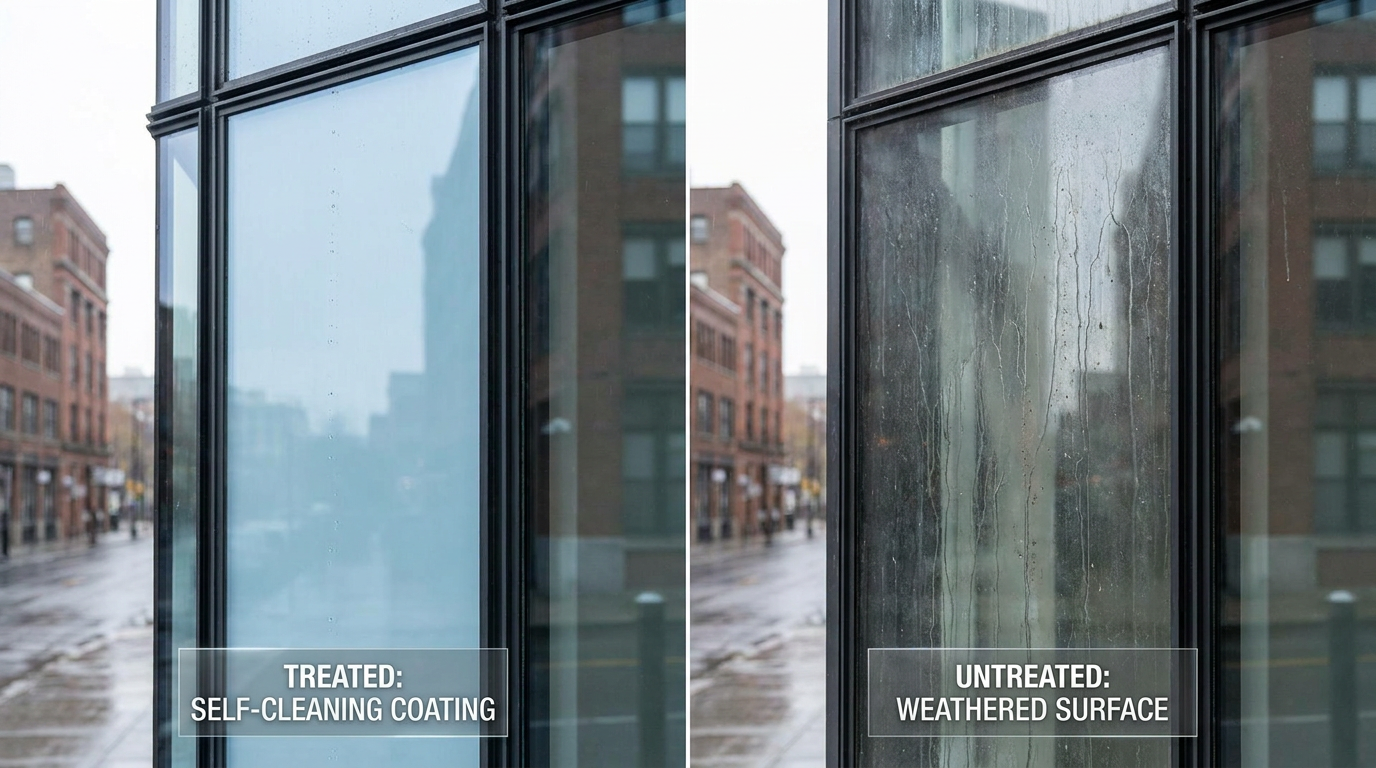
Nano-titanium dioxide is one of the more visible nano-material stories because it is tied to self-cleaning surfaces. In the right coating or surface treatment, it can help break down certain organic contaminants under light exposure and can also support water sheeting behavior that helps carry dirt away. For building owners, that matters on façades, glazing, and exterior finishes where appearance and maintenance costs are constant concerns. On the right building, a surface that stays cleaner longer is not just cosmetic. It can reduce cleaning frequency and help preserve finish quality.
Photocatalytic products also connect to broader environmental conversations because they are sometimes promoted for air quality-related benefits under specific conditions. Still, the practical construction angle is usually about maintenance and surface performance. If an exterior panel, coated masonry surface, or treated glass assembly can resist staining and weathering better, the lifecycle math may improve. Owners care about that because façade cleaning is expensive, disruptive, and recurring.
These products do need realistic expectations. A self-cleaning surface is not a self-maintaining building. Local climate, orientation, pollution load, rainfall patterns, and surface texture all affect how well the treatment performs. Marketing can sometimes oversimplify the result, but in practical terms the technology can be useful when matched to the right exposure and product system.
Carbon Nanotubes, Graphene, and Advanced Composites
Carbon nanotubes and graphene tend to get more headlines because they sound futuristic, but the practical construction story is still tied to specific functions. These materials are studied for strengthening composites, changing electrical behavior, enabling sensing, and improving crack resistance or multifunctional performance in certain systems. In simple terms, they can help create materials that do more than one job at once. A structural or protective material may also gain conductive or sensing capability, which opens the door to smart infrastructure and health monitoring.
That is important because buildings and infrastructure increasingly rely on data for maintenance planning. If a material can help detect strain, damage, or environmental change, it supports a different kind of asset management. This is not yet standard practice across everyday residential construction, but it is relevant in advanced envelopes, infrastructure, specialty panels, and research-driven systems. The overlap with smart building technology is one of the reasons nano-materials remain such an active subject.
As with other nano-enabled systems, there is a gap between what is technically possible and what is routinely buildable at scale. Cost, manufacturing consistency, certification, and field familiarity all affect adoption. Still, the direction is clear: materials are moving toward being more functional, not just more passive. Nano-scale additives are part of that shift.
Nano-Enabled Coatings, Sealants, and Surface Treatments
For renovation and mainstream construction, coatings and sealants are often the easiest entry point into nano-material use. Nano-enabled formulations can improve scratch resistance, UV resistance, stain resistance, corrosion protection, and water repellency. That matters on exposed steel, façade elements, flooring, glazing, masonry, and high-wear surfaces where maintenance and appearance are major concerns. Because coatings are already standard parts of building systems, improving them is often simpler than changing the underlying structure.
These products can be especially useful in environments where weather, pollution, or heavy use quickly degrade standard finishes. Better corrosion resistance on metal components, for example, can extend the life of handrails, exterior fixtures, fasteners, or industrial building elements. Improved UV resistance can help reduce chalking, fading, or finish breakdown on exposed surfaces. In a practical sense, a better coating can delay a lot of repainting and replacement work.
Again, surface prep and application quality still matter. A nano-enabled coating applied over a dirty, damp, or unstable substrate will not perform the way it should. One of the most grounded ways to discuss these materials is to say that they reward good building practice. They can push performance higher, but they do not erase the fundamentals.
The Real Benefits: Performance, Cost, and Sustainability
When people hear about advanced materials, they often assume the main selling point is higher strength. In construction, the benefit is usually broader than that. Nano-materials matter because they can improve durability, reduce maintenance, support energy performance, and in some cases lower lifecycle costs. Those outcomes are more useful than lab numbers on their own because they connect directly to ownership, operations, and building service life.
Durability is the biggest practical advantage. If a material becomes denser, less permeable, more resistant to UV breakdown, less prone to corrosion, or better at shedding contamination, the building may simply hold up better over time. That matters on everything from a commercial façade to a parking structure to a residential exterior finish. Repair work is expensive, and deterioration rarely stays isolated. Water gets in, coatings fail, cracks spread, and one maintenance issue turns into three.
Cost reduction usually shows up over the lifecycle, not necessarily in the purchase price. Nano-enabled products may cost more upfront, but if they reduce cleaning cycles, extend coating life, improve concrete durability, or lower replacement frequency, the total cost of ownership can improve. This is how experienced builders and owners should assess them. The right question is not whether a product is more expensive per unit. The right question is whether it lowers the cost of performance over the period the building will actually be used.
Sustainability also enters the conversation in a practical way. A material that lasts longer and needs less replacement generally reduces resource demand over time. If a coating extends the service life of a substrate, that is a sustainability benefit. If a concrete mix improves durability and reduces premature repair, that matters too. Some nano-materials also contribute to energy-related performance by improving insulation behavior, solar control, or reflective properties, though the result always depends on the full assembly and climate context.
One useful way to summarize the benefits is to look at them across a building lifecycle rather than at the product shelf. Nano-materials may support better first performance, but their bigger value often lies in what happens five, ten, or twenty years later. That is where fewer repairs, cleaner surfaces, and more stable performance begin to pay off.
Common Misconceptions That Need Clearing Up
One of the biggest problems with nano-materials in public discussion is that the term itself can make people either overexcited or overly cautious. Neither reaction helps. The reality is more grounded. Many nano-materials are simply nano-scale forms of familiar substances, and their usefulness depends on what they are being asked to do in a product. They are not automatically revolutionary, and they are not automatically dangerous.
Another common misconception is that nano-enabled means the whole building product is dominated by nanoparticles. That is usually not true. In many cases, only a small fraction of a coating, admixture, sealant, or composite includes nanoscale components. Those components may be there to influence one performance trait such as density, reactivity, surface hardness, or stain resistance. The rest of the product may be conventional and well understood.
People also confuse nanotechnology with entirely separate trends such as 3D printing. The two can overlap in advanced materials and additive manufacturing, but they are not the same thing. A building can use additive manufacturing without nano-materials, and a standard cast or coated system can use nano-materials without any connection to 3D printing. Clear language matters because hype tends to blur technical differences that are important in real procurement and specification work.
Finally, there is the assumption that if a little nano additive helps, more must help more. That is not how materials work. Performance often depends on correct dosing, particle size, surface treatment, and uniform dispersion. Too much additive or poor integration can create processing issues or diminish performance. Good formulations are usually carefully balanced, not overloaded.
Safety, Regulation, and Why They Matter in North America
A balanced discussion of nano-materials in construction has to include safety and regulation. In both Canada and the United States, government agencies treat nanomaterials as a distinct area because nanoscale forms can behave differently than conventional chemical substances. That does not mean all nano-materials are unsafe. It means they deserve case-by-case evaluation based on identity, exposure route, use pattern, release potential, and health or environmental effects.
In Canada, Health Canada regulates nanomaterials under the Canadian Environmental Protection Act and uses a working definition that includes substances manufactured at or within the nanoscale or that have nanoscale internal or surface structures. That working definition exists in part because international consensus on definitions is still evolving. Canada also published a final Framework for the Risk Assessment of Manufactured Nanomaterials under CEPA in 2026, which shows that policy development is active and ongoing rather than frozen in place.
In the United States, the EPA has made clear that manufacturers or processors of certain nanoscale chemical substances may need to notify the agency with information about chemical identity, production volume, use, exposure, release, and health and safety data. That matters for construction products because nano-enabled materials do not enter the market in a regulatory vacuum. If a manufacturer is serious, there should be documentation, testing, and compliance thinking behind the product rather than just a marketing label.
For contractors and owners, the practical issue is occupational hygiene and informed product selection. If a material contains nano-scale ingredients, it is reasonable to ask how it is handled during manufacturing, installation, cutting, sanding, spraying, or demolition. The level of risk depends heavily on the form of the material and the exposure scenario. A cured coating is different from an airborne powder. A sealed composite panel is different from a process that creates dust. Good safety practice means understanding those differences and following product-specific guidance.
Responsible adoption does not mean avoiding nano-materials. It means choosing products with credible documentation, understanding how they are used, and respecting exposure control just as you would with any advanced construction material.
The Quality Control Problem: Why Measurement and Standardization Matter
If there is one issue that separates promising nano-materials from dependable building products, it is quality control. NIST has repeatedly emphasized metrology, reference materials, and standardization because measuring nanoscale properties consistently is hard. Particle size, shape, surface chemistry, and dispersion quality can all change product behavior. Two products may sound similar on a sales sheet and perform differently in the field because the underlying nano-scale characteristics are not the same.
This matters more in construction than in many other industries because buildings are assembled from layers of materials that interact over time. A nano-enabled coating has to bond to a substrate, survive weather exposure, and age predictably. A nano-enhanced concrete mix has to remain workable during placement and cure as expected under field conditions. A composite panel has to maintain both its structural and environmental performance. In every case, repeatability matters.
That is why builders should be careful around vague claims. Terms like advanced, smart, self-cleaning, or nano-enhanced sound impressive, but they are not substitutes for technical data. Serious products should come with test standards, performance metrics, installation requirements, and clear limitations. If the manufacturer cannot explain what the nano component does, how it is measured, and where the product is appropriate, that is a warning sign.
From a practical standpoint, this is no different from other quality issues in construction. A good membrane, coating, or admixture is only as dependable as the manufacturing controls behind it. Nano-materials just make that point sharper because performance is tied to very small-scale consistency that can be difficult to verify without robust testing.

Where Nano-Materials Fit in Renovation Projects
For renovation work, nano-materials are usually most relevant where owners want better performance without tearing the whole assembly apart. Surface treatments, protective coatings, sealers, glazing improvements, and targeted repair materials are often the most accessible options. That makes sense because renovation budgets are usually looking for high-value interventions, not science experiments. If a nano-enabled product can extend the life of an existing component, it deserves a look.
Exterior restoration is a good example. A coating with improved water repellency, UV resistance, or stain resistance may help preserve a façade finish and slow deterioration. A self-cleaning treatment on glazing or cladding may reduce maintenance demands on hard-to-access elevations. In industrial or coastal settings, better corrosion protection can be especially valuable because replacement work is disruptive and expensive. These are practical renovation gains, not theoretical ones.
Flooring, countertops, high-touch surfaces, and interior finishes can also benefit in some cases from nano-enabled protective layers that improve scratch resistance or ease of cleaning. The point is not that every renovation should be filled with nano products. The point is that renovation often benefits from products that improve an existing system rather than replace it, and that is one of the strongest use cases for nano-scale enhancements.
What Builders, Architects, and Owners Should Ask Before Choosing a Nano-Enabled Product
Because the term nano can be used loosely in marketing, buyers need a practical screening process. The first question should always be basic: what specific problem is this product solving? A product that claims to be nano-enhanced should be tied to a defined performance goal such as lower permeability, cleaner surfaces, better abrasion resistance, or improved corrosion protection. If the benefit is vague, the product probably is too.
The next question is how the performance is documented. Ask what testing standards were used, whether the product has field history, and how it compares with conventional alternatives under the same conditions. A credible manufacturer should be able to explain not just that the material contains a nano-scale component, but why that component improves the product and what installation conditions matter. Performance data is more useful than buzzwords every time.
It is also worth asking about compatibility and maintenance. Does the product require a special substrate condition, curing regime, cleaning method, or recoat interval? Does it change workability, drying time, or handling requirements? Advanced materials sometimes fail not because the technology is bad, but because the trade installation process was not adjusted to match the product.
Finally, ask about health, safety, and regulatory documentation. Safety data, handling instructions, and any relevant compliance information should be available and understandable. This is especially important for products applied by spray, products that generate dust during installation, or products used in enclosed work areas. Good technology still needs good practice around it.
The Future of Nano-Materials in Building Systems
The long-term direction of nano-materials in construction is not just about stronger concrete or cleaner glass. It is about multifunctional materials that combine durability, sensing, self-healing, energy performance, and lower maintenance into the same system. That trend fits where building technology is already going. Owners want structures that last longer, tell us more about their condition, and cost less to operate over time.
Research is continuing on hierarchical composites, additive manufacturing, mechanical characterization, environmental fate and transport, and safer-by-design development. Those areas may sound academic, but they matter because they shape which products become dependable enough for mainstream construction. As standards improve and more products build field history, nano-materials are likely to become less of a niche talking point and more of a quiet upgrade built into familiar systems.
That may be the most realistic prediction of all. Most successful construction technologies stop feeling futuristic once they prove themselves. They become another accepted part of how we build. If nano-materials continue to deliver measurable gains in service life, maintenance reduction, resilience, and performance, they will likely follow that path. People may not even think of them as nano-products anymore. They will simply be the better version of concrete, coating, glass, sealant, or panel that the market has learned to trust.
Final Takeaway
Nano-materials in modern construction are best understood as practical performance tools, not science fiction. They work at a scale so small that it changes how familiar substances behave, and those changes can improve concrete durability, coating performance, surface cleanliness, corrosion resistance, and more. For builders and property owners, the real value is not the label. It is the possibility of longer service life, lower maintenance, better resilience, and stronger lifecycle economics.
At the same time, the field needs to be approached with discipline. Regulation in Canada and the United States reflects the fact that nano-scale forms may need separate attention in risk assessment and reporting. Product quality depends on formulation, dispersion, measurement, and standardization. Installation still depends on good workmanship. Those realities do not weaken the case for nano-materials. They simply put the subject where it belongs, which is in the same practical framework used for every good building decision.
If you strip away the hype, the message is straightforward. Nano-materials are not a replacement for sound design, proper detailing, and skilled labor. They are one more way to make buildings perform better when those fundamentals are already in place. That is why they matter in modern construction, and why they are worth understanding now rather than later.
Quick Reference: Main Points to Remember
- Nano-materials are typically defined at about 1 to 100 nanometers, with properties that can differ from the same material at larger scale.
- A human hair is around 80,000 to 100,000 nanometers wide, which helps show how small the nanoscale really is.
- In construction, the most practical uses are often in concrete, coatings, glass, sealants, and composites rather than whole building systems made entirely from nano-materials.
- Nano-silica can improve cement hydration and density, while nano-titanium dioxide is known for self-cleaning and photocatalytic surface treatments.
- Carbon nanotubes and graphene are being studied for advanced composites, sensing, and multifunctional performance.
- The biggest benefits are usually durability, reduced maintenance, and lower lifecycle cost, not just higher upfront performance.
- Regulation and safety matter, especially in manufacturing, installation, and exposure control.
- Quality control is critical because nano-scale performance depends on particle size, surface chemistry, dispersion, and consistent production.



No Comment! Be the first one.