


Urban population growth is not a temporary cycle or a niche planning issue. It is one of the most important structural forces shaping how cities function, how housing markets perform, how infrastructure is financed, and how communities experience opportunity. Across Canada and North America, growth is concentrating in major metropolitan areas where the pressure on land, services, and public systems is highest. That concentration changes the development conversation from a question of whether cities will grow to a question of how they will grow, and whether that growth will improve or undermine urban life.
Table Of Content
- Why Urban Population Growth Continues to Accelerate
- The Canadian Urban Context: Growth Is Concentrated, Not Evenly Distributed
- Housing Is the Most Visible Test of Growth Management
- Housing strategies that align with sustainable growth
- Density Must Be Paired With Mobility
- Infrastructure Is the Hidden Backbone of Sustainable Urban Growth
- Climate Resilience Is Now Core to Growth Strategy
- Land-Use Efficiency and the Case for the Compact City
- Governance, Data, and the Need for Better Urban Decision-Making
- Common Misconceptions About Urban Population Growth
- A Strategic Framework for Managing Growth Sustainably
- The Long-Term Opportunity in Urban Growth
For planners, developers, municipalities, and policymakers, the challenge is strategic. Population growth can support economic vitality, labour market depth, cultural dynamism, and stronger tax bases. At the same time, if growth is not matched by housing supply, transportation capacity, utility upgrades, and resilient urban design, the result is familiar: higher housing costs, longer commutes, deeper inequality, more emissions, and more pressure on aging infrastructure. Sustainable development therefore begins with a simple principle: cities must plan for the people they are actually attracting, not the populations they were designed to serve decades ago.
This issue is especially relevant in Canada, where urban concentration continues to intensify. Statistics Canada reported that on July 1, 2024, the combined population of Canada’s 41 census metropolitan areas reached 30,893,239 people. Another Statistics Canada release reported that by July 1, 2025, about 74.8% of Canadians lived in a census metropolitan area. Immigration is a major factor in this pattern, with new immigrants accounting for almost the entirety of growth in large urban centres. These numbers matter because they reveal where demand is landing and where policy failure becomes visible fastest.
Globally, the urbanization story is even larger. UN sources describe cities as home to roughly half the world’s population, with that share expected to rise further by 2050. That trajectory makes urban systems central to economic inclusion, climate performance, and the achievement of the Sustainable Development Goals, especially SDG 11, which focuses on sustainable cities and communities. In practical terms, this means urban population growth must be managed through coordinated land use, housing, transportation, infrastructure, and governance rather than through isolated policy responses.
This article offers a strategic overview of what is driving urban population growth and how cities can respond in a way that aligns with sustainability goals and enhances urban living conditions. The core argument is straightforward: growth itself is not the problem. The real issue is whether urban form, housing delivery, infrastructure investment, and public policy evolve quickly enough to absorb growth well.
Why Urban Population Growth Continues to Accelerate
Urban population growth is often discussed as if it were a single trend with a single cause, but in reality it is driven by several overlapping forces. Migration, immigration, job concentration, educational opportunity, health care access, cultural amenities, and household formation all contribute to urban expansion. Even in mature metropolitan systems, growth does not stop simply because a city is already large. It often intensifies because large cities become more economically magnetic over time, attracting both talent and investment while reinforcing their own role as regional anchors.
In Canada, the concentration of growth in metropolitan areas reflects this pattern clearly. Large urban centres remain the primary destinations for newcomers because they offer employment networks, established communities, postsecondary institutions, and more robust service ecosystems. That concentration creates a feedback loop. As more people arrive, demand for housing, transit, schools, utilities, and public space rises, which can support more investment and intensification if planning systems are aligned. If they are not, scarcity becomes the defining feature of urban life.
It is also important to understand that urban population growth is not synonymous with outward sprawl. One of the most common misconceptions in development debates is that more people automatically mean more land consumption at the edge of the city. In practice, cities can absorb substantial growth through infill, redevelopment, mid-rise intensification, transit-oriented communities, and missing-middle housing forms such as duplexes, triplexes, fourplexes, courtyard apartments, and townhouses. The real planning question is not whether growth occurs, but whether urban form becomes more land efficient as it does.
UN-Habitat’s sustainable urbanization guidance emphasizes land-use efficiency and the relationship between land consumption and population growth. That framework is strategically useful because it pushes cities to think beyond raw unit counts or boundary expansion. A city that grows its population faster than its land footprint is generally moving toward a more sustainable form, assuming infrastructure and livability keep pace. A city that consumes land faster than population growth is often embedding future infrastructure costs, transportation dependence, and environmental exposure into its growth model.
Urban growth becomes a problem only when cities fail to align housing, infrastructure, and land use with the pace and geography of demand.
The Canadian Urban Context: Growth Is Concentrated, Not Evenly Distributed
One of the most significant implications of recent demographic data is that Canada’s population growth is not occurring evenly across the country. It is disproportionately concentrated in metropolitan regions, which means national population growth translates into very local development pressure. This matters because infrastructure, zoning, approvals, servicing capacity, and transportation systems are managed at local and regional levels. A national growth narrative therefore becomes a municipal implementation challenge.
When nearly three quarters of the population lives in census metropolitan areas, and when those metro areas receive the vast majority of immigration-linked growth, the consequences for development planning are immediate. Housing shortages emerge first in the strongest labour markets. Transit crowding becomes more visible in the same corridors where job growth clusters. Water, wastewater, and power systems face the greatest strain in places where redevelopment, towers, and infill are moving faster than capital upgrades. The result is that urban growth management is no longer a secondary municipal function. It is one of the central operating realities of modern governance.
For developers, this concentration also changes how feasibility should be evaluated. Traditional greenfield expansion remains part of the housing equation in some markets, but the long term value in many major regions increasingly depends on how well projects connect to transit, services, jobs, and existing infrastructure. Land that supports compact, mixed-use, transit-oriented growth often becomes more strategically valuable over time because it aligns with both public policy and consumer demand. As cities seek to reduce congestion and emissions while expanding housing supply, location efficiency becomes a stronger determinant of project resilience.
Local governments are central to this transition. The OECD notes that local governments in OECD countries account for 55% of public investment and play critical roles in water, housing, transport, infrastructure, and climate policy. That observation is more than an institutional detail. It means sustainable urban growth depends heavily on municipal capacity, regional coordination, and the ability to finance and sequence infrastructure investments that support private development. Without that coordination, growth can continue numerically while quality of life declines functionally.
Housing Is the Most Visible Test of Growth Management
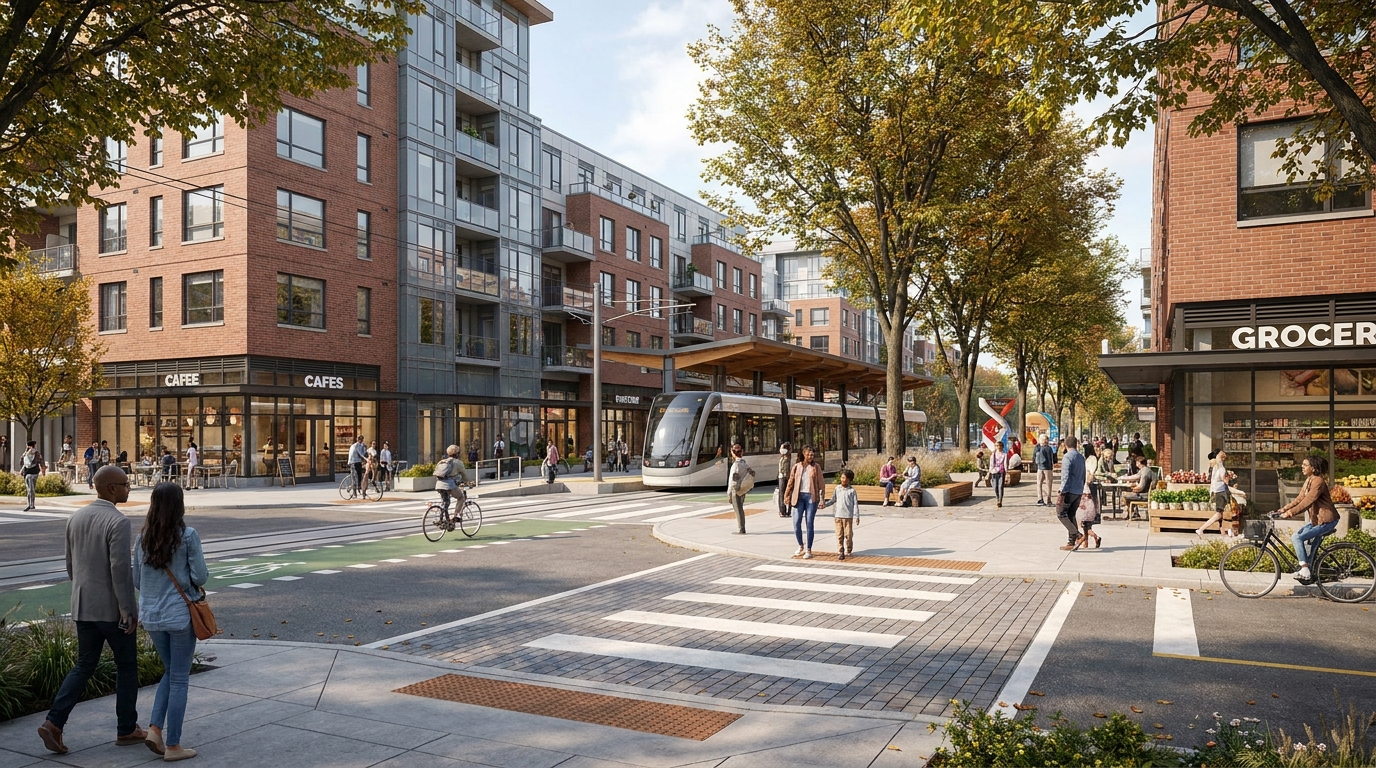
Housing is where urban population growth becomes personal. Residents may not follow metropolitan demographic forecasts or infrastructure capital plans, but they immediately feel rent increases, home price escalation, overcrowding, and displacement pressure. That is why housing affordability has become the dominant urban policy issue in many North American cities. It is also why sustainable development cannot be discussed only in environmental terms. If a city grows in a way that prices people out of housing or forces them into long commutes, it is not developing sustainably.
UN-Habitat’s World Cities Report 2026 emphasizes adequate housing as a foundational pillar of sustainable urban development and well-being. This is a critical framing. Housing is not merely a market output. It is the spatial platform through which people access employment, education, health care, social networks, and urban opportunity. When housing supply lags population growth, the consequences spread far beyond shelter. Labour mobility weakens, homelessness risk rises, families delay life decisions, and social inequality hardens geographically.
Strategically, the housing response to urban population growth has to be broader than high-rise construction alone. Major towers are important in many core and transit-rich locations, but sustainable housing supply also depends on unlocking a spectrum of forms across established neighborhoods. Missing-middle housing is especially important because it can add homes in a more distributed, context-sensitive way. Mid-rise apartments, multiplexes, stacked townhomes, laneway suites, secondary suites, and mixed-use corridor redevelopment can all expand supply while supporting walkable urbanism and more efficient use of land.
Approval speed is also part of the sustainability equation. A city may adopt pro-growth rhetoric, but if entitlement processes are slow, uncertain, and inconsistent, supply will not arrive at the pace required. Delays raise carrying costs, increase risk premiums, and reduce the number of feasible projects, especially rental housing and mid-scale infill. Faster, clearer approvals are not simply about developer convenience. They are a practical mechanism for aligning production with demographic reality.
There is another misconception worth correcting here. More population does not always harm livability. The outcome depends on whether housing, infrastructure, and services grow in step with demand. Well-planned density can support vibrant retail, stronger transit, shorter commutes, and better access to amenities. Poorly managed growth creates scarcity and stress, but well-managed growth can produce more complete and functional urban environments.
Housing strategies that align with sustainable growth
From a strategic standpoint, cities and development partners should focus on several complementary housing approaches rather than relying on a single solution. The most effective systems typically combine policy reform, infrastructure investment, and delivery certainty.
- Expand as-of-right permissions for missing-middle and mid-rise housing in appropriate urban areas so supply can grow incrementally and predictably.
- Prioritize transit-oriented housing near rapid transit stations and major bus corridors where infrastructure efficiency and mobility access are strongest.
- Support rental production through predictable approvals, reduced barriers, and financing tools that improve project viability.
- Coordinate growth with servicing capacity so areas targeted for housing intensification can actually absorb new residents without system failure.
- Use public land strategically for mixed-income and affordable housing outcomes where land cost is a major barrier.
Density Must Be Paired With Mobility
Population growth is sustainable only if residents can move efficiently through the city without becoming increasingly dependent on private vehicles. Transportation planning is therefore inseparable from growth management. Transit-oriented development remains one of the clearest strategies for aligning land use and mobility because it concentrates housing, employment, and services around high-capacity transit corridors. When done properly, it reduces per-capita emissions, shortens travel times, and supports a more productive use of urban land.
Transit-oriented growth also improves household economics. Transportation is one of the largest cost categories after housing. When residents can walk, cycle, or take reliable transit to work, school, and daily services, total living costs become more manageable. That matters in an affordability crisis. It also matters for labour market participation, because access to opportunity should not depend on car ownership.
Yet transit alone is not enough. Sustainable growth requires a full mobility system that includes complete streets, safe cycling infrastructure, accessible sidewalks, and strong connections between neighborhoods and transit nodes. This is where 15-minute-city style planning remains influential. The concept is often oversimplified in public debate, but its core insight is valuable: daily needs should be reachable with less time, less cost, and less environmental impact. Growth should therefore create more local access, not more forced travel.
For developers, mobility integration is increasingly a value proposition as well as a planning requirement. Projects that connect residents to employment, retail, public space, and transit are generally more resilient to changing consumer expectations and policy frameworks. In many markets, buyers and renters are increasingly choosing neighborhoods based on convenience, travel time, and quality of place rather than square footage alone. That means urban population growth is reshaping not only demand quantity, but demand preferences.
Infrastructure Is the Hidden Backbone of Sustainable Urban Growth
Housing and transit attract the most public attention, but infrastructure determines whether growth is actually supportable. Water systems, wastewater capacity, energy distribution, roads, schools, health facilities, broadband, and public realm investments all shape how additional population is absorbed. If infrastructure lags too far behind, even well-located growth can trigger service decline, community opposition, and project delays. Sustainable development therefore depends on seeing infrastructure not as a back-end technical issue, but as a front-end growth strategy.
This is particularly important in mature North American cities where much of the urban fabric was built for earlier population levels and different climate assumptions. Aging pipes, undersized transit stations, constrained substations, and stormwater systems designed for past rainfall patterns are increasingly incompatible with current growth trajectories. Infrastructure planning must therefore do two things at once: accommodate more residents and improve system resilience under more volatile environmental conditions.
That dual mandate raises important financing questions. Municipalities are being asked to support more housing, faster approvals, better transit, and greater climate resilience while managing fiscal constraints and legacy infrastructure deficits. Intergovernmental coordination becomes essential in this context. Federal and provincial governments influence immigration levels, housing policy, transit funding, and infrastructure programs, while municipalities control zoning, local servicing, and approvals. Sustainable urban growth succeeds when these layers operate in the same direction rather than at cross-purposes.
Infrastructure timing also shapes land value and project feasibility. Land with nominal zoning potential but inadequate servicing is not truly development-ready. Conversely, areas where governments have committed to transit, utilities, and public realm upgrades often become strategic growth nodes. In this sense, infrastructure is not simply a response to growth. It is one of the main tools that determines where growth can be steered productively.
Climate Resilience Is Now Core to Growth Strategy
There was a time when environmental planning could be treated as a parallel agenda rather than a central growth issue. That time has passed. Climate adaptation and resilience are now inseparable from urban population growth because the costs of adding people to vulnerable systems are rising. The OECD notes that cities’ environmental impact and vulnerability to extreme weather will continue to increase unless action is scaled up. For urban planners and developers, this means each additional resident must be accommodated in a way that lowers exposure to heat, flooding, infrastructure disruption, and emissions over the long term.
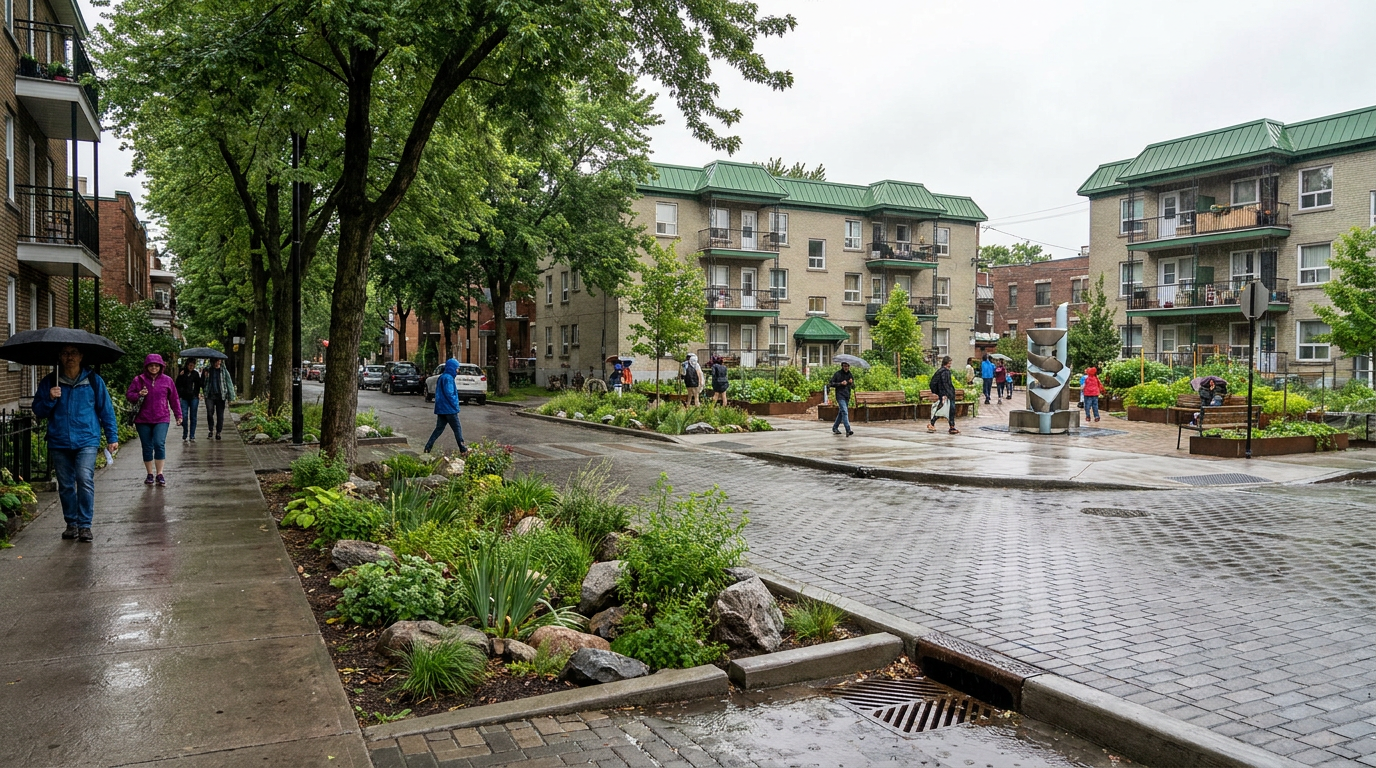
Resilience begins with urban form. Compact, transit-served communities generally reduce per-capita energy use and transportation emissions compared with low-density, car-dependent expansion. But resilience also depends on finer-grain design and engineering decisions. Stormwater management, permeable surfaces, bioswales, tree canopy expansion, building cooling strategies, district energy potential, backup power, and utility redundancy all become more important as density rises and climate volatility intensifies.
Heat mitigation is especially significant in growing cities. As hard surfaces expand and tree cover declines, urban heat island effects can worsen public health risks, especially for seniors, low-income households, and residents in apartments without adequate cooling. Sustainable growth therefore requires more than adding units. It requires building neighborhoods that remain healthy and functional during extreme weather events. Parks, shaded streets, cool materials, ventilation corridors, and green roofs are all part of this response.
Flood risk presents a similar challenge. A city that intensifies without modernizing drainage and watershed management can inadvertently place more people and assets in harm’s way. Climate resilience should be embedded in approvals, infrastructure standards, and long range land use planning, not addressed only after projects are approved. The strategic objective is clear: accommodate more residents while reducing aggregate risk, not increasing it.
Sustainable growth is not only about fitting more people into cities. It is about shaping urban form so each additional resident can live with lower emissions, lower climate risk, and better access to services.
Land-Use Efficiency and the Case for the Compact City
The idea of the compact city is sometimes misunderstood as a purely architectural preference for taller buildings. In reality, it is a strategic planning model built around land-use efficiency, reduced infrastructure burden, better mobility outcomes, and stronger support for public services. A compact city uses land more carefully by directing growth toward areas where residents can be served more efficiently, travel shorter distances, and rely less heavily on automobiles. This approach aligns closely with UN-Habitat’s emphasis on sustainable urbanization and the measurement of land consumption relative to population growth.
Compact development does not mean every neighborhood should look the same. It means cities should use a range of urban forms that support efficient growth. In some locations that means high-rise residential and employment clusters around major transit stations. In others it means gentle density in stable neighborhoods, mixed-use main streets, institutional corridor redevelopment, or underused commercial site intensification. The key is to distribute growth in ways that improve the overall performance of the urban system.
From a fiscal perspective, compact growth often outperforms sprawl over the long term. Extending roads, pipes, transit routes, and emergency services over larger geographic areas is expensive, especially when tax yields per hectare remain low. By contrast, infill and intensification can leverage existing infrastructure more efficiently, though they also require strategic upgrades and careful planning. The goal is not density for its own sake. The goal is to produce urban form that is financially, socially, and environmentally more durable.
There is also a broader competitiveness argument. Cities that manage growth well tend to retain talent more effectively, attract investment, and support more innovative economies. Employers want access to deep labour pools, reliable transportation, and attainable housing for workers across income levels. If urban population growth outpaces the capacity of a region to house and move people, economic performance eventually suffers. Sustainable development is therefore not only a social or environmental priority. It is also an economic one.
Governance, Data, and the Need for Better Urban Decision-Making
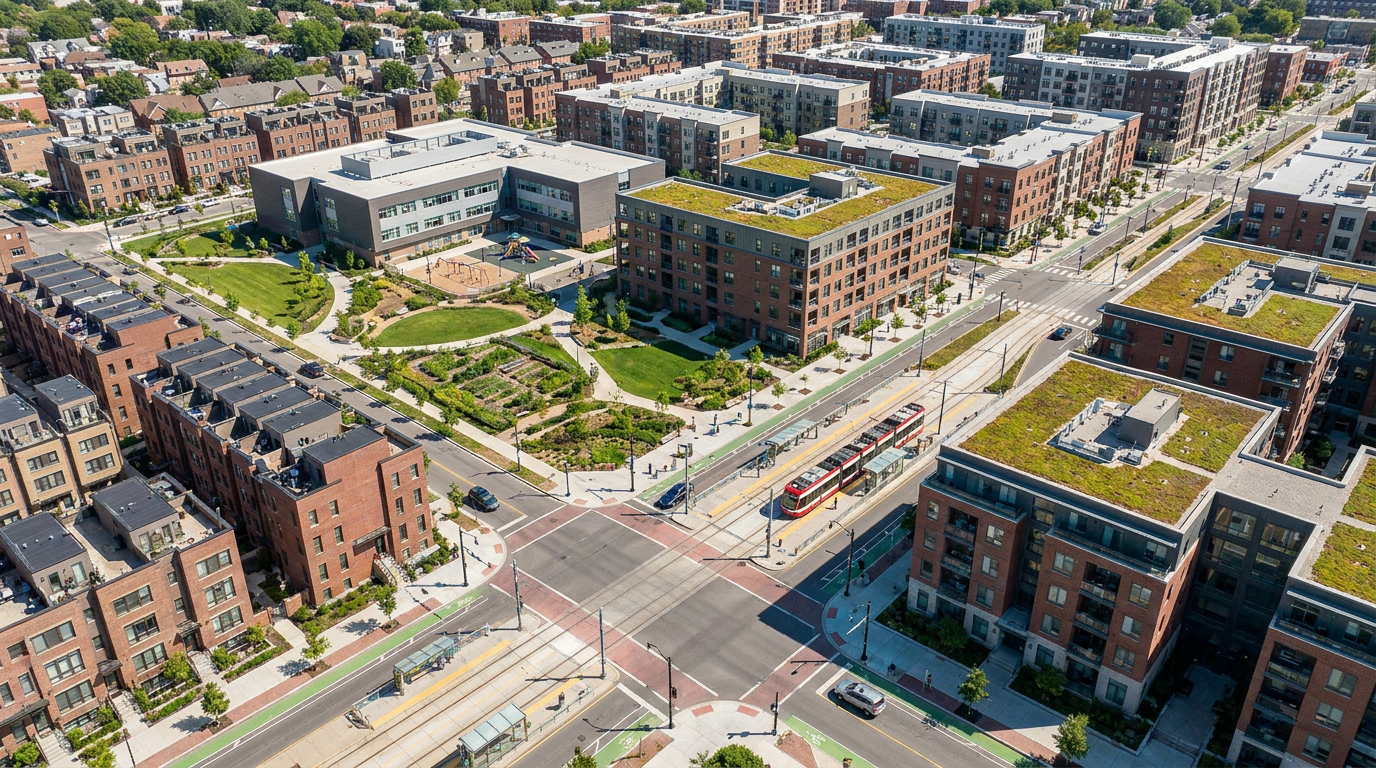
One of the most important shifts in contemporary urban policy is the move toward more data-driven growth management. As cities absorb more population under tighter land, infrastructure, and climate constraints, they need better tools to measure what is happening in real time. City-focused observatories, demographic forecasting systems, housing pipeline dashboards, and land-use efficiency indicators are becoming more prominent because they help governments align policy with evidence rather than assumption.
This is particularly useful in fast-growing regions where outdated assumptions can distort decisions for years. If population growth is stronger than expected, but zoning capacity, school planning, or transit investment remains tied to older forecasts, the mismatch will eventually show up in affordability and service pressures. Conversely, if cities can track where growth is occurring, which approvals are stalled, where infrastructure capacity exists, and how access to jobs and amenities is changing, they can allocate resources more strategically.
Good governance also requires public participation and trust. Sustainable urbanization is not just about technical efficiency. It is also about legitimacy and inclusion. Communities are more likely to support growth when they can see that new development is connected to housing need, mobility improvements, public space investment, and broader quality-of-life outcomes. Opposition often intensifies when residents perceive growth as extractive, poorly serviced, or disconnected from community benefit.
For this reason, the best urban growth strategies are not merely permissive or restrictive. They are coherent. They explain where growth should go, what infrastructure will support it, how housing diversity will be expanded, how climate risks will be managed, and how public value will be created over time. That level of coherence is what separates reactive planning from strategic city building.
Common Misconceptions About Urban Population Growth
Several misconceptions continue to complicate public conversations about urban population growth. The first is the belief that urbanization is effectively finished in North America. In reality, mature metropolitan regions continue to change through immigration, migration, household formation, aging, and economic restructuring. Even if total growth rates fluctuate, the need to adapt housing, infrastructure, and land use remains constant.
The second misconception is that sustainability in cities is mainly an environmental issue. Environmental performance is essential, but sustainable urban development also includes housing affordability, social inclusion, public health, access to opportunity, and governance capacity. A city with lower emissions but deep housing exclusion is not fully sustainable. A city with strong transit but failing infrastructure resilience is not either. The definition has to be broad enough to reflect how people actually live.
The third misconception is that density itself causes urban dysfunction. Density can reveal dysfunction, but it does not create it automatically. What creates dysfunction is inadequate planning, weak infrastructure sequencing, delayed housing delivery, and fragmented governance. In many cases, density is what makes better transit, more local retail, stronger public services, and lower per-capita emissions possible. The challenge is not to avoid density. It is to deliver it with competence.
A Strategic Framework for Managing Growth Sustainably
If cities want to manage urban population growth in a way that improves urban living conditions, they need a practical framework that connects policy goals with implementation. At a high level, that framework should integrate land use, housing, infrastructure, mobility, resilience, and finance rather than treating them as separate files. Growth is multidimensional, so the response must be as well.
- Forecast growth realistically. Cities should plan around current demographic trajectories, including immigration-linked concentration in metropolitan regions, rather than relying on outdated assumptions.
- Zone for enough housing. Growth targets are not credible if zoning capacity is constrained, geographically narrow, or politically fragile.
- Link housing to transit and services. The most sustainable growth locations are places where residents can access jobs, schools, amenities, and daily needs efficiently.
- Invest in enabling infrastructure. Water, wastewater, power, stormwater, schools, and public realm improvements must be sequenced with growth areas.
- Embed climate resilience early. Adaptation should be designed into projects and district plans from the beginning rather than treated as a later adjustment.
- Measure performance. Track land-use efficiency, housing delivery, mobility access, affordability, and resilience outcomes using transparent indicators.
- Coordinate across governments. Sustainable growth depends on alignment between municipal planning authority and higher-order funding and policy levers.
This framework is not theoretical. It reflects the operational reality of growing cities. The jurisdictions that perform best over time are usually those that understand growth as a managed system rather than a series of project-by-project disputes. They create room for housing, support it with infrastructure, tie it to mobility, and maintain a long-range view of climate and fiscal sustainability.
The Long-Term Opportunity in Urban Growth
It is easy to discuss urban population growth only in terms of strain and scarcity, because those pressures are visible and urgent. But growth also represents opportunity. More residents can support stronger labour markets, more viable transit systems, more diverse local economies, and a richer civic life. The question is whether cities have the vision and institutional capacity to convert population growth into better urban outcomes instead of compounding existing deficits.
That requires leadership from both the public and private sectors. Governments must modernize planning systems, accelerate approvals where appropriate, finance infrastructure intelligently, and align land use with sustainability goals. Developers must think beyond isolated site yield and consider how projects fit within broader patterns of mobility, service access, resilience, and neighborhood function. The most valuable development over the long term will be the kind that helps cities absorb growth gracefully rather than merely capitalize on scarcity.
For Canada and North America, the stakes are high. Population growth will continue to test housing systems, public investment frameworks, and governance models. At the same time, it offers a chance to build more complete, inclusive, and climate-ready urban regions. Cities that recognize this moment as a structural turning point will be better positioned to compete economically, protect quality of life, and meet the broader ambitions reflected in SDG 11 and the New Urban Agenda.
Urban population growth is not the challenge to be feared. Poorly managed growth is. If cities plan for density, invest in enabling infrastructure, expand housing options, strengthen transit, and build resilience into the urban fabric, growth can become a catalyst for better living conditions rather than a threat to them. That is the strategic path to sustainable urban development, and it is increasingly the only credible path forward.



No Comment! Be the first one.