



Minimalism has long held a certain mystique in interior design. It suggests stillness, elegance, and a confident understanding that beauty does not need excess to be felt. Yet the most compelling version of minimalism today is not severe, empty, or emotionally distant. It is softer, warmer, and more attuned to the way people truly live. In modern North American homes, where open plans often do double duty and visual noise competes with digital overload, minimal interiors have become less of a stylistic statement and more of a practical way to restore calm.
Table Of Content
- Why Minimalism Feels So Relevant Right Now
- The Difference Between Minimalism and Emptiness
- The Link Between Home Environment and Mental Clarity
- The Principles of Minimal Interior Design
- Intentional Editing
- Visual Continuity
- Clear Circulation
- Concealed Storage
- Sensory Softness
- How Warm Minimalism Softens the Style
- Designing Minimal Interiors Room by Room
- The Living Room
- The Kitchen
- The Bedroom
- The Bathroom
- The Home Office and Multiuse Spaces
- Practical Steps to Create a Clutter Free Minimal Home
- Minimalism, Family Life, and Real World Living
- Common Minimalism Mistakes to Avoid
- The Lasting Beauty of Living With Less
The enduring appeal of minimalism lies in what it removes and what it reveals. By stripping away visual clutter, unnecessary furniture, and decorative excess, it allows proportion, light, texture, and craftsmanship to come forward. A room begins to breathe. A simple linen curtain catches afternoon sun with new importance. The grain of oak feels richer. The line of a well designed sofa becomes sculpture. In this sense, minimalism is not about deprivation. It is about making room for what matters.
There is also a deeper reason why minimal interiors continue to resonate. Research in environmental psychology suggests that cluttered home environments can be associated with increased stress, poorer mood patterns, and reduced feelings of restoration. One often cited 2010 study found that women who described their homes in more stressful terms, including clutter and unfinishedness, showed flatter cortisol slopes across the day and experienced more depressed mood as the day progressed. While such findings do not prove that minimalism itself is a cure for mental strain, they do support a larger truth that many people feel intuitively: our surroundings shape our emotional experience.
To embrace minimalism, then, is not simply to chase a trend. It is to design with intention. It is to create a home that offers visual quiet, daily efficiency, and a more thoughtful relationship to the objects we keep close. This article explores the principles behind minimal interiors, the rising influence of warm minimalism, and the practical ways simplicity can support both aesthetics and well being.
Minimalism is most beautiful when it feels inhabited, intentional, and calm rather than empty.
Why Minimalism Feels So Relevant Right Now
Minimalism has evolved in response to contemporary life. Many homes in the United States and Canada are now asked to perform more roles than ever before. A dining table becomes a workspace. A living room turns into a media room, a family zone, and a place to host guests. In cities, compact apartments and condominiums require discipline in planning. Even in larger suburban homes, open plan layouts can quickly feel chaotic if every function is visually exposed. In this context, a minimalist approach offers order, flexibility, and relief.
Trend reporting from Houzz and design publications has shown that the conversation around minimal interiors in 2025 and 2026 is moving firmly toward warm minimalism. This means neutral palettes with depth rather than flat whiteness, natural materials instead of glossy sterility, and storage solutions that hide visual clutter without erasing comfort. Integrated appliances, panel ready cabinetry, concealed hoods, and seamless lighting systems are increasingly popular because they support a calmer visual field. The room appears effortless, even when it has been carefully engineered.
At the same time, designer surveys indicate that stark forms of Scandinavian minimalism are sharing space with more expressive styles. This is an important nuance. Minimalism has not disappeared, but it has softened. Homeowners want serenity, though not at the cost of personality. They want interiors that are edited, but still welcoming. The most successful minimalist spaces today acknowledge this desire by combining restraint with warmth, utility with sensuality, and clarity with soul.
There is also a cultural yearning for environments that feel slower and more restorative. In an age of notifications, constant images, and endless decision making, the home has become one of the few spaces where visual and mental quiet can still be cultivated. A minimal interior supports this instinct beautifully. It lowers friction. It reduces distraction. It creates an atmosphere in which the eye can rest and the mind can follow.
The Difference Between Minimalism and Emptiness
One of the most persistent misconceptions about minimalism is that it demands cold, blank, almost impersonal rooms. In reality, emptiness and minimalism are not the same thing. An empty room can feel unfinished or soulless. A minimalist room, by contrast, feels considered. It contains only what is necessary, useful, or deeply beautiful, but what remains has presence. The effect is not absence. It is clarity.
Modern minimalism also understands the emotional power of texture. A restrained room becomes inviting through tactile contrasts such as brushed oak against plaster walls, boucle upholstery beside smooth stone, or woven linen softening clean architectural lines. These elements create richness without clutter. They allow the senses to engage gently rather than aggressively. This is why many of the most elegant minimalist interiors today feel warm and cocooning rather than austere.
Color plays a crucial role as well. The old stereotype of all white minimalism has given way to nuanced palettes built from cream, sand, taupe, clay, warm gray, moss, and muted charcoal. Such tones create visual continuity while still offering softness and depth. They support natural light rather than competing with it. They also help rooms feel grounded, which is especially important in homes meant to promote rest and concentration.
When practiced thoughtfully, minimalism does not ask you to erase your life. It asks you to curate it. A ceramic bowl collected on travels, a treasured reading chair, or a single work of art can carry more emotional force in a pared back room than they ever could in a crowded one. Restraint gives meaning to selection. It turns ordinary objects into anchors of identity.
The Link Between Home Environment and Mental Clarity
The connection between interior design and emotional experience is often discussed in poetic terms, yet there is meaningful research behind it. Studies in environmental psychology have associated cluttered and stressful domestic environments with less favorable mood patterns and higher stress markers. The 2010 study frequently referenced in conversations about home clutter found that women who described their homes as cluttered or unfinished showed flatter diurnal cortisol slopes and increasing depressed mood throughout the day, while women who described their homes as restorative showed healthier stress patterns and better mood.
Other studies strengthen the broader picture. Research involving mothers and twin children found that the positive association between maternal sensitivity and child theory of mind appeared only when levels of clutter and crowding were lower. A separate study of community living older adults found that higher levels of household clutter were significantly associated with more depressive and anxiety symptoms. These findings should be interpreted carefully. They do not mean that a pristine room guarantees emotional health, nor that mess alone causes psychological distress. Human well being is always shaped by many factors. Even so, the home environment clearly has the capacity to either support or complicate daily ease.
From a practical standpoint, this makes intuitive sense. Clutter competes for attention. It increases visual demand. It can complicate routines, prolong cleaning, and heighten the low level fatigue that accumulates over a busy week. Minimal interiors reduce this friction. They create systems that make everyday actions more fluid, whether that means finding keys, clearing a work surface, or preparing for guests without stress. The reward is not simply a pretty room. It is the feeling of being less burdened by one’s surroundings.
Minimalism can also help reduce decision fatigue. When rooms contain fewer objects, fewer colors, and more consistent materials, the mind processes the environment with greater ease. You move through the day with less sensory interruption. This is especially beneficial in spaces dedicated to restoration, such as bedrooms, reading corners, and bathrooms, where calm should not have to compete with excess visual information.
The Principles of Minimal Interior Design
Intentional Editing
At the heart of minimalism is editing. This means evaluating what belongs in a room and what merely occupies it. Every piece should have a reason to remain, whether functional, emotional, or aesthetic. This process is not about ruthless denial. It is about asking better questions. Does this table improve the way the room works? Does this decorative item add meaning or simply fill silence? Does this chair support the rhythm of daily life, or does it interrupt circulation?
Intentional editing gives a room coherence. It also allows quality to replace quantity. A single beautifully made sideboard can hold more visual authority than multiple smaller storage pieces that create noise. One large artwork may calm a wall more effectively than a busy gallery arrangement. Minimalism teaches that subtraction often reveals strength.
Visual Continuity
Minimal interiors rely on a sense of flow. This often begins with a limited, harmonious palette and materials that repeat in subtle ways from one space to another. Continuity does not mean monotony. It means that transitions feel graceful. Oak flooring extending through an open plan living area, matching metal finishes on fixtures, and soft tonal layering in textiles all help the eye move without interruption.
When visual continuity is achieved, a home feels larger, quieter, and more composed. This is particularly valuable in condos, smaller houses, and multifunctional spaces where too many competing finishes can make rooms feel fractured. Simplicity becomes a tool for spatial generosity.
Clear Circulation
A truly minimal room is never cramped by objects. It respects movement. Pathways remain open. Furniture placement feels intuitive. There is enough breathing room around each piece to appreciate its form and to use the space comfortably. This principle is as much about well being as it is about aesthetics. Clear circulation makes a home feel calmer and more dignified. It also supports safety and practicality, especially for children, older adults, and anyone navigating busy daily routines.
Health and home safety sources, including CDC materials, note that clutter can contribute to trip hazards and complicate care delivery in the home. Minimalism therefore offers a functional elegance. It makes life easier not just to look at, but to live in.
Concealed Storage
One of the quiet luxuries of modern minimalism is invisible organization. Hidden storage allows everyday necessities to exist without dominating the room. This might include built in cabinetry, under bed storage, media units with flush doors, entry benches with concealed compartments, or kitchens with panel ready appliances and integrated pantries. Houzz trend reporting has highlighted these seamless features as increasingly desirable because they preserve visual serenity while maintaining full functionality.
Concealed storage is what allows minimal interiors to feel realistic rather than performative. It acknowledges that real life requires charging cables, paperwork, pantry items, and seasonal layers. The goal is not to pretend these needs do not exist. It is to design a place for them so they do not occupy the visual foreground.
Sensory Softness
Minimalism becomes most successful when it attends to the senses. Hard surfaces alone can feel severe. A more refined approach introduces softness through natural fibers, acoustic balance, warm light, and tactile materials. Linen drapery, wool rugs, matte ceramics, wood grains, and dimmable lighting all contribute to a room that feels calm in the body as well as the eye.
This sensory dimension is one reason warm minimalism has become so beloved. It recognizes that beauty is not only visual. A sanctuary is built through atmosphere.
How Warm Minimalism Softens the Style
Warm minimalism represents a graceful evolution of the minimalist ideal. Instead of relying on stark contrast and absolute reduction, it embraces softness, subtle layering, and the organic character of materials. A room might still be spare, but it no longer feels clinical. It feels luminous and lived in. This shift has broad appeal because it suits the emotional expectations of home. Most people do not want to inhabit a showroom. They want to inhabit peace.
Materials are central to this warmth. Travertine, limestone, oak, walnut, limewash, clay toned textiles, leather, and hand finished ceramics all bring depth without chaos. Their imperfections are part of their beauty. They remind us that simplicity can be sensual. In many ways, warm minimalism overlaps with biophilic design by drawing the outside world inward through natural textures, daylight, and earthy palettes.
The furniture in these spaces often balances clean silhouettes with softness in detail. Think rounded edges, upholstered forms, low visual weight, and pieces that feel sculptural without being dramatic. Decorative objects are few, but carefully chosen. A branch in a stone vessel, a stack of art books, or a single lamp with a linen shade can be enough to complete a composition.
This interpretation of minimalism is also better suited to North American life because it allows comfort to remain visible. A throw blanket can stay draped over a chair if it contributes to the room. A breakfast nook can feel intimate, not just efficient. The result is not an aesthetic of denial. It is one of edited abundance, where every element earns its place through beauty, usefulness, or both.
Designing Minimal Interiors Room by Room
The Living Room
The living room is often where minimalism has the greatest visual impact because it is typically the most public and multifunctional area of the home. Begin by identifying a focal point, such as a fireplace, a view, or a single work of art, and allow the rest of the room to support it rather than compete. Limit furniture to pieces that truly serve gathering, reading, or conversation. If a chair exists only to fill a corner, it may not be necessary.
A restrained color palette helps create tranquility, but texture is what prevents the room from feeling flat. Pair a tailored sofa with a wool rug, a timber side table, and softly pleated curtains. Keep surfaces mostly clear, with perhaps one or two meaningful objects. This gives the eye a place to rest and allows the architecture to come forward. In open plan spaces, concealed storage for media devices, toys, and accessories is invaluable for maintaining visual order.
The Kitchen
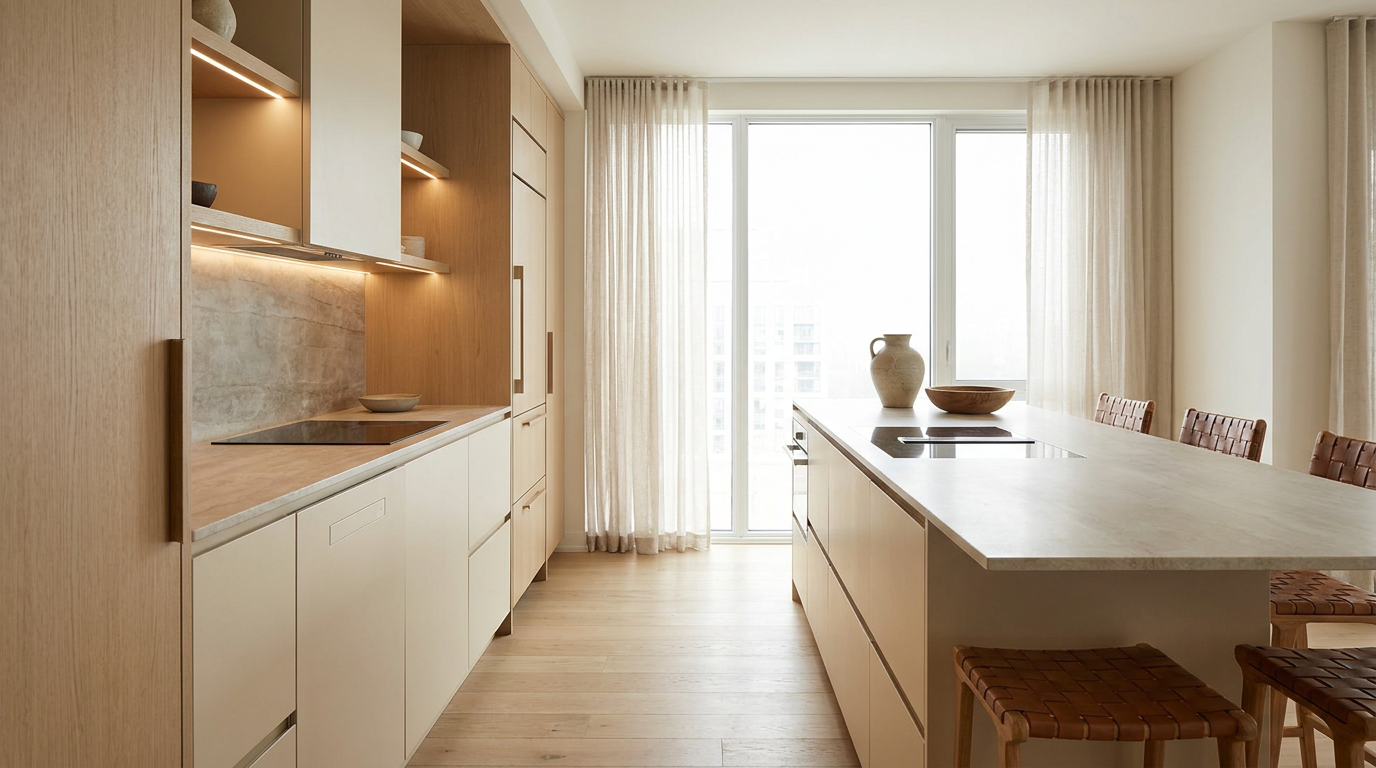
The kitchen may be the room where minimalism feels most immediately practical. Counters free of visual clutter make cooking feel calmer, cleaning easier, and the entire home more ordered. Current design trends strongly favor hidden appliances, integrated lighting, flush cabinetry, and pantry systems that keep daily essentials organized behind simple fronts. This creates a polished, restful backdrop for one of the busiest rooms in the house.
Minimal kitchens are especially effective when materials do the decorative work. A beautiful slab backsplash, wood grain cabinetry, or handmade tile in a quiet tone can add richness without requiring layers of ornament. Open shelving should be used sparingly and only for objects that are both useful and visually cohesive. The goal is not to erase life, but to let function look graceful.
The Bedroom
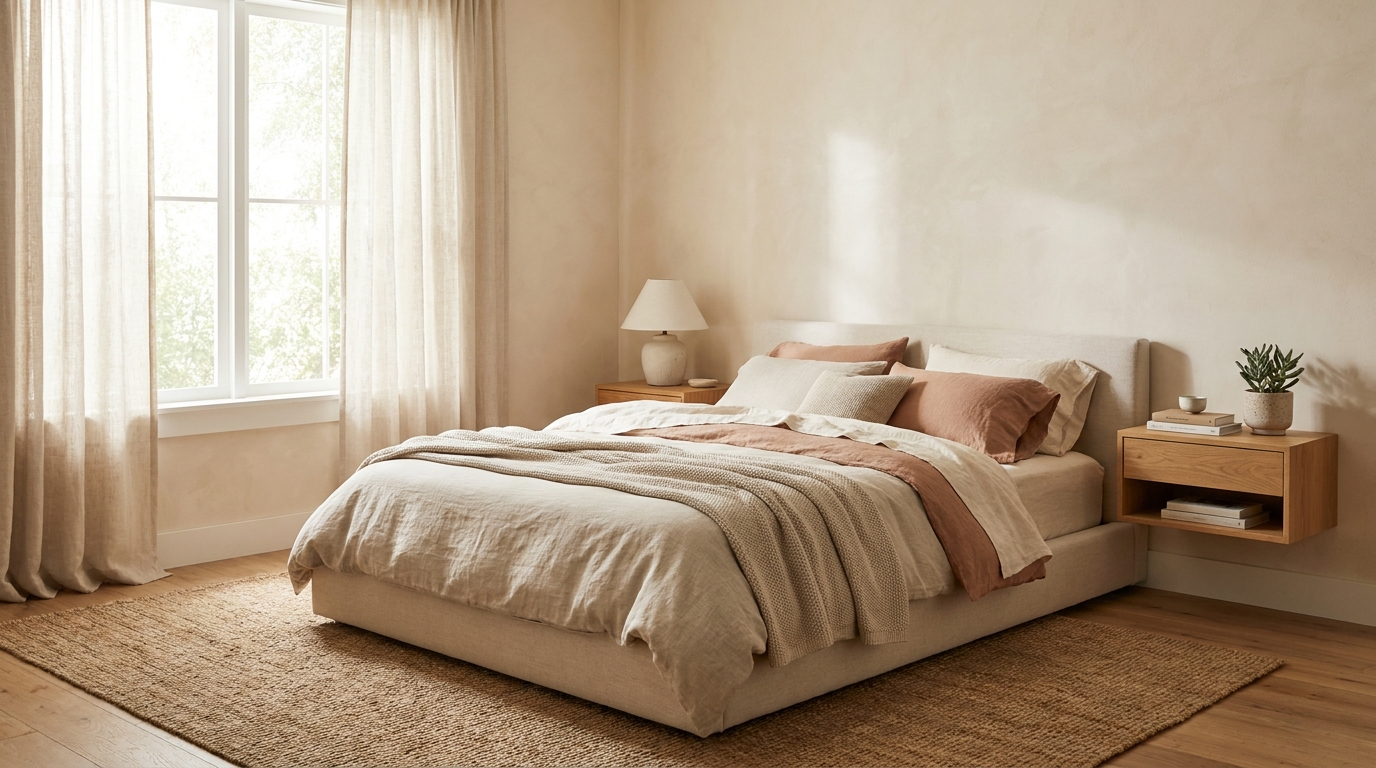
No room benefits more from minimalism’s calming influence than the bedroom. This is where visual restraint most directly supports rest. Keep the palette soft and low contrast. Choose bedside tables with enough storage to contain essentials. Let bedding provide warmth through material rather than pattern overload. The room should feel like an exhale the moment you enter.
Technology also deserves thoughtful handling in minimalist bedrooms. Visible cords, blinking chargers, and excess screens disrupt the sense of retreat. Where possible, hide wires, simplify surfaces, and reduce electronic presence. The fewer distractions the room contains, the easier it becomes to associate it with restoration rather than stimulation.
The Bathroom
A minimalist bathroom can feel deeply luxurious because it transforms routine into ritual. Clean lines, simple fixtures, concealed storage, and a restrained material palette contribute to a spa like atmosphere. Store everyday products out of sight as much as possible, keeping only the most beautiful or essential items visible. A stone tray, folded towels, and a single branch can be enough to create softness.
Lighting matters enormously here. Favor diffused, warm illumination over harsh brightness. Good light flatters the room and the person within it. Minimalism in the bathroom is not about cold perfection. It is about gentle clarity.
The Home Office and Multiuse Spaces
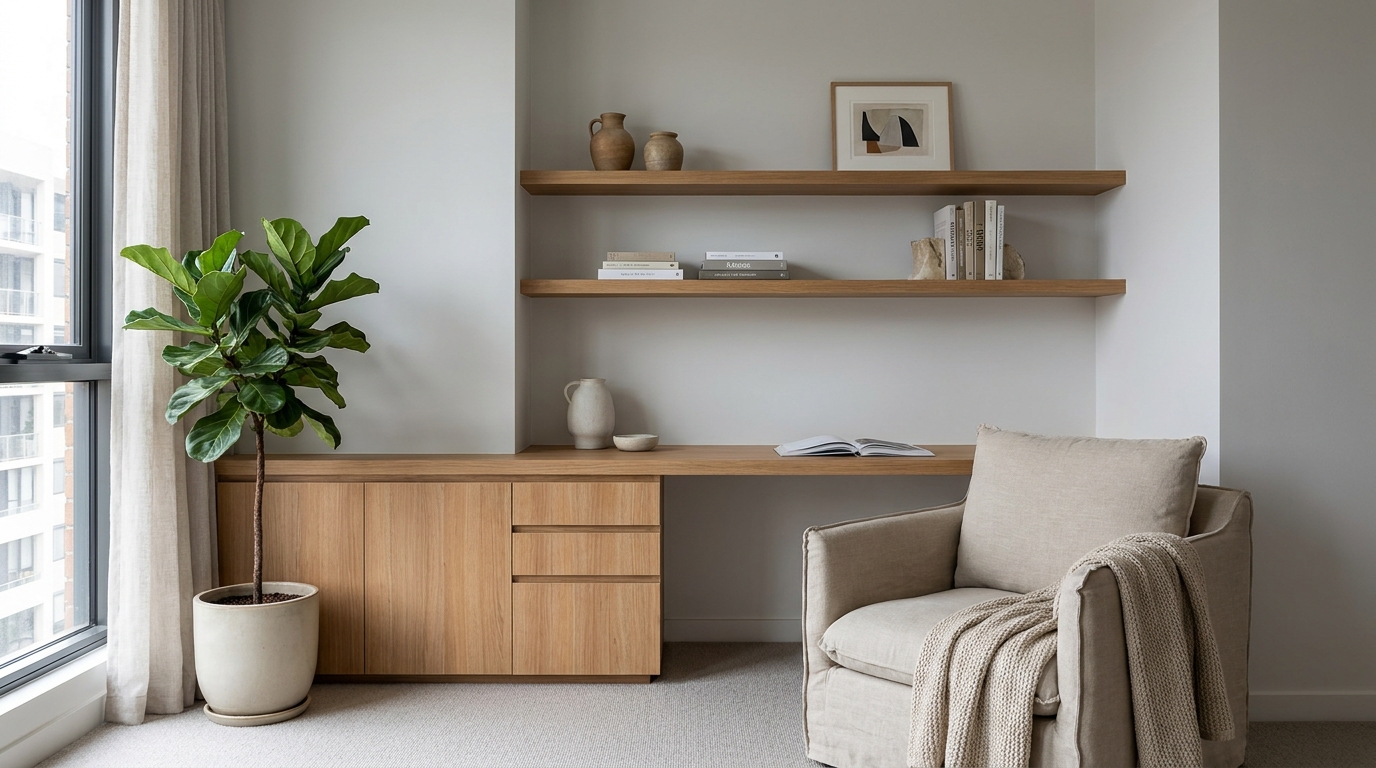
As homes continue to accommodate work, study, and leisure within shared footprints, minimalism becomes a powerful planning tool. A compact office nook can feel calm and highly functional if storage is built in, cables are managed, and the desk surface is kept intentionally sparse. In multiuse rooms, zoning is essential. A rug, lighting change, or shelving arrangement can define one function from another without visual clutter.
Adaptability is one of minimalism’s quiet strengths. When a room is not overcrowded, it can evolve more easily. This is especially valuable in apartments, family homes, and condos where square footage is precious and every piece must justify itself.
Practical Steps to Create a Clutter Free Minimal Home
Minimalism becomes approachable when it is treated as a sequence of thoughtful decisions rather than a dramatic purge. The process begins with observation. Notice which areas of the home create friction. Is the entry piled with shoes and bags? Does the kitchen counter constantly disappear beneath appliances and paper? Does the bedroom collect laundry and visual stress? These are not failures. They are design clues.
From there, focus on systems before styling. Beautiful minimal interiors are sustained by good organization. If an item has no designated place, it will eventually become clutter. Built in storage is ideal, but freestanding solutions can work beautifully if they are simple, well proportioned, and cohesive with the room. Think in categories. Daily essentials should be easiest to access. Occasional items can be stored higher or deeper. Decorative objects should be few enough to dust effortlessly and appreciate fully.
It is also wise to edit by frequency of use and emotional significance. Ask yourself what truly serves your routines and what merely lingers from habit. Minimalism does not require you to eliminate cherished possessions, but it does invite honesty about volume. A few beloved items displayed with space around them can feel more meaningful than many scattered without intention.
To help simplify the process, these foundational steps can guide almost any room:
- Remove everything that does not belong in the space and group similar items together.
- Define the room’s primary function and select furniture that supports it directly.
- Create hidden storage for visual clutter, especially technology, paperwork, and daily accessories.
- Limit the palette to a small range of harmonious tones and repeat materials thoughtfully.
- Leave negative space on shelves, walls, and surfaces so the room can breathe.
- Introduce warmth through texture, natural light, plants, and tactile finishes.
- Reassess regularly so clutter does not quietly return.
These steps may sound simple, yet their effect can be profound. A room with fewer competing elements is easier to clean, easier to maintain, and easier to enjoy. It begins to support the life unfolding within it rather than interrupt it.
Minimalism, Family Life, and Real World Living
Some people assume minimalism is only realistic for those who live alone or have highly controlled households. In fact, it can be especially valuable for families. When children, work schedules, and daily routines all converge in one home, visual and practical systems matter even more. Lower levels of clutter can support smoother transitions, easier cleanup, and calmer interactions. Research on home crowding and clutter has even suggested that household environment may shape how family relationships and developmental processes play out.
This does not mean every family home should look pristine at all times. Life is dynamic. Toys appear. Backpacks land by the door. Laundry cycles endlessly. Minimalism in a family context is not about rigid perfection. It is about reducing excess so the essentials are easier to manage. Closed storage, baskets, built ins, and designated drop zones can make a tremendous difference. Rooms become flexible rather than overwhelmed.
For older adults, minimal interiors can also offer practical and emotional benefits. Research has associated higher clutter levels with more depressive and anxiety symptoms among community living older adults, while safety sources point to the trip hazards clutter can create. A thoughtfully simplified home may therefore support both confidence and comfort. Clear pathways, better lighting, and carefully chosen furnishings can be deeply elegant while also serving long term ease.
Common Minimalism Mistakes to Avoid
The first mistake is confusing minimalism with total removal. When a room is stripped of all softness, color variation, or personal meaning, it often feels uncomfortable rather than serene. The cure is to reintroduce texture, proportion, and a few expressive elements. Minimalism succeeds through balance, not severity.
The second mistake is decluttering without redesigning. Removing objects will improve a room, but it will not necessarily make it minimal in the truest sense. Furniture may still be oversized. Layout may still block circulation. Lighting may still feel harsh. Minimal interiors depend on space planning as much as organization. The arrangement itself must support calm.
The third mistake is relying on visible storage. Open baskets, exposed shelves, and decorative trays can be useful, but too many of them simply create curated clutter. If everything remains on display, the eye still works hard. Invest in concealed storage wherever possible, especially in high use rooms.
The final mistake is expecting minimalism to solve every emotional challenge. A beautiful, uncluttered home can absolutely support ease, focus, and restoration, but it is not a substitute for broader forms of care. The healthiest way to speak about minimalism is as one valuable design strategy among many, not a miracle cure. Its power lies in how consistently it improves daily experience.
The Lasting Beauty of Living With Less
Minimalism endures because it offers more than a look. It offers a rhythm. It asks us to choose carefully, live lightly, and allow our homes to become places of refuge rather than accumulation. In a world of constant stimulation, this has become a quiet luxury. The beauty of a minimal interior is not only in its clean lines or tonal harmony. It is in the way it makes morning routines gentler, evenings calmer, and ordinary moments more breathable.
There is something deeply sophisticated about a room that does not need to prove itself. A well edited home feels confident. It trusts proportion, materials, light, and silence. It allows a single vase, a warm timber surface, or a shaft of sun across stone to be enough. This sensibility is timeless because it is rooted in discernment rather than novelty.
For those drawn to minimal interiors, the invitation is not to mimic a sterile ideal. It is to create an environment that feels clear, restorative, and unmistakably your own. Let simplicity reveal what you love most. Let storage support rather than dominate. Let texture bring softness. Let negative space become part of the composition. The most beautiful minimal homes are not empty at all. They are full of intention.
When embraced with warmth and realism, minimalism becomes an act of care. It cares for the eye by reducing noise. It cares for the mind by lowering daily friction. It cares for the home by making it easier to use and maintain. And perhaps most importantly, it cares for the life within the home by making room for what deserves attention. In that sense, minimalism is not about having less for the sake of less. It is about living with enough, beautifully.



No Comment! Be the first one.