



Environmental assessments sit at the intersection of city building, environmental stewardship, infrastructure planning, and public trust. In land development, they are often misunderstood as a narrow compliance exercise that appears late in the process and slows everything down. In reality, a well-executed environmental assessment can be one of the most valuable strategic tools available to a developer, municipality, or project team because it helps identify risk early, improve project design, strengthen approvals strategy, and build a more durable case for growth.
Table Of Content
- Why Environmental Assessments Matter in Land Development
- The Shift from Environmental Assessment to Broader Impact Assessment
- How the Environmental Assessment Process Supports Better Projects
- Early Scoping Changes the Economics of Development
- Key Issues Environmental Assessments Examine in Housing and Urban Development
- Public Participation and Community Acceptance Are Strategic, Not Cosmetic
- Indigenous Rights and Knowledge Strengthen Decision-Making
- Environmental Assessment as a Risk-Management Tool
- North American Trends: Faster Reviews, Higher Expectations
- Environmental Assessments and Housing Supply
- Common Misconceptions About Environmental Assessments
- What Strong Environmental Assessment Looks Like in Practice
- Final Thoughts: Better Assessment, Better Cities
That matters more than ever in an era defined by housing shortages, intensifying urban regions, rising infrastructure costs, climate pressure, and heightened public scrutiny of development decisions. Large housing projects do not succeed on zoning alone. They depend on a much broader system of confidence that includes environmental performance, service capacity, transportation impacts, human health, resilience, and community acceptance. Environmental assessments help organize that system into a disciplined process before construction begins, when changes are still possible and far less expensive than redesigning later.
In Canada, the policy direction has also evolved. The federal framework shifted from the Canadian Environmental Assessment Act, 2012 to the Impact Assessment Act in 2019, reflecting a broader understanding of how projects affect not only the natural environment, but also health, society, Indigenous rights, and long term sustainability. That shift is important for anyone involved in land development because it signals a wider expectation. Decision-makers are no longer asking only whether a project can be built. They are asking whether it can be built responsibly, transparently, and in a way that supports sustainable urban growth.
This article explains why environmental assessments matter in land development, how the process works, what developers and communities should pay attention to, and why these assessments can unlock better projects rather than simply constrain them. For housing development in particular, they are not just about avoiding harm. They are about making better choices on where, how, and under what conditions growth should occur.
Strategic insight: The most successful development teams do not treat environmental assessment as a late-stage obstacle. They use it early as a design, approvals, and risk-management framework that improves project feasibility.
Why Environmental Assessments Matter in Land Development
At the most basic level, an environmental assessment evaluates whether a proposed project is likely to cause significant adverse effects and what can be done to avoid, reduce, or manage those effects. That definition sounds technical, but the implications are practical. Every major development changes the land around it. It affects stormwater movement, traffic patterns, vegetation, servicing demand, air quality, noise, habitat, and the experience of nearby communities. If those impacts are not studied early, they have a way of resurfacing later through delays, redesign costs, permit complications, public opposition, and sometimes legal challenge.
For large scale housing projects, environmental assessments are especially important because urban growth now happens in increasingly complex contexts. New communities may be proposed near natural heritage systems, flood-prone lands, constrained road networks, aging wastewater systems, agricultural interfaces, or established neighbourhoods already concerned about cumulative change. Infill sites may carry contamination risk, noise sensitivity, shadow impacts, tree protection issues, or pressure on local infrastructure. Greenfield sites may raise questions about wetland disturbance, wildlife corridors, runoff management, and long term municipal servicing capacity. An environmental assessment helps turn these issues from abstract concerns into documented, testable planning inputs.
The strategic value is often underestimated. Canadian guidance explicitly notes that assessments can reduce costs and delays when they begin early enough for mitigation to be integrated into project design. That is a major point for developers. If a project team identifies a drainage constraint, sensitive habitat area, or mobility conflict during early planning, it may be able to revise the concept plan, adjust the road network, reposition buildings, phase infrastructure differently, or preserve key natural features before those decisions harden. The same issue discovered too late can derail schedules, damage credibility, and materially alter project economics.
Environmental assessments also matter because they create a structured record. Development approval is not only about internal confidence. It is about external confidence from municipalities, regulators, Indigenous communities, agencies, lenders, partners, and the public. A thorough environmental review shows that concerns were identified, tested, and addressed through evidence rather than assumption. In a period when public trust in development decisions is often thin, that record can be decisive.
The Shift from Environmental Assessment to Broader Impact Assessment
One of the most important changes in the Canadian context is conceptual. The federal conversation has moved beyond a narrow environmental lens toward a broader impact assessment framework. The Impact Assessment Act reflects this shift by considering environmental, health, social, and economic factors alongside sustainability, Indigenous rights, and public participation. For urban development audiences, this is more than a legal distinction. It signals that project evaluation is becoming more integrated and more reflective of how real communities experience growth.
Traditionally, many people thought of environmental assessment as something limited to biophysical impacts such as wetlands, wildlife, watercourses, or emissions. Those topics remain essential, but they are no longer the whole story. Major development decisions now sit within a wider planning logic that asks how projects interact with human health, local infrastructure, mobility, community well-being, and cumulative change over time. This aligns with the reality of land development. A project can comply with basic site-level environmental requirements yet still create serious problems if it overloads roads, contributes to flood risk, undermines climate resilience, or fails to address community concerns transparently.
The broader impact-assessment model also reinforces the idea that development is not a single permit event. It is a sequence of choices that should be coordinated. Federal guidance has emphasized collaboration, permitting plans, and the goal of one project, one review to reduce duplication and improve predictability. That objective matters because fragmented review processes are expensive and difficult for everyone involved. When environmental analysis is coordinated with broader planning and approvals, projects move with better clarity and stronger accountability.
This shift has implications for developers, consultants, and municipalities alike. It means that environmental assessment should not be isolated within a siloed technical stream. It should inform broader decisions about site selection, density, infrastructure investment, phasing, public engagement, and long term growth strategy. That is where its value compounds.

How the Environmental Assessment Process Supports Better Projects
A strong environmental assessment does not simply produce a report. It supports better decisions through a sequence of analysis, consultation, alternatives review, mitigation planning, and follow-up. While the exact process varies depending on jurisdiction, project type, and whether federal, provincial, or municipal triggers apply, the underlying logic is consistent. The assessment asks what the project is, what it could affect, how those effects can be avoided or reduced, what alternatives exist, what the public and Indigenous communities have raised, and what conditions should govern implementation.
In practical land development terms, this means the process can shape a project in substantial ways. A housing project may need to reconfigure grading to protect downstream water quality. A road alignment may need to shift to avoid a sensitive natural feature. Construction timing may need adjustment to reduce seasonal habitat disruption. Noise barriers, setbacks, tree retention strategies, transit integration, or enhanced stormwater systems may be required. Far from being evidence of failure, these changes often indicate that the process is working as intended. It is easier and more responsible to solve these issues on paper than after shovels are in the ground.
Canadian guidance also highlights several recurring considerations that are highly relevant to urban development. These include cumulative effects, project alternatives, accident and malfunction scenarios, public comments, mitigation measures, and follow-up requirements. Each of these categories has strategic implications. Cumulative effects matter because one project rarely acts alone. In fast-growing regions, traffic, water demand, habitat fragmentation, and infrastructure stress build incrementally. Alternative means matter because there is often more than one way to achieve a housing target or site program. Follow-up matters because approvals are not meaningful if no one verifies whether the predicted impacts and mitigation measures proved accurate in practice.
Developers sometimes resist this level of scrutiny because it appears to add time and cost. That view is understandable but incomplete. Every major project already carries risk. The real question is whether that risk is being identified deliberately or discovered reactively. Environmental assessment front-loads the hard questions. Done properly, that tends to improve certainty, not reduce it.
Early Scoping Changes the Economics of Development
One of the clearest lessons from both policy guidance and industry practice is that environmental assessment works best when it begins early. This is not just a procedural preference. It is a fundamental economic principle in land development. The earlier a constraint is identified, the cheaper it is to address. Conversely, the later it is discovered, the more deeply it is embedded in drawings, pro formas, servicing assumptions, and stakeholder expectations.
Early scoping allows the project team to understand whether a site is suitable for the intended program and under what conditions. It can reveal whether a large housing development should proceed at all, whether it needs a different density pattern, whether servicing upgrades are required, whether natural systems require buffers, or whether an alternative site would produce fewer conflicts. In this sense, environmental assessment is not anti-development. It is pro-feasibility because it improves the quality of the initial decision.
For investors and landowners, that is critical. A parcel may appear valuable on a planning map, but its true development value depends on what can actually be delivered once environmental, infrastructure, and community factors are accounted for. The assessment process helps translate theoretical land potential into realistic strategic positioning. That is one reason experienced development teams increasingly integrate environmental review with due diligence and master planning rather than treating it as a downstream compliance step.
Key Issues Environmental Assessments Examine in Housing and Urban Development
Although every project is different, environmental assessments in land development typically examine a combination of physical, ecological, servicing, and social issues that directly affect project viability. The relevance of each category depends on the site and jurisdiction, but the general pattern is clear. The assessment must test how the project interacts with both the natural environment and the human systems that support urban life.
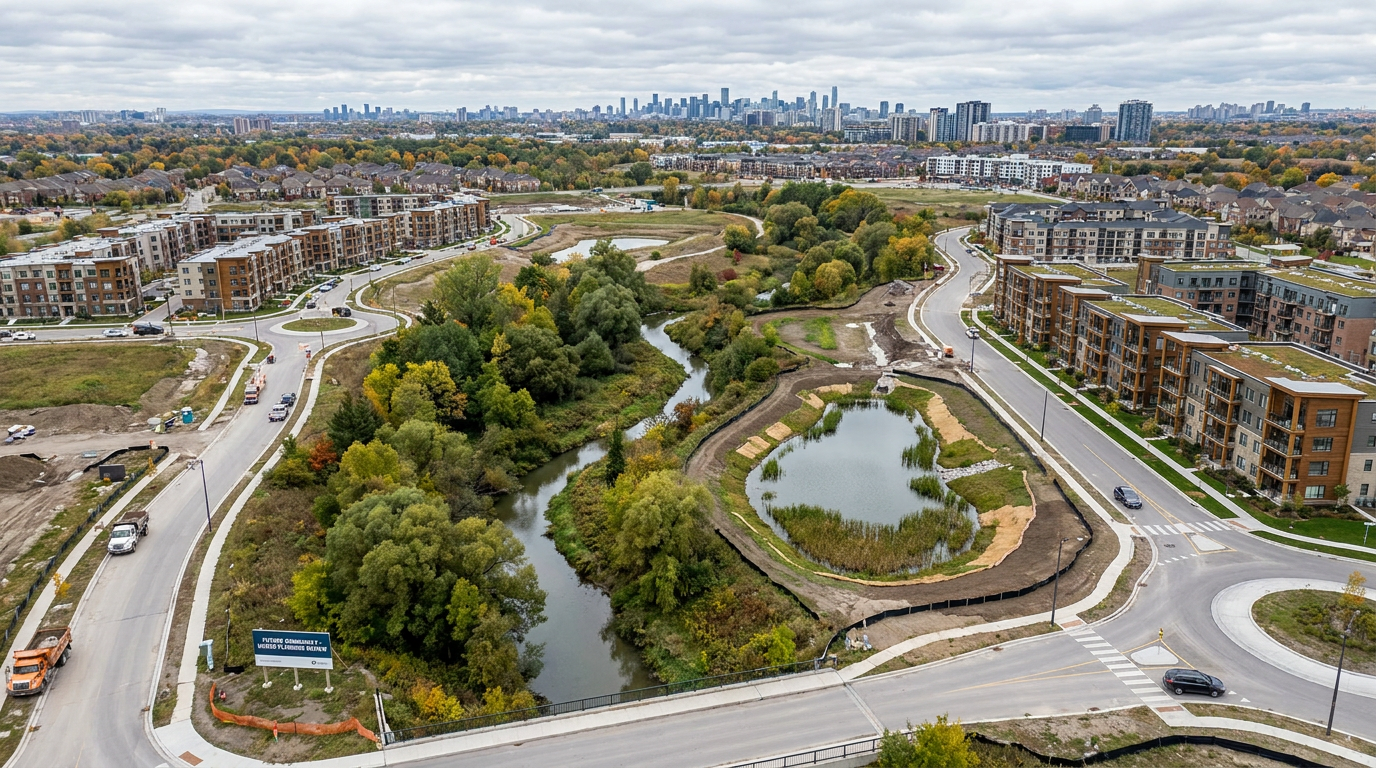
Stormwater and water management are often among the most consequential topics. Urbanization changes runoff volumes, drainage timing, and water quality. Without careful design, development can increase flood risk, erode channels, and degrade receiving water bodies. Environmental assessment helps determine what management systems are needed, whether the site can support the intended build form, and how low-impact development features or detention infrastructure can be integrated effectively.
Transportation and mobility impacts are also central, especially for large housing projects. A development can be environmentally acceptable in a narrow sense yet still fail strategically if it overwhelms road capacity, undermines transit operations, or increases emissions through poor connectivity. Assessments help link land use to mobility patterns, ensuring that growth aligns more closely with transportation infrastructure and long term urban form goals.
Noise, air quality, habitat disruption, vegetation loss, wastewater capacity, climate resilience, and cumulative effects all deserve serious attention as well. In established communities, public concern often centers on these practical everyday impacts. People want to know whether a project will worsen flooding, eliminate mature trees, increase traffic, strain schools and sewers, or reduce quality of life. Environmental assessment provides the framework for addressing those questions with evidence rather than speculation.
The following issues commonly shape environmental assessment outcomes in major land development projects:
- Stormwater and flood risk: Whether runoff can be controlled and downstream systems protected.
- Natural heritage and habitat: Whether wetlands, woodlands, species, and ecological corridors are affected.
- Transportation and access: Whether roads, transit, and active mobility systems can support the project.
- Noise and air quality: Whether residents and nearby communities face health or livability impacts.
- Servicing capacity: Whether water, wastewater, and utility systems can accommodate growth.
- Cumulative effects: Whether combined impacts from multiple projects create broader regional strain.
- Climate resilience: Whether the site and design are prepared for heat, flooding, and extreme weather.
- Follow-up and compliance: Whether mitigation can be monitored and enforced after approval.
When these issues are addressed well, the result is not simply an approved project. It is a project that is more aligned with the realities of long term city building. That distinction matters because many development failures are not caused by one catastrophic flaw. They result from accumulated misalignments that should have been identified earlier.
Public Participation and Community Acceptance Are Strategic, Not Cosmetic
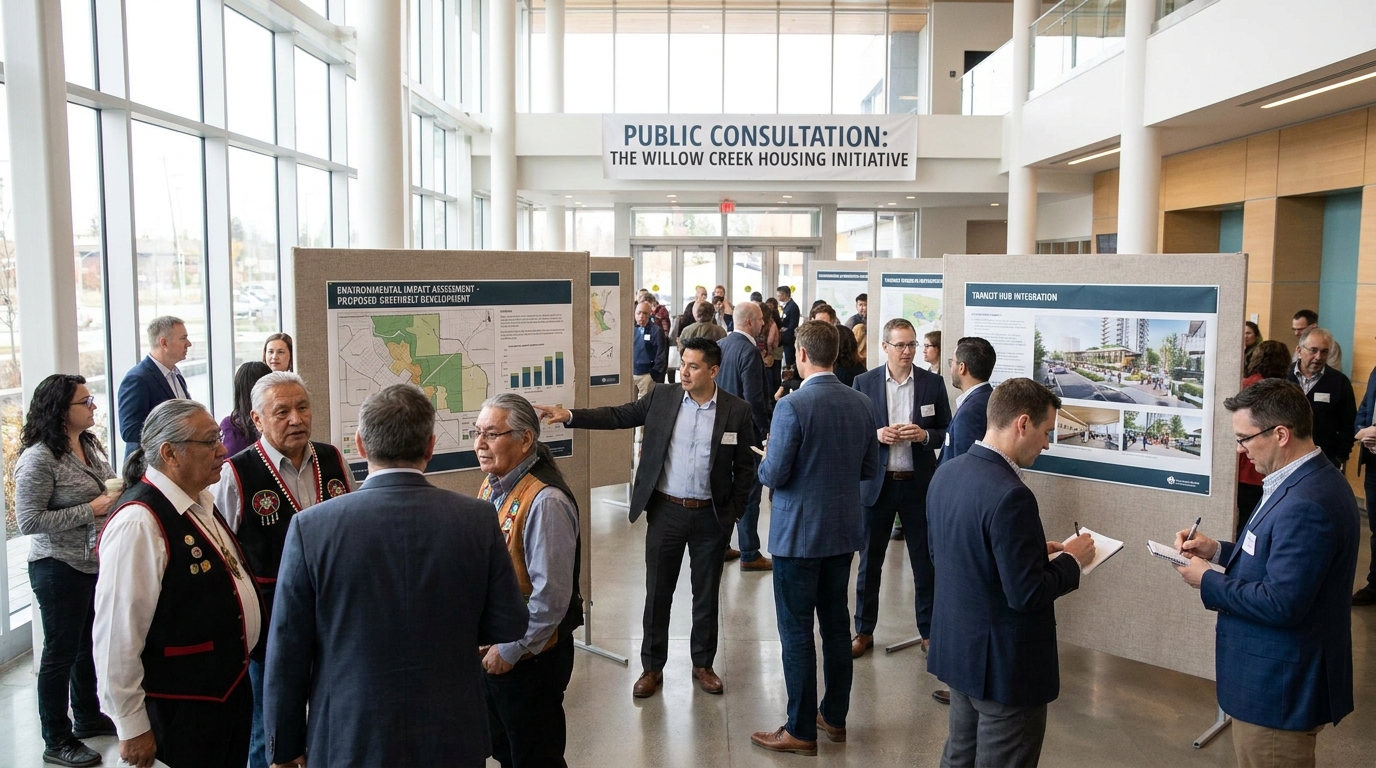
One of the most persistent misconceptions about environmental assessment is that public participation is symbolic. In fact, both Canadian policy and practical experience show the opposite. Public comments can influence conditions, mitigation measures, and decision statements. In some cases, those conditions become legally binding if the project proceeds. For development teams, this means community input is not something to be managed superficially. It is a substantive part of the approvals environment.
This is particularly important in urban growth areas where trust is often fragile. Residents may support the idea of more housing in general while opposing a specific project because they believe local impacts have not been understood or respected. Environmental assessment can help bridge that gap by making the issues visible, the analysis transparent, and the proposed solutions testable. A community is more likely to accept change when it can see that concerns about traffic, runoff, noise, tree loss, or local services were taken seriously and addressed through enforceable measures.
That does not mean every concern disappears. Development inherently changes place, and not every stakeholder will agree. But transparency changes the quality of disagreement. Instead of a debate driven by uncertainty and mistrust, the process creates a framework in which evidence can be reviewed and trade-offs can be discussed more honestly. From a strategic standpoint, that is the foundation of social licence.
Developers who understand this tend to perform better over time. They recognize that community acceptance is not achieved through branding alone. It comes from disciplined planning, credible consultation, and a willingness to adapt the project where the evidence supports change. Environmental assessment helps institutionalize that discipline.
Indigenous Rights and Knowledge Strengthen Decision-Making
In Canada, public participation is only part of the broader consultation landscape. Indigenous rights and Indigenous Knowledge are central to the impact assessment process. This is not merely a legal requirement. It reflects a more complete understanding of land, stewardship, and long term consequence. Federal guidance has emphasized that including Indigenous Knowledge strengthens analysis, improves decisions, and contributes to better outcomes for Indigenous Peoples and other Canadians.
For land development, this has strategic importance beyond compliance. Indigenous communities may hold deep place-based knowledge about water systems, species patterns, seasonal conditions, cultural values, and historical land use that is not captured in conventional datasets alone. Bringing that knowledge into the assessment process can improve the quality of environmental analysis and reveal risks or opportunities that standard technical review might miss.
There is also a broader governance dimension. Large projects increasingly require credibility across multiple jurisdictions and communities. Where Indigenous rights may be affected, a project that ignores this reality is not simply incomplete. It is exposed. Respectful engagement, transparent process, and meaningful incorporation of Indigenous perspectives improve both the substance and legitimacy of decision-making. In an increasingly complex approvals environment, legitimacy is itself a form of project resilience.
This matters in urban and suburban contexts as much as in remote or resource-based projects. Land development in growing metropolitan regions still occurs on lands with cultural, legal, ecological, and historical significance. Strategic development planning must account for that reality. Environmental and impact assessments provide one of the most important formal frameworks for doing so.
Environmental Assessment as a Risk-Management Tool
From an executive perspective, environmental assessment should be understood as a disciplined risk-management instrument. Development carries financial risk, regulatory risk, schedule risk, design risk, infrastructure risk, and reputational risk. Environmental review does not eliminate those exposures, but it organizes them into a process where they can be identified, ranked, mitigated, and communicated with greater confidence.
Consider the alternative. A project advances with limited baseline analysis, broad assumptions about servicing, minimal community engagement, and weak documentation of natural systems. At first, this may look faster. But when unexpected constraints emerge, agencies request new studies, residents mobilize, redesign becomes necessary, and timelines extend. The project may still proceed, but now from a weaker position and often at a higher cost. That is not streamlining. It is deferred complexity.
Environmental assessment reduces the likelihood of that outcome by forcing critical questions to the surface earlier. It also creates a record that can support financing, partnership discussions, and internal governance. Institutional capital, municipal partners, and long term asset managers increasingly want evidence that a project has been tested against environmental and social risk, not just market demand. In that sense, environmental assessment increasingly overlaps with broader ESG expectations and responsible development frameworks.
Risk management also includes enforcement and follow-up. One of the misconceptions identified in policy discussions is that environmental assessment ends at approval. It does not. Monitoring, compliance, and follow-up are often required to verify whether predicted effects occurred and whether mitigation worked. That post-approval discipline matters because good planning is not only about making predictions. It is about testing them in the real world and adjusting when necessary.
North American Trends: Faster Reviews, Higher Expectations
The broader North American context is also worth noting. In the United States, the National Environmental Policy Act framework is often described as a screening and disclosure system, and the Council on Environmental Quality has reported that roughly 99 percent of NEPA reviews are completed without a full Environmental Impact Statement. That is a useful comparison point because it shows that most projects are resolved through lower-intensity review pathways, with only a relatively small share requiring the most comprehensive level of analysis.
At the same time, speed and predictability remain major policy concerns. CEQ reporting in 2025 indicated that it analyzed 1,903 final EISs published between 2010 and 2024 and found shorter completion times in the 2021 to 2024 period than in the prior two four-year periods. Recent reforms also set statutory deadlines of one year for environmental assessments and two years for EISs under NEPA section 107, although agencies have not consistently met those timelines. The lesson here is not that scrutiny is disappearing. It is that governments are trying to reconcile careful review with the need for more timely decisions.
Canada is under similar pressure. Policymakers, municipalities, and industry all want more housing and infrastructure delivered more efficiently. Yet the response is increasingly not to eliminate environmental review, but to improve it through earlier scoping, better coordination, clearer permitting plans, stronger transparency, and digital registries. This is an important distinction. The policy trajectory is toward better managed assessment, not toward abandoning the logic of assessment altogether.
For the development industry, that means capability matters. Teams that can scope early, coordinate across disciplines, and communicate clearly are better positioned in a world where both timelines and standards are under pressure. Speed without rigor is unstable. Rigor without coordination is slow. The strategic goal is to achieve both.
Environmental Assessments and Housing Supply
Housing supply is now one of the defining policy issues in Canadian cities, and that reality can make environmental assessment appear politically inconvenient. When the public sees escalating prices, scarce rental stock, and persistent underbuilding, any process associated with delay can become a target. That response is understandable, but it risks framing the issue too narrowly. The real challenge is not whether housing should move faster. It is how to move faster without creating avoidable environmental, infrastructure, and community problems that undermine long term urban performance.
Environmental assessment should be seen as part of the solution to that challenge. Better front-end analysis can help direct growth to more suitable locations, align phasing with infrastructure capacity, reduce permitting conflicts, and support higher quality approvals. This is particularly important for large housing projects that define future neighbourhood structure for decades. If those communities are placed or designed poorly, the costs are socialized over generations through congestion, flooding, service gaps, ecological loss, and expensive retrofits.
There is also a strategic distinction between delay caused by process and delay caused by poor project preparation. Many approvals problems blamed on environmental regulation are actually failures of early planning, incomplete documentation, fragmented coordination, or unrealistic assumptions about site capability. A disciplined environmental assessment can expose those weaknesses early enough to correct them. In that sense, it can accelerate delivery by improving project readiness.
For cities trying to grow responsibly, this is a crucial message. Sustainable housing supply is not simply about producing more units. It is about producing more units in places and forms that can succeed over time. Environmental assessment contributes directly to that goal when it is used intelligently.
Common Misconceptions About Environmental Assessments
Because environmental assessments are technical and often associated with regulation, several misconceptions continue to distort how they are understood in the development world. Clearing these up is important because bad assumptions lead to weaker strategy.
- Environmental assessments are just a box-ticking exercise. In reality, they can materially reshape project design, phasing, and mitigation strategy. They are often most valuable before major design commitments are finalized.
- They only examine ecological impacts. Modern frameworks, especially in Canada, also consider health, social effects, cumulative impacts, public participation, and Indigenous rights.
- Projects with environmental impacts are automatically rejected. The purpose of assessment is usually to identify impacts, compare alternatives, define mitigation, and determine conditions for proceeding responsibly.
- Public engagement is optional or symbolic. Public comments can influence conditions and recommendations, particularly in federal processes.
- The process ends once approval is granted. Follow-up, monitoring, and compliance are often built into approvals to verify outcomes and enforce mitigation.
These misconceptions matter because they affect behaviour. If a development team treats environmental assessment as a late-stage nuisance, it will likely underinvest in early due diligence, miss design opportunities, and expose itself to avoidable friction. If a municipality sees environmental review only as a procedural burden, it may fail to use the process as a strategic lens for where and how growth should occur. Better outcomes start with a better understanding of what the process is actually for.
What Strong Environmental Assessment Looks Like in Practice
High-quality environmental assessment in land development has several recognizable characteristics. It starts early, before the site plan is effectively fixed. It is integrated across disciplines, not isolated in a technical annex. It tests alternatives honestly rather than defending a predetermined design at all costs. It incorporates meaningful public and Indigenous participation. It distinguishes between manageable impacts and unacceptable ones. And it translates findings into practical design responses, conditions, monitoring plans, and implementation commitments.
Strong assessments also acknowledge cumulative context. A housing project does not exist in a vacuum. It sits inside a watershed, a transportation system, a municipal servicing network, a policy framework, and a community history. Good environmental review accounts for those layers. That broader view is especially important in fast-growing metropolitan regions where the cumulative effect of many individually modest decisions can be significant.
Another sign of strength is transparency. Clear documentation, accessible data, and understandable communication improve public trust and regulatory efficiency. In an era of digital registries and growing expectations around disclosure, opaque or defensive reporting is a strategic liability. The more clearly a project team explains baseline conditions, predicted impacts, alternatives, and mitigation, the more credible its case becomes.
Ultimately, the best assessments do not merely satisfy regulators. They improve the project itself. They help create communities that function better, endure longer, and generate less conflict over time. That is good planning, good governance, and increasingly good business.
Final Thoughts: Better Assessment, Better Cities
Environmental assessments are often discussed in the language of obligation, but the more useful lens is strategy. Cities are growing under pressure. Housing demand is intense, land is scarce, infrastructure is costly, and climate risk is rising. In that environment, development decisions must do more than meet immediate market demand. They must stand up to long term scrutiny from regulators, communities, Indigenous governments, investors, and future residents. Environmental assessment helps create that discipline.
When used properly, the process does not sit in opposition to growth. It improves growth by clarifying what a site can support, what a community will require, what mitigation is necessary, and what conditions should govern implementation. It helps development move from concept to credible delivery. It reduces the likelihood of costly surprises. It creates a framework for accountability after approval. And it increases the chances that urban expansion or intensification will be accepted as responsible rather than imposed.
For developers, planners, and municipalities, that is the central takeaway. Environmental assessment is not just about getting to yes or no. It is about getting to a better yes. In a period when every major land decision carries environmental, social, and political consequence, that distinction is not procedural. It is foundational to how we build durable, livable, and sustainable cities.



No Comment! Be the first one.