JP Morgan’s Aldersgate Retrofit Signals Where Core Office Development Is Heading
JP Morgan’s £60 million plan to refurbish and extend 140 Aldersgate is not just another City of London office upgrade. It is a clear signal about the next cycle of prime urban development: retain the asset, improve performance, add selective density, and protect long-term value in locations where land is too strategic to leave under-optimized.
According to Building, JP Morgan’s asset management business has submitted plans to the City of London for the nine-storey office building near the Barbican, originally completed in 2005. Gensler’s proposals would retain the structure, extend the top two storeys, overhaul the facade, and upgrade thermal performance. That combination matters. It reflects the commercial reality now shaping major office markets: the highest-value sites still need growth, but wholesale demolition is becoming harder to justify against carbon, planning, cost, and delivery risk.
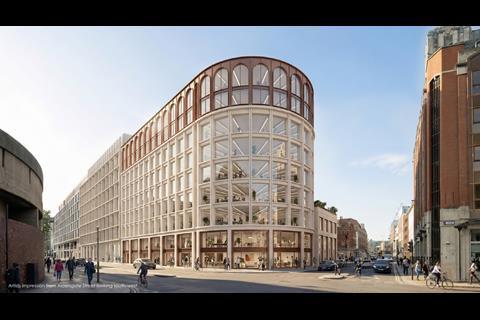
For developers and institutional owners, Aldersgate shows how central business district land strategy is changing. The question is no longer simply how much floor area can be added. It is how much value can be unlocked while keeping planning exposure, construction disruption, tenant downtime, and embodied carbon within acceptable limits. Retaining the primary structure shortens the political argument and can improve the feasibility case, especially in dense urban environments where logistics, heritage context, and public realm sensitivity all constrain delivery.
The City of London is also operating in a competitive office environment. Demand is concentrating in buildings that can meet higher occupier expectations around energy performance, terraces, wellness, flexibility, and identity. Mid-2000s assets are now entering a critical repositioning window. Many are structurally sound but commercially dated. Owners that move early can preserve relevance before leasing weakness forces deeper discounting or larger capital interventions.
The next generation of core office development will be won by owners who can add intensity without resetting the whole site.
The project team also tells its own story. Turner & Townsend, DP9, Buro Happold, Arup, Sweco, Gardiner & Theobald, and Gustafson Porter + Bowman point to a scheme where planning, cost certainty, structural capacity, facade performance, MEP strategy, and landscape are all central to value creation. This is not cosmetic refurbishment. It is a technical repositioning of an income-producing urban asset.

The wider JP Morgan pipeline reinforces the pattern. Building also reports that bids have been returned for the firm’s £500 million One Spitalfields redevelopment, where Foster & Partners’ plans would retain and extend the existing building to deliver 870,000 square feet of office and retail space, plus 70,000 square feet of new terracing. In both cases, the development thesis is clear: strong locations justify major reinvestment, but the route to that reinvestment is increasingly adaptive, not purely replacement-led.
For city planners, these schemes raise an important policy question. If London wants to remain globally competitive while meeting climate obligations, it needs approval pathways that reward high-quality retrofit, intelligent intensification, and public realm upgrades. For developers and investors, the message is equally direct. The feasibility of central sites will depend less on simple acquisition and rebuild assumptions, and more on structural audits, carbon accounting, lease event timing, energy upgrades, and the ability to convert existing buildings into next-cycle assets without losing the locational advantage they already hold.
Source: Building