



Environmental risk has moved from the margins of real estate investing to the center of serious decision making. For investors focused on preserving capital and improving long-term returns, this shift is not theoretical. Environmental conditions can influence what you pay for a property, whether a lender is willing to finance it, how insurers price coverage, what tenants are prepared to accept, and how attractive the asset looks when it is time to sell. In practical terms, environmental risk is now a material underwriting variable, not a side issue reserved for specialists.
Table Of Content
- Why Environmental Risk Matters More Than Many Investors Realize
- Contaminated Land and Legacy Uses: The Hidden Risk Beneath the Deal
- What Investors Should Review on Potentially Contaminated Sites
- Flood Risk: The Hazard Becoming More Visible to Markets
- Practical Flood Due Diligence Questions
- Wildfire and Smoke Exposure: Risk Beyond the Burn Zone
- Erosion, Coastal Hazards, and Sea-Level Rise
- Climate-Related Regulation and Disclosure Expectations
- How Environmental Risk Affects Property Value and Investment Strategy
- Common Ways Environmental Risk Changes Investment Performance
- Environmental Due Diligence Should Be Part of Underwriting, Not an Afterthought
- Mitigation Strategies That Protect Value
- Misconceptions That Can Lead to Expensive Mistakes
- A Practical Investor Framework for Environmental Risk Management
- Final Thoughts
That matters for both novice and seasoned investors. Newer buyers often assume environmental exposure only applies to former factories, gas stations, or large industrial parcels. Experienced investors know the reality is wider. Residential, retail, office, industrial, mixed-use, and land development projects can all face contamination concerns, flood exposure, wildfire risk, erosion, coastal hazards, and climate-related restrictions that alter the economics of a deal. The effect may be immediate through remediation costs or delayed through higher insurance premiums, reduced liquidity, and weaker exit pricing.
In Canada, the importance of this issue is reinforced by the scale of known contamination and the growing visibility of climate-driven hazards. Canada reports approximately 24,000 identified federal contaminated sites, with more than 19,000 already closed after historical review, testing, cleanup, or long-term monitoring. That statistic matters because it shows how common legacy land-use issues can be in a market where prior site history is not always obvious from current appearance. A clean-looking parcel can still carry a complicated environmental profile beneath the surface.
The proactive investor does not wait for environmental risk to appear during legal closing or after acquisition. The disciplined approach is to identify, price, test, negotiate, mitigate, and monitor these risks through the full life cycle of the investment. This article explains the main environmental risks that matter in real estate, how they affect value and strategy, and what practical steps investors can take to protect returns without losing sight of opportunity.

Why Environmental Risk Matters More Than Many Investors Realize
Every real estate investment is built on assumptions about income, cost, financing, demand, and future marketability. Environmental risk can disrupt each of those assumptions. A site with suspected contamination may require a lower purchase price, costly investigation, or post-closing remediation. A building in a flood-prone area may face higher insurance costs, more frequent disruptions, and reduced buyer appetite over time. A property near wildfire-prone land may remain structurally intact but still suffer from smoke exposure, evacuation-related vacancy, and business interruption.
This is why environmental risk should be viewed through three lenses at once. The first is physical hazard, which includes the direct impact of contamination, flooding, fire, erosion, or air-quality events. The second is legal liability, which can involve cleanup responsibility, land-use restrictions, disclosure obligations, or future claims. The third is financial impairment, which affects debt terms, insurance availability, operating performance, capital expenditure requirements, and eventual resale value. The strongest investors underwrite all three.
There is also a timing issue. Environmental risk often compounds over a hold period. An asset that appears manageable at acquisition can become more challenging later if insurance tightens, flood maps are updated, wildfire conditions worsen, or redevelopment plans run into institutional controls attached to prior remediation. The longer the hold period, the more important it becomes to evaluate not only current conditions but also plausible future scenarios.
Key investor takeaway: Environmental risk is not just about avoiding disaster. It is about protecting liquidity, preserving financing flexibility, and preventing a quality asset from becoming operationally expensive or strategically constrained.
Contaminated Land and Legacy Uses: The Hidden Risk Beneath the Deal
Contamination remains one of the most important environmental risks in real estate because it is often invisible until proper diligence begins. Many sites carry legacy issues tied to historical uses such as fuel storage, dry cleaning, manufacturing, transport depots, metal works, agricultural chemicals, waste disposal, or fill of unknown origin. Even residential and mixed-use properties can be affected if they sit on or beside land with an industrial past. Investors who assume current appearance tells the full story are exposed to expensive surprises.
Canada’s contaminated-sites framework shows how widespread the issue can be. The federal government reports roughly 24,000 identified federal contaminated sites, and more than 19,000 have already been closed after review, testing, cleanup, or long-term monitoring. It has also committed substantial funding to contaminated-sites management through the Federal Contaminated Sites Action Plan, with $7.18 billion in approved funding since 2005, including $1.48 billion in Budget 2024 for Phase V covering 2025 to 2030. For private investors, the lesson is clear. Legacy contamination is common enough that it deserves structured diligence on a routine basis.
The first line of defense is usually a Phase I Environmental Site Assessment. This assessment reviews historical records, title documents, aerial photographs, regulatory databases, surrounding land uses, and site observations to identify red flags. A Phase I does not involve invasive sampling, but it establishes whether there is reason to suspect contamination. If the findings indicate concern, a Phase II Environmental Site Assessment may follow, using soil, groundwater, or vapour testing to confirm conditions and assess severity.
These assessments are not just technical exercises. They directly affect negotiation strategy and investment structure. A property with manageable contamination may still be a strong investment if the investor understands the cleanup cost, timetable, future-use limits, and allocation of liability. A property with uncertain or severe contamination may require a lower price, seller indemnities, escrow holdbacks, environmental insurance, or a complete decision to walk away. The point is not to avoid every imperfect site. It is to avoid buying risk blindly.
Brownfield redevelopment illustrates this balance well. Infill and urban revitalization opportunities often involve sites with historic industrial or commercial uses. These can be attractive because they occupy strategic locations and may trade at discounts relative to clean sites. However, investors need to understand that remediation under risk-based cleanup programs does not always mean every trace of contamination is removed. EPA guidance explains that many brownfields are remediated using approaches that leave residual contamination in place while relying on engineering controls, institutional controls, and land-use restrictions. In investment terms, that can affect what can be built, how the site must be managed, and how future buyers or lenders view the asset.
What Investors Should Review on Potentially Contaminated Sites
When contamination is possible, investors should approach diligence with discipline and specificity. A strong review goes beyond ordering a report and filing it away. It should answer practical questions tied to underwriting, use, timing, and exit strategy. The most useful framework includes the following:
- Historical land use: Determine what the site and surrounding properties were used for over time, including industrial, fuel, railway, agricultural, or waste-related activities.
- Regulatory status: Confirm whether the property has open files, compliance orders, remediation requirements, or closure documentation from prior programs.
- Scope of remediation: Understand whether contamination was removed, capped, contained, or left in place under a risk-managed plan.
- Ongoing obligations: Review any monitoring requirements, vapour barriers, groundwater controls, or use restrictions that survive closing.
- Impact on redevelopment: Assess whether future density, excavation, underground parking, or change of use could trigger additional cost or regulatory review.
Investors who understand these details are in a far stronger position to decide whether contamination is a manageable cost, a negotiation point, or a deal breaker.
Flood Risk: The Hazard Becoming More Visible to Markets
Flooding has become one of the most visible climate-related risks in real estate because it can affect both physical damage and long-term insurability. Water exposure can damage structures, mechanical systems, finishes, parking, landscaping, and tenant operations. It can also trigger mold, service interruptions, business downtime, and expensive resilience retrofits. Even when a building does not experience catastrophic loss, repeated flooding or near misses can weaken demand and increase operating risk.
What is changing now is not only the hazard itself but the quality and reach of data. Canada has expanded flood-hazard mapping and public risk-access tools through adaptation initiatives. The federal government announced $164.2 million over five years in 2023 to advance flood-hazard mapping and related information access, and it later launched Canada’s Flood Risk Finder in 2026 to improve flood-risk awareness for homeowners, renters, and businesses. For investors, better mapping means flood exposure is becoming more measurable, more transparent, and more likely to be reflected in pricing and underwriting.
That transparency can reshape deals. A property once considered acceptable because it was not obviously near water may reveal surface-water, riverine, or drainage-related exposure in updated mapping. Lenders and insurers may react before the broader market does, which means acquisition assumptions can change quickly. A flood-prone property may require more equity, carry higher premiums, or need resilience capital that compresses projected returns.
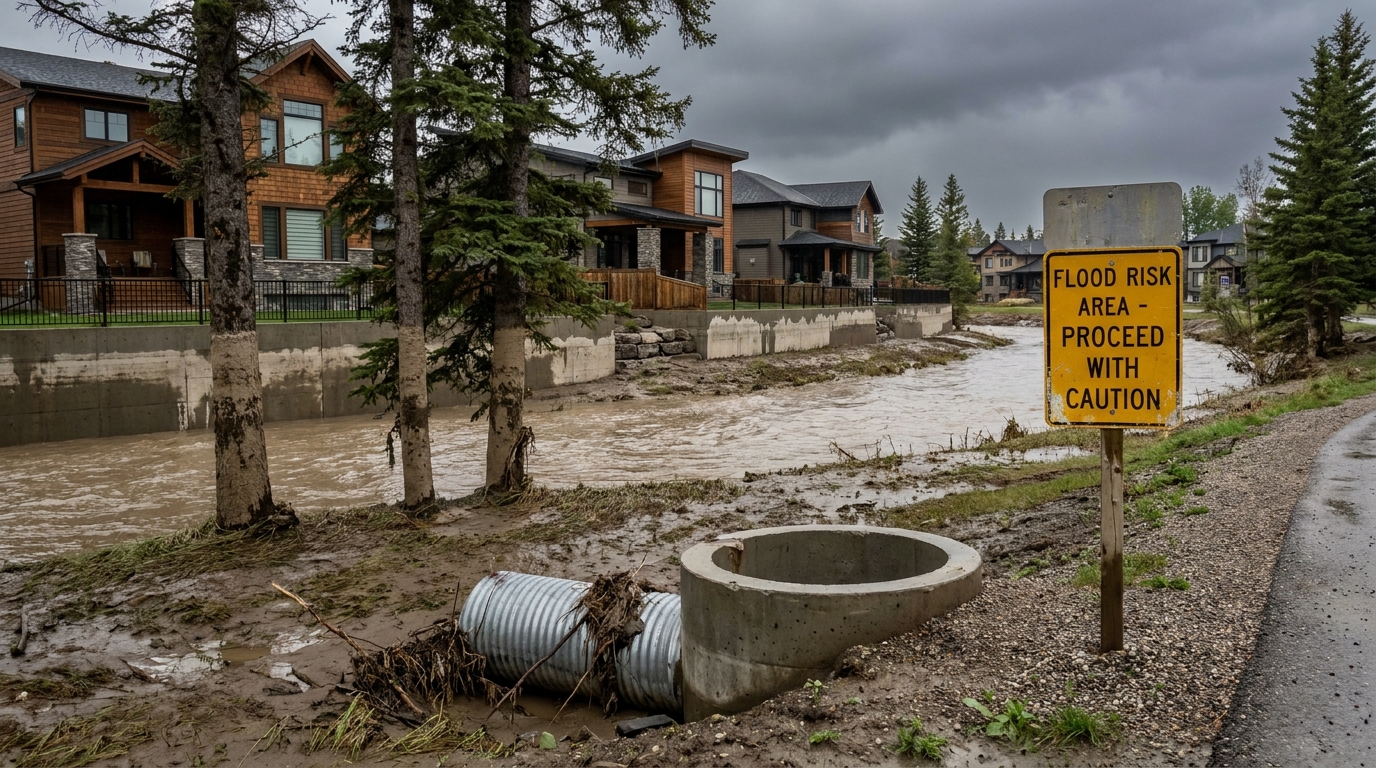
One common misconception is that being outside a currently mapped floodplain means a property is low risk for the entire hold period. That assumption is increasingly unreliable. Flood exposure can change as rainfall patterns intensify, upstream development alters runoff, drainage systems age, and mapping methods improve. Investors should examine not only current designation but also topography, basement vulnerability, stormwater infrastructure, prior claims, and neighborhood flooding history.
Flood risk also extends beyond direct repair cost. It can influence rent growth, tenant retention, lender appetite, and resale liquidity. In some cases, a building may remain fundamentally sound but still lose competitiveness because tenants perceive disruption risk or because buyers anticipate future adaptation costs. This is why flood risk analysis should be integrated into capex planning and hold-period strategy, not handled solely as an insurance matter.
Practical Flood Due Diligence Questions
When underwriting flood exposure, investors should seek answers that connect directly to operational resilience and future value. Useful questions include whether the property has experienced prior flood events, whether critical systems are below grade, whether drainage and grading are adequate, whether access roads become vulnerable during heavy rainfall, and whether local infrastructure improvements are planned. The objective is not just to identify whether flooding is possible. It is to estimate how expensive and frequent the disruption could become.
Wildfire and Smoke Exposure: Risk Beyond the Burn Zone
Wildfire risk is often misunderstood because many investors focus only on whether flames could physically reach a property. That is a narrow view. In many markets, especially exurban and forest-adjacent areas, wildfire exposure includes direct burn risk, smoke-related disruption, evacuation orders, power interruptions, reduced tourism, construction delays, and longer-term insurance repricing. For income-producing real estate, these secondary effects can be just as damaging to cash flow as direct structural damage.
Natural Resources Canada reported 5,844 fires in 2024, below the 25-year average of 6,554, while noting that wildfire impacts on property, evacuations, air quality, and fire-management costs have increased in recent years. That distinction matters. Even if annual fire counts fluctuate, investor risk does not disappear. What matters is how fire behavior, smoke spread, and community disruption affect marketability, operating continuity, and tenant confidence.
Assets in the wildland-urban interface deserve particular attention. Residential communities near forests, resort properties, logistics facilities at the edge of developed areas, and low-density subdivisions can face elevated exposure. A property may not burn, yet still suffer from repeated smoke events that degrade air quality, reduce short-term occupancy, increase maintenance, and create liability concerns for vulnerable occupants. Commercial tenants may also reassess location strategy if seasonal disruption becomes more frequent.
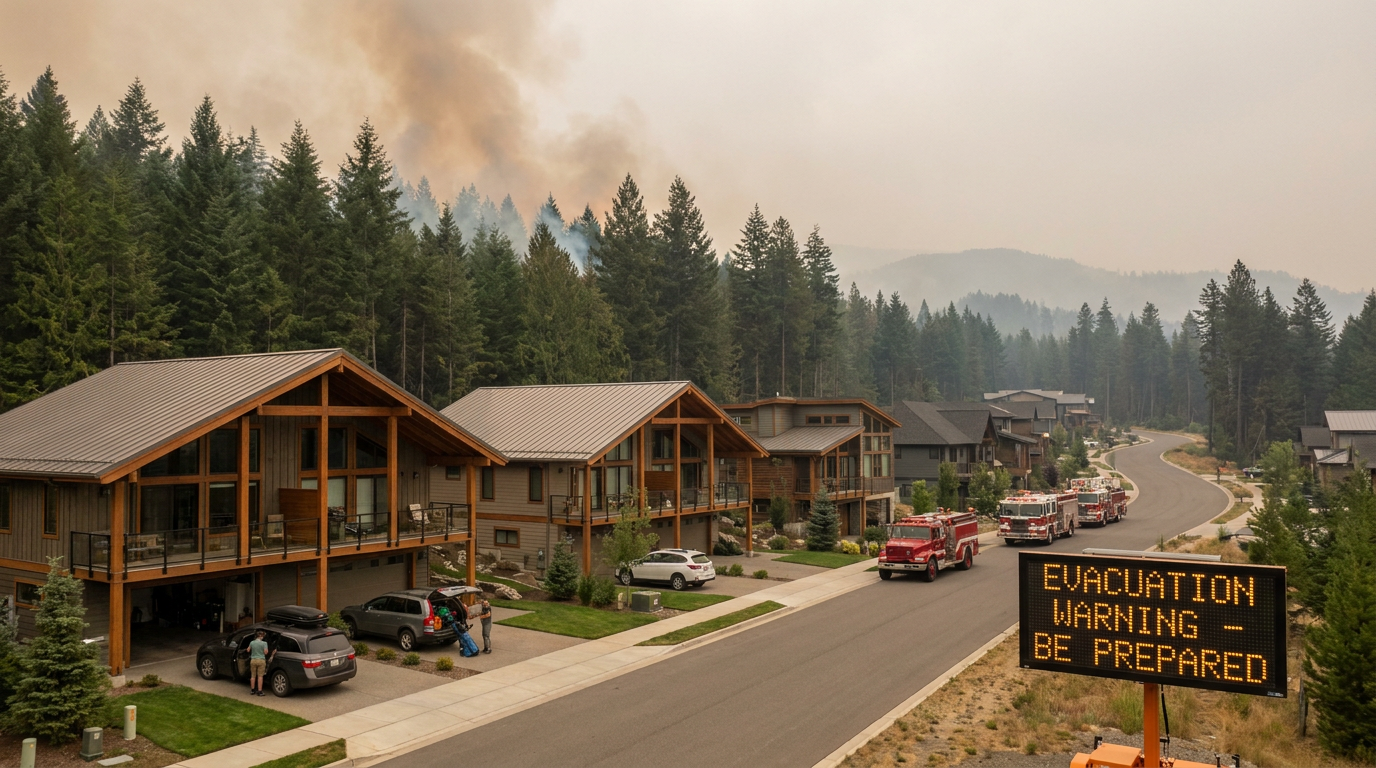
Investors should also consider insurance market behavior. Wildfire-prone zones can face rising premiums, stricter terms, larger deductibles, or narrower coverage availability. That has direct implications for debt-service coverage and return modeling. A property that looks attractive based on conventional income metrics may become less compelling if insurance costs rise materially over the hold period or if the asset becomes harder to refinance.
Mitigation still matters. Defensible space, fire-resistant materials, upgraded ventilation and filtration, backup power, emergency access planning, and business continuity measures can improve resilience. But the right approach begins with accurate exposure analysis. Investors should review vegetation adjacency, topography, local fire history, access routes, water supply, municipal response capacity, and smoke frequency. These are no longer peripheral data points in many Canadian and North American markets.
Erosion, Coastal Hazards, and Sea-Level Rise
For coastal and shoreline properties, risk extends beyond simple floodplain designation. Erosion, chronic inundation, storm surge, and future sea-level rise can all affect land stability, building condition, redevelopment rights, and long-term insurability. Waterfront assets often command pricing premiums because of lifestyle, view corridors, or tourism value. Those same qualities can mask longer-term vulnerability if investors focus on current demand and ignore physical change over the intended hold period.
NOAA’s sea-level-rise tools are designed to help communities visualize coastal flooding hazards and identify areas at risk. While these tools are often discussed in a public planning context, the logic applies directly to investors. Real estate valuation depends on what a property can earn, what it will cost to hold, and how future buyers perceive risk. If coastal exposure is likely to increase over time, today’s premium pricing may overstate long-term value unless adaptation costs and use constraints are properly reflected in the model.
Erosion risk can be especially relevant for properties along bluffs, shorelines, riverbanks, and unstable coastal edges. These issues may not trigger immediate damage, but they can reduce usable land, alter setbacks, complicate expansion, and increase maintenance requirements. Lenders and insurers often look closely at these conditions because they affect collateral durability. Investors should do the same.
For development and redevelopment projects, coastal and erosion hazards can also alter entitlement assumptions. A parcel may support fewer units, require different construction methods, or face more complex permitting because of habitat, shoreline, or adaptation considerations. In a premium market, even a small reduction in buildable potential can materially change land value. Environmental risk therefore has a direct line to residual-land analysis and development margin.
Climate-Related Regulation and Disclosure Expectations
Environmental risk in real estate is no longer confined to contamination law or municipal planning review. It is increasingly part of broader financial-risk management. Recent Canadian policy direction reflects this shift. The Government of Canada’s 2025 climate-related financial risk management report indicates that federal organizations responsible for property and infrastructure are taking measures to improve resilience, while the National Adaptation Strategy and flood-mapping programs point to continued public investment in adaptation and risk visibility.
For investors, the practical implication is that climate resilience is becoming a balance-sheet issue. Lenders, insurers, institutional partners, and public authorities are progressively more interested in whether assets can withstand climate-related stress over time. That does not mean every transaction will face a formal climate stress test today. It does mean expectations are moving. Properties with weak resilience profiles may encounter more scrutiny, lower leverage, or reduced buyer depth in future years.
This trend also changes the way investors should think about disclosure and governance. Environmental risk should be documented in investment committee materials, acquisition memos, reserve planning, and asset-management reviews. It should sit alongside lease risk, debt risk, and market risk because it can directly influence all three. Investors who build this discipline now are better prepared for a market in which resilience is increasingly priced rather than merely discussed.
How Environmental Risk Affects Property Value and Investment Strategy
Environmental risk influences value in several ways, and the effect is not always obvious in the first underwriting pass. In some cases, the impact is immediate and quantifiable, such as remediation cost, engineering upgrades, or higher insurance expense. In other cases, it is indirect, appearing through slower lease-up, tenant reluctance, refinancing difficulty, lower terminal value, or reduced strategic flexibility. Sophisticated investors avoid the mistake of looking only for direct repair costs.
Consider a contaminated infill site in a strong urban location. If remediation is well understood, land-use restrictions are acceptable, and the discount is attractive, the property may still offer compelling upside. By contrast, a pristine asset in a flood-sensitive area may look stronger on first review but become less attractive if resilience capex, insurance repricing, and future tenant concerns are likely to rise faster than rent. Risk management is therefore not simply about saying yes or no to hazard. It is about determining whether the price, structure, and strategy appropriately reflect reality.
Environmental risk also shapes hold-period decisions. Some assets justify short-term stabilization and disposition if uncertainty is likely to increase. Others support long-term ownership if resilience upgrades can protect income and improve market positioning. The right strategy depends on the relationship between hazard exposure, mitigation cost, tenant demand, financing flexibility, and expected liquidity at exit.
Common Ways Environmental Risk Changes Investment Performance
- Acquisition pricing: Buyers may require discounts to cover known or suspected environmental issues.
- Financing terms: Lenders may lower leverage, add conditions, or decline exposure in higher-risk scenarios.
- Insurance cost: Premiums, deductibles, and coverage scope can change materially based on hazard profile.
- Operating expenses: Monitoring, remediation systems, resilience upgrades, filtration, drainage, and maintenance can raise annual costs.
- Redevelopment potential: Controls, setbacks, restrictions, or physical exposure can reduce future optionality.
- Exit liquidity: Buyers may discount or avoid assets that appear vulnerable or operationally constrained.
Environmental Due Diligence Should Be Part of Underwriting, Not an Afterthought
The best investors treat environmental review as a core workstream during acquisition. It should begin early enough to influence pricing, deal structure, and lender conversations before significant time and cost are committed. Waiting until late-stage closing to uncover contamination, flood complexity, or wildfire concerns weakens negotiation leverage and increases the risk of poor decisions under time pressure.
A disciplined environmental diligence process is usually layered. It starts with basic screening of location, historical use, flood exposure, wildfire interface conditions, and shoreline or erosion sensitivity. It then progresses to more formal reports where warranted, such as Phase I and Phase II assessments, specialized flood and drainage review, coastal engineering input, or wildfire resilience analysis. The depth should match the asset type, transaction size, and hold strategy.
Contract structure is also important. Investors should consider representations and warranties regarding environmental condition, indemnities for known issues, escrow holdbacks where obligations remain uncertain, and clear rights to terminate or reprice if diligence reveals material problems. Insurance may play a role in selected transactions, but it is not a substitute for understanding the risk. Good paper cannot rescue weak underwriting.
Smart underwriting principle: Environmental risk should be priced, tested, mitigated, and monitored over the life of the asset. A one-time report at acquisition is not enough when conditions, standards, and market expectations continue to evolve.
Mitigation Strategies That Protect Value
Mitigation is most effective when it is tied directly to a property’s risk profile and investment plan. For contamination, that may mean remediation, vapour barriers, groundwater monitoring, or engineering controls paired with legal review of land-use limitations. For flood-prone properties, it may include drainage improvements, elevated mechanical systems, backflow prevention, site grading, flood barriers, and emergency response planning. For wildfire-sensitive assets, mitigation may involve defensible landscaping, fire-resistant materials, air filtration upgrades, roof and vent protection, and continuity planning for tenants and staff.
The financial side of mitigation matters just as much as the technical side. Investors should budget resilience capex realistically and compare it against avoided loss, insurance savings, occupancy stability, and improved liquidity at exit. In many cases, mitigation should be viewed as value protection rather than optional spending. A resilient asset may command stronger tenant confidence and broader buyer interest, especially in markets where hazard awareness is rising.
Monitoring is equally important. Some environmental risks are dynamic. Flood maps change, wildfire seasons intensify, and regulatory expectations evolve. Remediated sites may require ongoing controls or periodic reporting. Owners should establish a review schedule that revisits environmental assumptions during refinancing, major lease events, redevelopment planning, and annual asset strategy updates.
Misconceptions That Can Lead to Expensive Mistakes
Several misconceptions continue to weaken investment decisions. The first is the belief that environmental risk only matters for industrial property. In reality, contamination can migrate, fill can be imported, and climate-related hazards affect every property category. The second is the assumption that a remediated site is automatically risk-free. Many cleanups rely on controls, restrictions, and ongoing assumptions about future use. Those conditions can materially affect redevelopment value.
A third misconception is that flood risk begins and ends with today’s mapped floodplain. As data improves and weather patterns shift, previously overlooked areas may become more exposed. A fourth is that environmental risk is purely a legal compliance issue. It is also a financing, insurance, leasing, operations, and valuation issue. Finally, many investors still treat wildfire as a direct-burn problem only, when smoke, evacuation disruption, and business interruption may be the more frequent source of loss.
Correcting these misconceptions does not require fear-based investing. It requires disciplined investing. The goal is not to reject every asset with environmental complexity. The goal is to understand the risk with enough precision to structure the deal intelligently and manage the asset profitably.
A Practical Investor Framework for Environmental Risk Management
For investors who want a repeatable process, the most effective framework is simple and strategic. Start by screening every opportunity for contamination history, flood exposure, wildfire interface risk, and coastal or erosion sensitivity. If concerns appear, escalate quickly into formal diligence. Translate findings into pricing, capex, legal protections, insurance review, and hold-period planning. Then revisit those assumptions periodically after closing.
This process works because it aligns environmental review with investment logic rather than treating it as a separate compliance exercise. It also improves decision quality across the portfolio. A buyer who consistently evaluates environmental risk is more likely to avoid stranded assets, negotiate from strength, and identify properties where complexity creates opportunity instead of hidden downside.
In practical terms, investors should build environmental checkpoints into acquisition and asset management using a structure like the following:
- Screen: Review site history, maps, known hazards, and market-specific environmental concerns before underwriting assumptions are finalized.
- Investigate: Commission appropriate technical reports where red flags exist, including Phase I, Phase II, flood, wildfire, or coastal assessments.
- Quantify: Convert findings into cost, timing, financing impact, insurance implications, and potential effect on exit value.
- Negotiate: Use the information to adjust price, seek indemnities, establish escrows, or revise transaction terms.
- Mitigate: Plan targeted remediation, resilience upgrades, controls, or operating changes that protect income and value.
- Monitor: Reassess environmental assumptions during ownership as conditions, regulation, and market expectations evolve.
Final Thoughts
Environmental risk has become a defining part of modern real estate investment because it affects far more than compliance. It can alter acquisition cost, financing terms, insurability, operating resilience, tenant demand, redevelopment flexibility, and ultimate exit value. In Canada and across North America, that reality is becoming clearer as contamination programs, flood mapping, adaptation investment, and climate-related financial risk frameworks continue to develop.
The disciplined investor responds with structure, not hesitation. Environmental due diligence belongs in underwriting from the start. Contamination should be investigated through proper assessments. Flood and wildfire exposure should be measured with the same seriousness as rent comps and debt sizing. Coastal and erosion hazards should be considered across the expected hold period, not just at acquisition. Legal protections, insurance review, resilience capex, and ongoing monitoring should all form part of the investment plan.
For novice investors, this approach reduces the chance of expensive surprises. For seasoned investors, it sharpens pricing, strengthens negotiation, and supports better portfolio construction. The broader point is simple. Environmental risk is now a core determinant of asset quality. The investors who understand it early, price it accurately, and manage it actively will be in the best position to protect capital and outperform over time.


No Comment! Be the first one.