


Smart building data has become one of the most useful tools in modern property operations, yet it is still often misunderstood. Many people hear the phrase and imagine a futuristic control room or a building that watches every move. In reality, smart building data is much more practical than that. It is the stream of information generated by systems already found in many residential, commercial, institutional, and mixed-use properties, including HVAC equipment, lighting controls, access systems, utility meters, indoor air quality monitors, elevators, and occupancy sensors.
Table Of Content
- What Is Smart Building Data?
- Why Better Data Changes Building Performance
- Energy Efficiency Is the Most Immediate Use Case
- Comfort Is Not a Luxury Metric
- Safety and Reliability Improve When Buildings Can See Problems Earlier
- How Property Managers Can Use Smart Building Data in Daily Operations
- A Simple Operational Framework
- How Residents and Occupants Benefit Directly
- Benchmarking Turns Raw Data Into Context
- The Real Challenges: Privacy, Governance, Interoperability, and Data Quality
- Common Misconceptions About Smart Building Data
- What the Future Looks Like
- Final Takeaway
What makes this data valuable is not the fact that it exists, but the fact that it can be used to make better decisions. A building that knows when spaces are occupied can reduce wasted heating and cooling in empty rooms. A manager who can see a slow ventilation failure before tenants start complaining can resolve an issue faster. A resident who lives in a building with better air quality monitoring, steadier temperatures, and fewer equipment outages experiences a property that simply feels easier to live in.
For property managers, owners, and operators, smart building data is becoming less of a technology upgrade and more of an operating strategy. North American research consistently shows that building optimization depends on combining data streams such as temperature, humidity, occupancy, air quality, and irradiance. Together, these signals support forecasting, fault detection, energy model calibration, and control optimization. That combination is what turns raw building readings into a more adaptive and efficient property.
For residents and office occupants, the benefits are equally tangible. Smart building data can support better ventilation, more stable comfort, fewer service disruptions, and a quicker response to safety issues. When implemented well, it creates spaces that are healthier, quieter, and more responsive to actual use patterns. The result is not just a smarter building on paper, but a better day-to-day experience inside it.
This guide explains what smart building data is, where it comes from, why it matters, and how it can be used in practical ways. It also addresses the concerns that deserve serious attention, including privacy, interoperability, governance, and data quality. The goal is simple: to show how better building data can lead to better living and working environments for everyone involved.
What Is Smart Building Data?
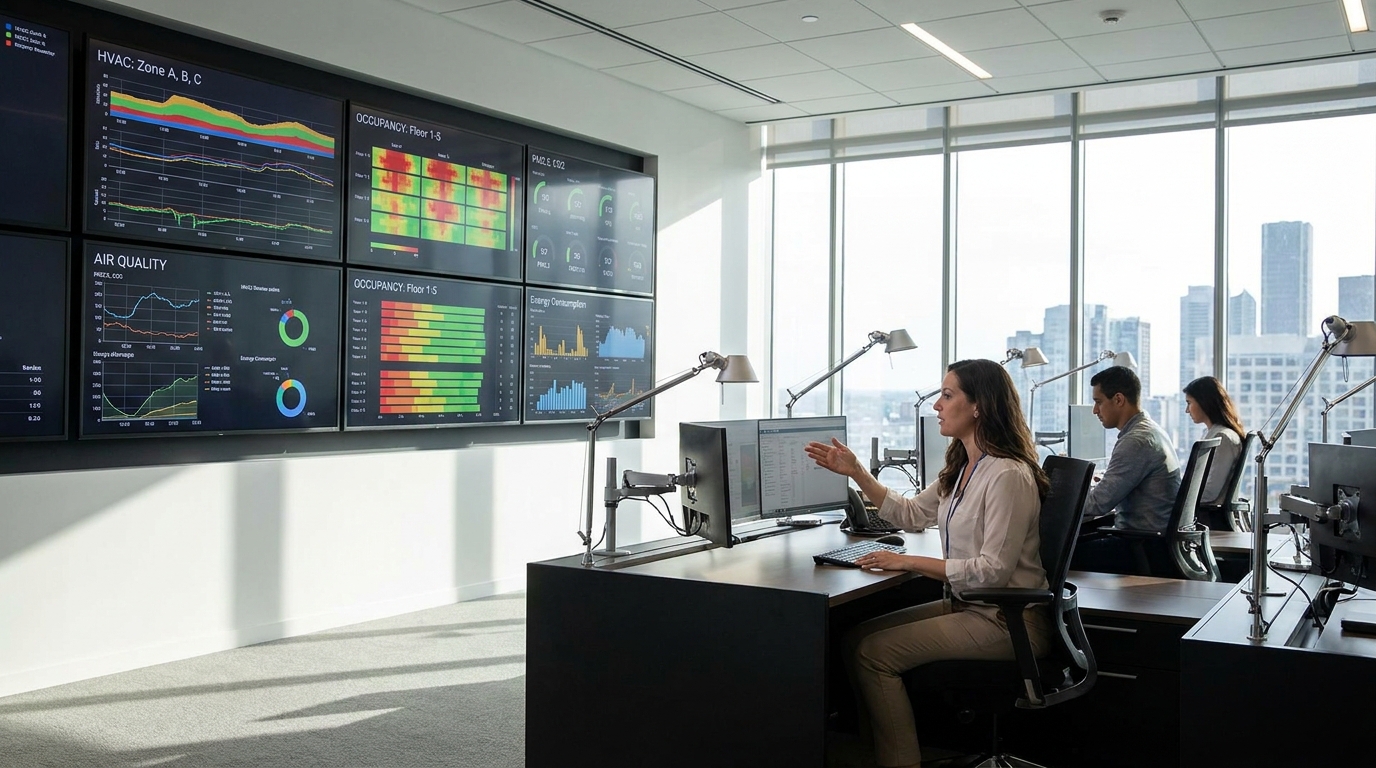
Smart building data refers to the operational information generated by connected systems across a property. This can include energy meters that track electricity, gas, and water use, HVAC sensors that monitor temperature and humidity, occupancy systems that estimate how many people are in a space, air quality devices that measure CO2 or particulates, and access systems that log when doors open or close. Some buildings also collect data from elevators, lighting systems, solar panels, battery storage, shading devices, and maintenance software.
The important point is that these are not isolated pieces of information. In traditional building operations, systems often work in silos. The HVAC system may have one dashboard, lighting another, and utility billing yet another. Smart building data becomes more useful when those streams are connected and interpreted together. A rise in energy use means far more when viewed alongside occupancy patterns, weather changes, and equipment run times.
This is one reason interoperability matters so much. ASHRAE’s BACnet standard has become the dominant open protocol for building automation and control data exchange, helping systems from different vendors communicate more effectively. In practical terms, that means a property manager has a better chance of combining HVAC, security, and lighting information into a single operational picture rather than managing each subsystem separately. A unified view improves decision making because the building can be understood as one environment instead of several disconnected machines.
There is also a misconception that smart building data is only relevant in major office towers. In fact, it is increasingly useful in multifamily residential buildings, schools, healthcare facilities, retail spaces, warehouses, and mixed-use developments. A mid-sized apartment building can benefit from leak detection, central plant analytics, and common-area air quality monitoring. A condominium can use utility benchmarking and occupancy-aware ventilation schedules. A workplace can align comfort settings more precisely with real attendance patterns.
In other words, smart building data is less about size and more about operational intent. If a property team wants to reduce waste, improve comfort, strengthen reliability, and make decisions with more confidence, data becomes essential. The building does not need to be futuristic. It just needs to be measurable, connected, and managed with purpose.
Why Better Data Changes Building Performance
Buildings are complicated environments because they must balance several goals at once. They need to remain comfortable, efficient, safe, compliant, and financially sustainable. These goals can conflict when operators do not have enough information. For example, a building may overcool common areas to avoid complaints, but that increases utility costs and may actually reduce comfort. Another property may cut ventilation to save energy without realizing indoor air quality is deteriorating during peak occupancy periods.
Better data helps resolve these tradeoffs because it replaces assumptions with evidence. If managers know when spaces are occupied, what temperatures are drifting, how indoor air quality changes over the day, and where energy use spikes occur, they can tune systems more precisely. This is what building optimization research points to repeatedly. Useful optimization does not depend on one sensor or one device. It depends on combining multiple signals into a more complete model of what the building is doing.
That model supports several practical functions. It enables forecasting, so managers can anticipate demand rather than simply react to it. It supports fault detection, so equipment issues can be identified before they become full failures. It improves calibration, meaning energy models better reflect real-world building behavior. And it strengthens control optimization, helping systems respond to actual conditions rather than static schedules.
For occupants, these improvements are often invisible in the best sense. The room is comfortable when they arrive. Ventilation feels fresh without being wasteful. Elevators and common systems fail less often. The building responds more intelligently to heat waves, cold snaps, and changing occupancy. That is the quiet value of data-driven operations: the building works better without demanding attention.
Energy Efficiency Is the Most Immediate Use Case
Among all the benefits of smart building data, energy reduction is usually the easiest to quantify and the fastest to understand. Buildings are major energy users across Canada and the United States, and operating costs have become more sensitive to utility pricing, peak demand charges, and carbon-related pressures. This makes energy performance a technical issue and a financial one. Smart building data helps address both.
One of the clearest examples is occupancy-aware control. ARPA-E’s SENSOR program has explicitly targeted HVAC savings through occupancy sensing, occupant counting, and CO2-based ventilation control, with the goal of reducing HVAC energy use by 30 percent in residential and commercial buildings. That target matters because HVAC is often one of the largest energy loads in a property. If heating, cooling, and ventilation can respond more accurately to real use rather than default schedules, wasted energy can fall sharply.
Consider a meeting room, fitness area, or shared amenity space that sits empty for long periods and then becomes fully occupied in short bursts. A static schedule may condition that room heavily all day. An occupancy-aware system can scale heating, cooling, and ventilation to actual demand. The result is less waste when the room is empty and better air delivery when it is full. This improves efficiency and often comfort at the same time.
Another major opportunity lies in peak demand management. Connected devices and richer building data can support grid-interactive efficient buildings, which are designed to adjust loads in response to grid conditions, utility pricing, or renewable energy availability. In practice, this can mean pre-cooling a building before a peak demand event, shifting some loads to lower-cost hours, or coordinating with on-site solar and battery systems. For owners, this can reduce costs. For the grid, it adds flexibility at a time when electrification and decarbonization are intensifying pressure on infrastructure.
Energy efficiency becomes even more powerful when paired with benchmarking. In Canada, Natural Resources Canada reports that ENERGY STAR Portfolio Manager is used to track the energy use of 30,500 buildings. That scale matters because benchmarking turns raw utility and meter data into relative performance insight. A property manager can see not only how a building is performing internally, but also how it compares with similar assets. That helps identify underperformance, prioritize retrofits, and communicate progress to owners, lenders, residents, and regulators.
Without this layer of interpretation, meter data can remain passive. With benchmarking, it becomes actionable. A building that looks acceptable in isolation may be weak against its peers. Another building may show strong year-over-year improvement that supports renovation planning or investor reporting. Smart building data is most useful when it moves from collection to comparison, then from comparison to decision.
Comfort Is Not a Luxury Metric
One of the biggest mistakes in building operations is treating comfort as secondary to efficiency. In practice, discomfort creates its own costs. It leads to complaints, work disruptions, higher turnover risk, and pressure to override systems manually. NREL research has emphasized that modern building models must account for occupant comfort, not just equipment energy use, because control decisions can otherwise save energy at the expense of livability. That point is critical. A building that performs well on paper but feels bad inside is not truly performing well.
Smart building data helps bridge this gap by giving managers a clearer picture of real indoor conditions. Temperature alone is not enough. Humidity matters. Air movement matters. CO2 levels matter. Occupancy density matters. Outdoor conditions matter. When these signals are understood together, operators can tune settings in ways that support efficiency without creating hot rooms, stale air, or uncomfortable fluctuations.
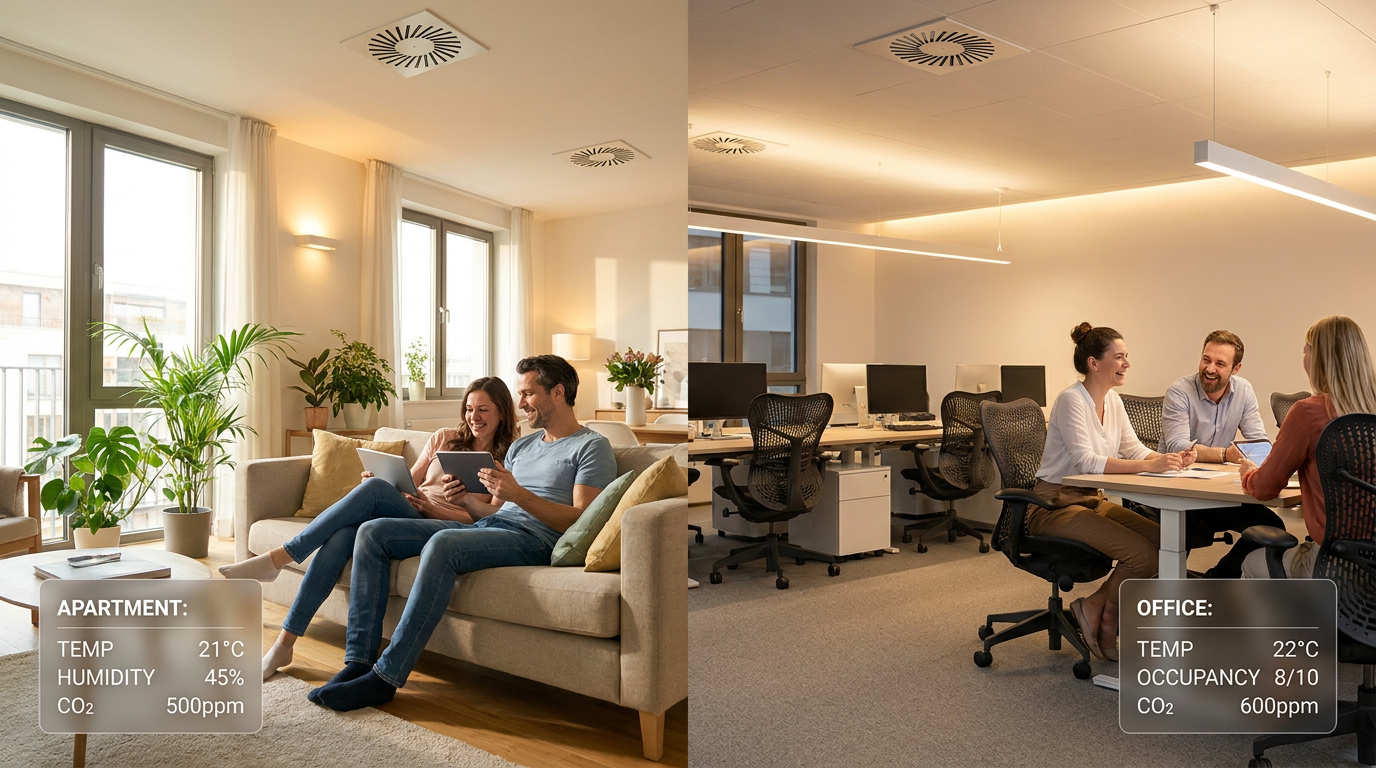
For residents, this can mean steadier temperatures from one day to the next and fewer unexplained swings across units or common spaces. For office workers, it can mean better ventilation in crowded zones and more consistent comfort in meeting areas that are used unpredictably. For schools and healthcare settings, it can contribute to spaces that feel more stable and supportive for concentration and recovery. Comfort is not a cosmetic benefit. It shapes how people perceive the quality and reliability of a building.
Occupancy-driven models are especially valuable here because they help systems respond to actual use patterns. Empty spaces do not need the same level of conditioning as active ones. But when people do occupy a room, the building needs to adapt quickly enough to maintain comfort. This is where good data and good controls work together. The best outcomes do not come from cutting service. They come from matching service more precisely to need.
Safety and Reliability Improve When Buildings Can See Problems Earlier
Safety in smart buildings is often discussed in terms of access control or security cameras, but operational safety is just as important. Continuous building data can reveal early signs of problems such as unusual temperature drift, failing ventilation, abnormal equipment cycling, pump degradation, water leaks, or irregular access activity. These signals allow teams to investigate before issues escalate into outages, damage, or health concerns.
Think about a ventilation system that begins underperforming gradually. Occupants may not notice the change immediately, or they may simply describe the space as stuffy. A manager relying on complaints will respond late. A manager watching airflow, CO2, temperature, and fan performance together can often identify a fault sooner. That can lead to faster service, fewer occupant complaints, and lower risk of secondary damage.
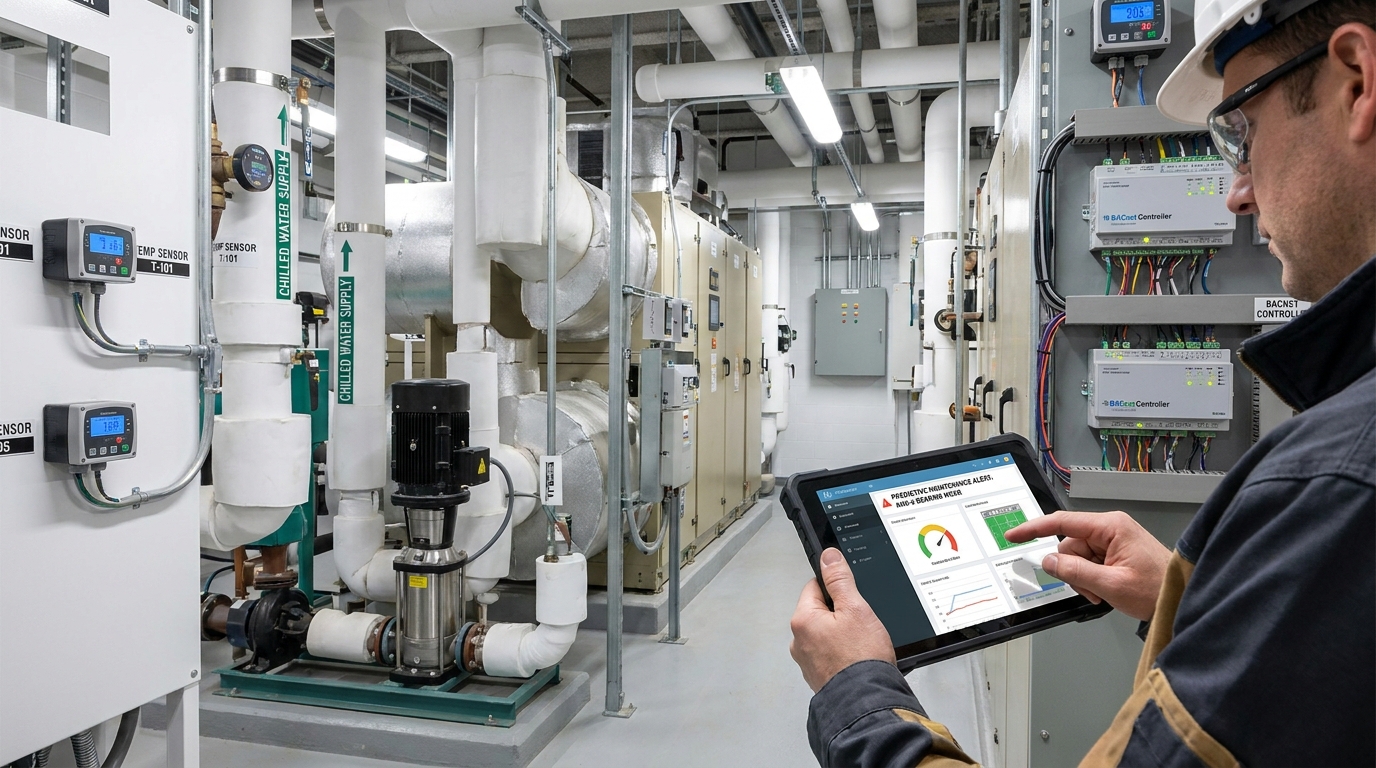
The same logic applies to heating and cooling systems. A small temperature drift in one zone may look minor at first, but when connected with compressor run time, occupancy patterns, and humidity readings, it may indicate a developing equipment fault. Smart building data allows maintenance teams to move from reactive work toward predictive maintenance. Instead of waiting for a unit to fail on the hottest day of the year, they can intervene when the data shows the system is no longer behaving normally.
Reliability also improves when systems can share information. BACnet and similar interoperability frameworks are important because they reduce the fragmentation that often hides building issues. When HVAC, lighting, access control, and metering systems operate in separate silos, a manager may miss the pattern linking them. In an integrated environment, those signals can be correlated and interpreted more intelligently. A power issue, occupancy anomaly, and ventilation alert may together tell a clearer story than any one alert could alone.
For residents and occupants, reliability is often the most appreciated benefit after comfort. People notice when elevators are out less often, when hot water service is more stable, when common areas feel consistently safe, and when maintenance requests are resolved before they become major disruptions. Data does not replace skilled facility teams, but it gives them a stronger basis for acting early and acting well.
How Property Managers Can Use Smart Building Data in Daily Operations
The most successful smart buildings are not the ones with the most sensors. They are the ones with the clearest operating routines built around data. Property managers do not need to become data scientists to benefit from this shift, but they do need a structured way to interpret and act on information. Smart building data is most effective when it supports recurring operational decisions.
One practical use is daily exception management. Instead of checking every system manually, managers can focus on exceptions such as unexplained energy spikes, unusual zone temperatures, rising indoor CO2 levels, after-hours occupancy, or equipment performance anomalies. This allows teams to prioritize the issues most likely to affect cost, comfort, or safety. It is a more efficient use of staff time because attention goes where the building is signaling actual risk.
Another use is seasonal tuning. Buildings often drift out of alignment as weather patterns change. Smart building data can show whether setpoints, schedules, and ventilation rates still make sense under new conditions. A property team can compare actual occupancy against programmed assumptions, review energy intensity by time of day, and see whether comfort complaints are tied to specific zones or hours. Small tuning adjustments can produce meaningful gains without major capital spending.
Maintenance planning also becomes sharper with data. Instead of servicing all equipment on a fixed schedule regardless of need, teams can increasingly prioritize based on run time, abnormal trends, and fault frequency. This does not eliminate preventive maintenance, but it makes it more targeted. Equipment that is working well can remain on routine schedules, while systems showing early signs of inefficiency or failure can receive faster attention.
Smart building data also strengthens communication. Property managers can show owners where energy waste is happening, explain why a retrofit should be prioritized, and demonstrate results after improvements are made. They can also communicate more clearly with residents and tenants. If a building introduces a ventilation upgrade, air quality monitoring can help explain its value. If common-area temperatures are adjusted for efficiency, data can show how comfort is being maintained rather than compromised.
At its best, smart building data gives managers a more credible and proactive role. They are not simply responding to complaints or invoices after the fact. They are actively shaping building performance with evidence.
A Simple Operational Framework
For teams that want a practical way to think about implementation, the following framework is useful:
- Measure the right signals. Focus first on high-value operational data such as energy use, temperature, humidity, occupancy, ventilation, air quality, and equipment status.
- Connect systems where possible. Use interoperable platforms and open standards so information can be viewed together rather than in isolated dashboards.
- Set performance goals. Define what success means, whether that is lower HVAC energy, fewer comfort complaints, better after-hours control, or improved maintenance response.
- Review exceptions regularly. Build routines for checking anomalies, trends, and alerts instead of relying only on manual inspections or occupant complaints.
- Act and verify. When changes are made, confirm that they improved outcomes rather than simply shifting problems elsewhere.
This framework is deliberately simple because complexity is often the enemy of adoption. A smart building strategy works best when data is connected to regular decisions, not stored indefinitely in dashboards no one uses.
How Residents and Occupants Benefit Directly
Residents and occupants are sometimes treated as passive beneficiaries of smart building upgrades, but they are central to the value equation. After all, buildings exist to serve people. The practical benefits they experience are often what determine whether a smart property strategy feels successful or intrusive.
One major benefit is improved environmental quality. Indoor air quality monitors can help operators maintain healthier ventilation levels, especially in shared spaces such as lobbies, fitness rooms, coworking areas, classrooms, and meeting rooms. If CO2 rises sharply during high occupancy, ventilation can be adjusted rather than left on a fixed schedule that may be too low or wastefully high. Occupants may not see the data directly, but they experience the result as fresher, more comfortable air.
Another benefit is consistency. In many buildings, comfort issues come from uneven control rather than complete system failure. One floor runs too warm, one corridor is overcooled, one meeting room always feels stale in the afternoon. Smart building data helps expose these patterns so that adjustments can be more precise. That creates a more predictable experience for the people using the space every day.
There is also a service quality benefit. Predictive maintenance and system monitoring can reduce the frequency of disruptive failures, whether that means HVAC outages, water issues, or persistent mechanical problems in common areas. Faster diagnosis also matters. When a resident reports a problem, the property team may already have trend data that points to the cause, reducing trial-and-error troubleshooting.
In office environments, better comfort and air quality can also support focus and productivity. People work differently in spaces that are too hot, too cold, or poorly ventilated. In residential settings, the impact shows up in well-being, satisfaction, and trust in management. Smart building data is not valuable because it is digital. It is valuable because it makes the physical environment more responsive to human needs.
Benchmarking Turns Raw Data Into Context
A common problem in property operations is having data without context. A monthly utility bill shows consumption, but not whether that level is good, bad, or typical for the building type. A submeter may show a spike, but not whether it reflects weather, occupancy, or poor system tuning. Benchmarking helps solve this by placing performance in a comparative frame.
In Canada, benchmarking infrastructure is becoming an increasingly important part of smart-building practice. ENERGY STAR Portfolio Manager, widely used through Natural Resources Canada programs, allows owners and managers to track energy use over time and compare against relevant building peers. This makes data more actionable because it helps identify outliers and reveal where improvement potential is greatest.
For example, a multifamily property may discover that its common-area energy use is unusually high relative to comparable buildings. That insight can direct attention toward corridor lighting schedules, ventilation settings, or domestic hot water systems. A commercial office building may find that despite moderate total consumption, peak demand is disproportionately expensive, suggesting an opportunity for load shifting or controls optimization. These are not abstract analytics exercises. They lead directly to operational and capital decisions.
Benchmarking also improves communication with external stakeholders. Investors increasingly want evidence of operating efficiency and resilience. Regulators may require disclosure. Residents may want to know whether efficiency claims are credible. A benchmarked performance record gives owners a clearer narrative supported by recognized frameworks rather than isolated claims.
Most importantly, benchmarking creates accountability over time. It makes it easier to answer practical questions. Did the retrofit work. Did the controls update reduce energy intensity. Did occupancy-aware ventilation improve outcomes without harming comfort. Data becomes more strategic when it can show direction, not just volume.
The Real Challenges: Privacy, Governance, Interoperability, and Data Quality
Smart building data is useful, but it is not automatically trustworthy or socially acceptable. Some of the strongest barriers to broader deployment in Canada and across North America involve data ownership, interoperability, and governance. These challenges deserve direct attention because they affect resident trust, vendor flexibility, and long-term system value.
Privacy is often the first concern, especially when occupancy sensing or Wi-Fi-based analytics are involved. These tools can improve space utilization analysis and energy management, but they can also raise legitimate questions about surveillance, consent, and data minimization. Residents and occupants need to know what is being collected, why it is being collected, whether it is aggregated or identifiable, how long it is retained, and who can access it. Without that clarity, even useful systems can face resistance.
The best implementations follow a privacy-by-design approach. That means collecting only the data needed for operational goals, anonymizing or aggregating wherever possible, limiting retention periods, controlling access carefully, and communicating policies clearly. If a building needs occupancy counts, it may not need personally identifiable movement histories. If Wi-Fi data is used for utilization patterns, governance should define the boundaries explicitly. Technical capability does not justify unlimited collection.
Interoperability is another challenge. As buildings accumulate more devices from different vendors, integration becomes harder if systems use proprietary structures or limited export options. This can trap owners in fragmented environments where data exists but cannot be combined effectively. Open protocols such as BACnet help, but successful integration still requires planning, procurement discipline, and a long-term view of architecture.
Data quality may be the most underrated issue of all. Faulty sensors, poor calibration, inconsistent naming conventions, missing timestamps, and unverified occupancy estimates can all weaken outcomes. More sensors do not automatically mean better decisions. If the data is inaccurate or poorly interpreted, managers may optimize the wrong thing. This is why governance should include not only privacy and access rules, but also quality assurance practices such as sensor validation, periodic calibration checks, metadata standards, and documented operating procedures.
Cybersecurity also belongs in this conversation. Any connected building system expands the digital attack surface. Property teams must work with IT and vendors to secure networks, segment critical systems, manage credentials carefully, and keep software current. A smart building should be efficient and responsive, but also resilient.
The strongest smart-building strategies do not start with devices. They start with a clear question: what data is worth collecting, who benefits from it, and how will it be governed responsibly?
Common Misconceptions About Smart Building Data
Several misconceptions continue to slow adoption or distort expectations. One is that smart building data only matters in large office towers. In reality, multifamily residential properties, student housing, retail centers, healthcare facilities, and mixed-use buildings can all benefit from better operational insight. The use cases differ, but the logic is the same: better visibility supports better decisions.
Another misconception is that smart building data always means more surveillance. It can, if badly designed. But in many cases the most useful data is operational and aggregated rather than personal. A system may need to know whether a floor is occupied, not which specific person entered a room. Responsible design matters here. The conversation should be about governance quality, not just technology presence.
A third misconception is that more sensors automatically produce better results. They do not. Without integration, analytics, and clear operating routines, data often remains unused. Many buildings have dashboards full of numbers that no one translates into action. The value comes from alignment between measurement, analysis, and operational follow-through.
There is also a persistent belief that energy savings and occupant comfort are opposing goals. This can be true when systems are bluntly optimized for one metric. But well-designed occupancy-aware controls and comfort-informed models can improve both. Empty spaces do not need full conditioning, while occupied spaces can receive better-targeted service. Efficiency and livability are not natural enemies. Poorly tuned systems make them look that way.
Finally, some assume that installing a building management system is enough. It is not. A BMS is important, but the real intelligence layer comes from combining BMS data with meters, occupancy signals, air quality readings, maintenance records, and benchmarking context. A control system alone does not guarantee insight. The value emerges when systems, data, and decisions are linked.
What the Future Looks Like
Smart building data is moving toward a more predictive and integrated future. Occupancy-aware HVAC optimization is accelerating because it offers a practical path to lower energy use without sacrificing comfort. Grid-interactive efficient buildings are gaining attention as utilities and property owners look for demand flexibility and better integration with renewables. Benchmarking and disclosure programs are making performance more visible, which increases the pressure to understand and improve data-driven operations.
At the same time, interoperability standards and open data architectures are becoming more important as buildings add more connected systems. Owners increasingly want flexibility rather than vendor lock-in. They want platforms that can evolve, integrate with analytics tools, and support portfolio-wide reporting. This is pushing the market toward smarter procurement and more disciplined digital infrastructure planning.
Privacy and governance will also become more central, not less. As sensing becomes more capable, resident acceptance will depend on transparency and restraint. The most trusted buildings will likely be the ones that can explain their data practices clearly and demonstrate visible benefits in comfort, safety, and efficiency. In other words, smart buildings will need social legitimacy as much as technical sophistication.
We are also likely to see broader use of digital twins, predictive maintenance models, and portfolio dashboards that combine operational, financial, and carbon performance. But even as tools become more advanced, the underlying principle will stay simple. Better data supports better decisions. Better decisions produce better buildings.
Final Takeaway
Smart building data is not just a technology layer added on top of a property. It is a practical operating strategy for making buildings more adaptive, efficient, safe, and comfortable. The data itself comes from familiar systems such as HVAC, lighting, meters, access control, air quality monitors, and occupancy tools. Its value appears when those signals are connected, interpreted, and acted on consistently.
For property managers, that means lower operating costs, better maintenance prioritization, stronger benchmarking, and more confident decision making. For residents and occupants, it means steadier comfort, healthier air, fewer disruptions, and a building that responds more effectively to real patterns of use. For owners, it means stronger long-term asset performance in a market that increasingly values efficiency, transparency, and resilience.
The practical message is straightforward. Smart building data works best when it is focused on outcomes, not novelty. Collect what matters. Govern it responsibly. Integrate it where possible. Use it to solve real operational problems. When that happens, better data does exactly what good property technology should do: it makes buildings work better for the people inside them.



No Comment! Be the first one.