



There are materials that define a room by their weight, and there are materials that define it by their light. Glass belongs to the second category. It has the unusual ability to be present without feeling heavy, to shape a boundary without turning it into a wall, and to elevate a room without overwhelming it. In interior design, glass finishes have become one of the most graceful ways to create spaces that feel open, luminous, and refined while still responding to the practical needs of privacy, safety, and everyday comfort.
Table Of Content
- Why Glass Finishes Feel So Relevant in Modern Interiors
- The Aesthetic Power of Lightness and Transparency
- Understanding the Most Popular Glass Finishes
- Clear Glass
- Frosted and Acid-Etched Glass
- Sandblasted Glass
- Patterned and Textured Glass
- Laminated Decorative Glass
- Mirror and Reflective Finishes
- How Glass Finishes Support Daylighting and Energy Awareness
- The Art of Privacy Without Darkness
- Where Glass Finishes Shine Most Beautifully
- Glass Partitions and Interior Glazed Walls
- Glass Railings
- Shower Enclosures
- Cabinetry, Doors, and Inserts
- Glass Brick and Translucent Blocks
- Safety, Standards, and Why Specification Matters
- Common Misconceptions About Glass Finishes
- Designing with Glass Finishes: A More Thoughtful Approach
- Maintenance, Durability, and Long-Term Grace
- Emerging Trends in Glass Finishes
- Conclusion: A Material That Balances Beauty and Performance
From a delicate frosted panel in a front entry to a frameless shower enclosure that gives a bathroom a serene, spa-like calm, glass finishes allow interiors to breathe. They help natural light travel farther into the home, they reduce visual clutter, and they introduce a polished modernity that can feel minimal or luxurious depending on the surrounding palette. The appeal is not limited to aesthetics. Today, designers and homeowners are also drawn to glass because it can support daylighting strategies, improve spatial flow, and contribute to a more considered living experience.
Glass finishes are the surface treatments and glass types—clear, frosted, acid-etched, sandblasted, patterned, laminated decorative, and mirrored—used in interior design to shape light, privacy, and mood within a room. In homes and commercial interiors across Canada and North America, glass is used not simply as a transparent surface but as a carefully tuned design material. A clear panel creates one mood, a textured or sandblasted panel another, and a softly etched or laminated surface something entirely different. Each finish influences how light is diffused, how much privacy is preserved, how maintenance will feel over time, and in certain applications, what safety standards must be met for railings, partitions, doors, and shower enclosures. This is why the most successful glass interiors are not built on appearance alone; they are shaped by a thoughtful balance of beauty, performance, and compliance.
This elegant material invites a richer conversation than many people expect. Glass is often misunderstood as something purely decorative, yet it participates in the architecture of comfort. It can reduce the need for artificial lighting during the day, soften harsh brightness, create a visual rhythm between rooms, and make even modest interiors feel more expansive. When chosen carefully, glass finishes become a bridge between openness and enclosure, offering a contemporary language that remains timeless because it is rooted in light itself.
Well-designed glass finishes do more than decorate a room. They guide daylight, preserve privacy, clarify circulation, and bring a sense of calm order to the spaces we inhabit every day.
Why Glass Finishes Feel So Relevant in Modern Interiors
Modern living asks a great deal from interior spaces. Rooms often need to serve multiple functions, especially in open-plan homes where the line between work, rest, gathering, and retreat has become increasingly fluid. Heavy partitions can make these spaces feel fragmented, while a completely open layout can sacrifice intimacy and acoustic comfort. Glass finishes answer this tension with exceptional elegance. They define zones while preserving visual continuity, offering separation without the emotional weight of opacity.
This is one of the reasons glass remains so compelling in contemporary design. It can make compact homes feel larger and generous homes feel lighter. It supports a calm visual language in which sight lines extend farther, daylight moves more freely, and surfaces interact with one another in subtle ways. In many interiors, the effect is almost atmospheric. Light touches a pane of etched glass differently than it touches painted drywall or solid wood, creating softness, reflection, and a sense of movement that shifts throughout the day.
The functional appeal is equally strong. The U.S. Department of Energy has long emphasized the value of daylighting, noting that properly designed daylighting strategies can help reduce lighting energy use and even lower cooling loads. That principle matters in residential design just as much as in commercial settings. When glass finishes allow natural light to reach deeper into a floor plan, the interior often feels healthier, more vibrant, and more connected to time and season. The design becomes not only more beautiful, but more responsive.
Another reason these finishes feel so current is that they align with the desire for visual simplicity. Today many homeowners want interiors that feel edited rather than crowded. Frameless shower glass, minimal railings, slim-profile partitions, and translucent decorative panels all help reduce clutter in the visual field. Instead of adding mass, they add definition. This is a particularly sophisticated move because it creates luxury through restraint.
The Aesthetic Power of Lightness and Transparency
There is a distinct emotional quality to an interior that uses glass well. It feels composed, airy, and effortlessly polished. This sense of lightness comes from the fact that glass does not stop the eye in the same way as opaque materials. It allows views to continue, reflections to multiply, and daylight to travel. Even when the glass is patterned or frosted, its translucency carries a softness that can transform the mood of a room.
Designers often speak about visual weight, and glass offers one of the lightest expressions available. In a stairway, for instance, a solid guard can feel bulky, whereas a tempered glass railing can almost disappear, allowing the architecture itself to take center stage. In a bathroom, a framed enclosure may read as a practical necessity, while a clear or lightly frosted glass enclosure can feel sculptural and serene. The room appears larger, cleaner, and more resolved.
That aesthetic lightness does not mean glass is neutral in character. Its finish determines whether the expression is crisp, romantic, quiet, textured, or bold. A clear finish is direct and modern. Frosted glass is soft and private. Reeded and fluted glass introduce rhythm. Acid-etched surfaces offer a refined matte effect that feels understated and luxurious. Decorative laminated panels can become almost artistic, introducing color, interlayers, or printed patterns that function like a permanent installation within the architecture.
For this reason, glass finishes are not a single look. They are a spectrum of design possibilities. In minimalist interiors, they support purity and openness. In more layered spaces, they can add depth, reflection, and tactility. Their elegance lies in versatility. Rather than forcing one aesthetic, they amplify the quality of the architecture around them.
Understanding the Most Popular Glass Finishes
To appreciate glass finishes fully, it helps to understand the range of options available. Each one speaks a slightly different visual language and serves a different practical purpose. The beauty of specification lies in pairing the finish to the demands of the space rather than choosing only by appearance.
Clear Glass
Clear glass is the purest expression of openness. It allows maximum visibility and typically offers a strong sense of continuity between one area and another. In living rooms, staircases, and shower enclosures, it creates a crisp contemporary feeling that works beautifully in homes where architectural lines, natural materials, and daylight are meant to remain uninterrupted.
Yet clear glass is not always the ideal choice. While it offers generous visible transmittance, that same clarity can sometimes increase glare or expose areas that need greater discretion. The clearest solution is not automatically the most comfortable one. In design, transparency must be considered alongside brightness, orientation, and the lived reality of the room.
Frosted and Acid-Etched Glass
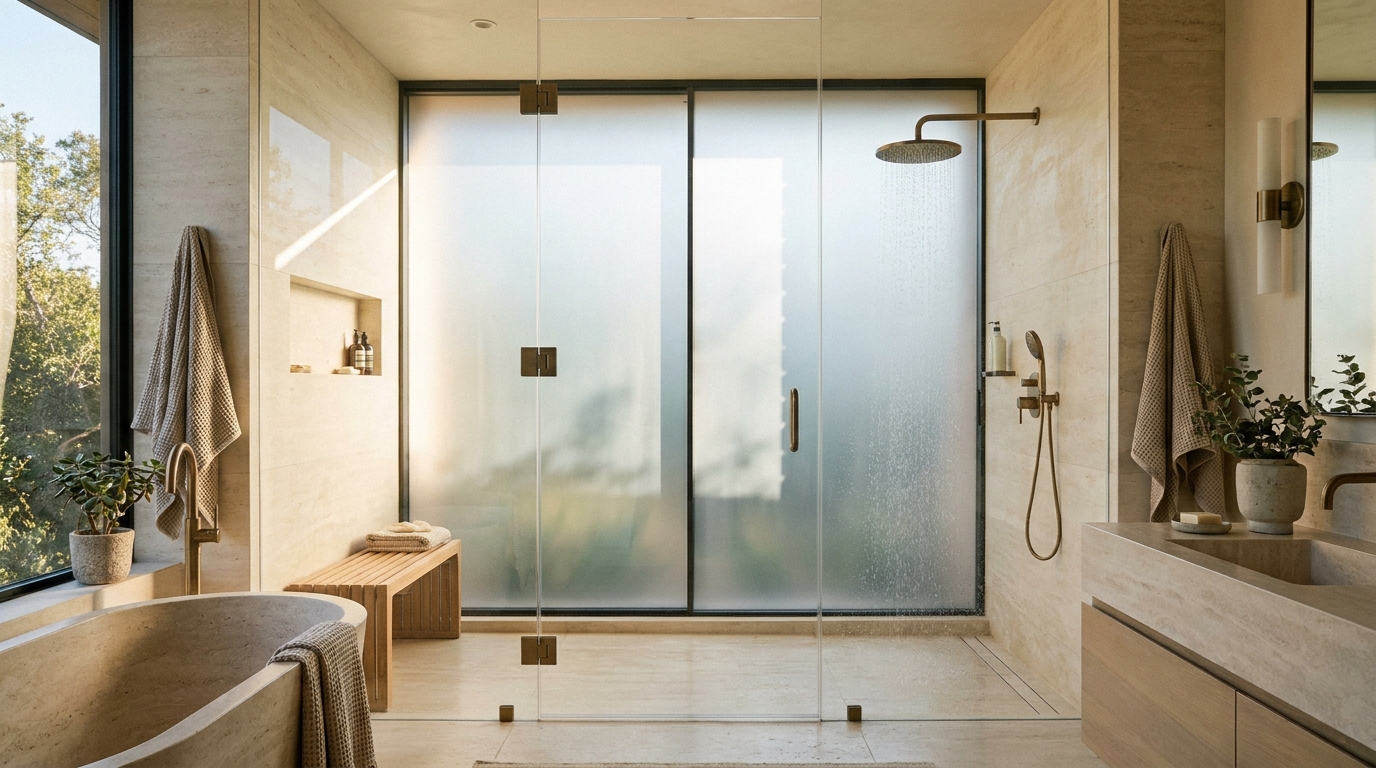
Frosted and acid-etched finishes are beloved because they obscure direct views while still admitting light. This makes them particularly suitable for bathrooms, front entries, meeting rooms, and interior partitions where privacy matters but darkness would feel oppressive. The light that passes through is softened and diffused, creating a gentle luminous effect that often feels more elegant than plain transparency.
Acid-etched glass in particular has a refined, velvety surface quality that many designers favor for high-end interiors. It feels subtle rather than flashy, and it works beautifully with stone, oak, brass, plaster, and other rich tactile finishes. Frosted films can also offer a flexible or budget-conscious solution in some applications, though permanent etched finishes tend to feel more integrated and durable.
Sandblasted Glass
Sandblasted glass offers privacy and texture, often with a slightly more artisanal character. It can be used across an entire panel or applied as a decorative motif. In custom interiors, this allows for patterns, gradients, and creative compositions that bring personality into a space while maintaining a mature aesthetic.
Because the surface treatment affects the feel and maintenance of the pane, sandblasted glass must be selected carefully for high-contact areas. It is visually rich, but like all specialty finishes, it performs best when both beauty and practicality are understood from the start.
Patterned and Textured Glass
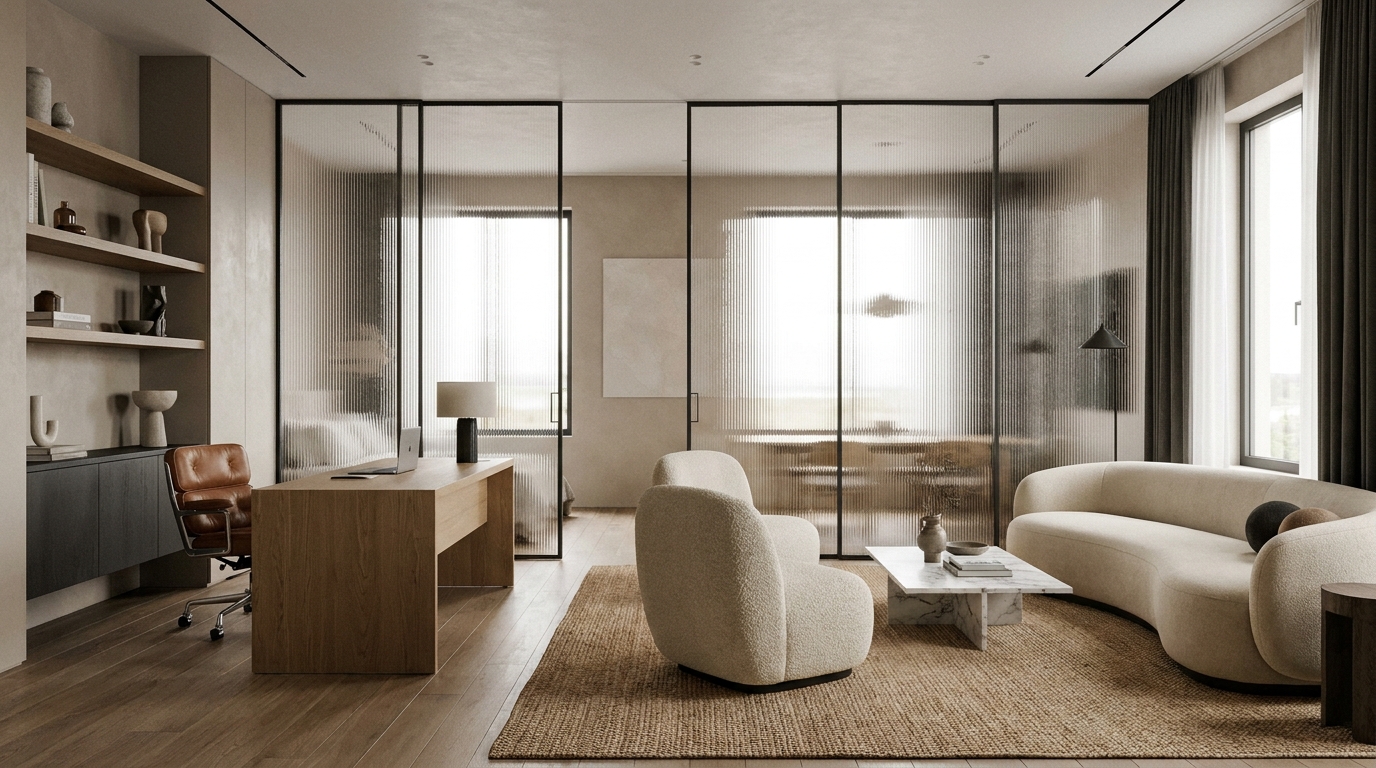
Patterned or textured glass is enjoying a renewed moment, especially in interiors that want privacy without sacrificing character. Reeded, fluted, ribbed, and organic textures catch light beautifully and distort views in a way that feels intentional rather than purely functional. They are especially effective in cabinet inserts, pantry doors, room dividers, and home office partitions.
One of the great charms of textured glass is that it introduces movement. As daylight shifts, the surface seems to animate. This brings a decorative layer to a room without requiring excess ornament. It is design at its most disciplined and expressive.
Laminated Decorative Glass
Laminated decorative glass combines layers of glass with an interlayer that can add safety, acoustic performance, color, texture, or design effects. This category has grown significantly as architects and manufacturers push toward more reliable high-performance decorative applications. Industry attention to laminated glass durability is an important sign that these products are evolving beyond novelty into serious architectural tools.
For interiors, decorative laminated glass can be a remarkable solution when a project needs privacy, impact resistance, and a custom visual statement. It is often used in partitions, feature walls, and specialty installations where the finish itself becomes part of the spatial identity.
Mirror and Reflective Finishes
Mirror finishes remain among the most transformative glass applications in interior design. They amplify light, visually expand small rooms, and add a glamorous note when used with restraint. A mirrored wall panel in a dining space or entry can completely alter the sense of depth, while antiqued mirror introduces softness and patina for a more romantic effect.
Reflective finishes must be composed carefully, however, since too much reflection can create visual confusion. The most successful mirrored interiors are those that understand proportion, placement, and what should be reflected. When done well, the result is sophisticated and immersive.
How Glass Finishes Support Daylighting and Energy Awareness
One of the most compelling reasons to use glass finishes is their contribution to daylighting. In design terms, daylighting means intentionally bringing natural light deeper into a building so that spaces feel brighter and more balanced during the day. This has aesthetic value, but it also has practical implications. According to the U.S. Department of Energy, well-designed daylighting can reduce lighting energy use and lower cooling loads. That makes glass an important material in conversations about sustainability and long-term comfort.
In interior applications, glass partitions, transoms, doors, and railings help borrowed light travel beyond perimeter windows. A hallway that would otherwise feel dim can glow softly when a glazed partition allows adjacent daylight to pass through. A bathroom can feel serene rather than enclosed when a privacy glass panel diffuses sunlight instead of blocking it. These gestures may seem delicate, yet they have a powerful cumulative effect on the way a home is experienced.
It is important to remember that visible transmittance is only one part of the equation. The Department of Energy also notes that glazing should be evaluated with glare control and heat gain in mind. In practical design language, this means the brightest pane is not always the most comfortable one. A finish that softens direct light may create a far better interior atmosphere than one that maximizes clarity but introduces harshness.
For North American homeowners, this nuanced view matters because glazing is increasingly discussed as part of overall energy performance rather than as decoration alone. Natural Resources Canada frames windows, doors, and skylights through an energy-efficiency lens, reminding us that glass choices affect more than style. Even when interior glass is not part of the exterior envelope, the way it distributes daylight through a home can support a smarter and more elegant relationship with light.
The Art of Privacy Without Darkness
Privacy is one of the most frequent reasons people hesitate to use more glass in their interiors. They imagine exposure, not discretion. Yet this is precisely where finishes become transformative. Frosted, etched, patterned, and laminated glass can obscure direct sight lines while preserving a sense of brightness and openness. Rather than closing a room off, they soften it.
This quality is invaluable in spaces like bathrooms, front vestibules, laundry rooms, and home offices. A frosted bathroom panel can preserve modesty while still allowing natural light to fill the room. A textured office partition can separate work from living without making either zone feel boxed in. In an entry sequence, privacy glazing can create a calm threshold that filters views from outside while retaining a luminous first impression.
Privacy glass is especially relevant in open-plan homes where residents often want flexible boundaries. A translucent divider between a kitchen and a study can distinguish uses without compromising the spaciousness of the whole. This is one of the quiet luxuries of good design. Instead of making a room choose between openness and retreat, the right finish offers both at once.
There is also a psychological elegance to diffused light. Opaque walls can feel final, while translucent materials feel atmospheric. They allow silhouettes, glow, and suggestion rather than full exposure. In this way, glass finishes often create more beautiful privacy than solid construction could offer.
Where Glass Finishes Shine Most Beautifully
Some materials are versatile in theory but limited in real life. Glass is not one of them. Its applications are wide and deeply adaptable, which is why it remains relevant across styles and building types. The key is to match the finish and performance specification to the room’s actual demands.
Glass Partitions and Interior Glazed Walls
Interior glazed partitions are among the most elegant ways to define space. They are especially effective in homes where daylight needs to be shared between zones, or where visual continuity helps a smaller footprint feel more generous. A fluted or frosted partition between a living room and office creates a soft boundary that is architectural without feeling severe.
In commercial spaces, glazed partitions are equally powerful because they preserve openness and professional polish while supporting meeting-room privacy. These assemblies are also part of a performance conversation, as interior glazed partitions are routinely tested by building-product certification and testing organizations for safety and reliability. Their success depends on more than appearance alone.
Glass Railings
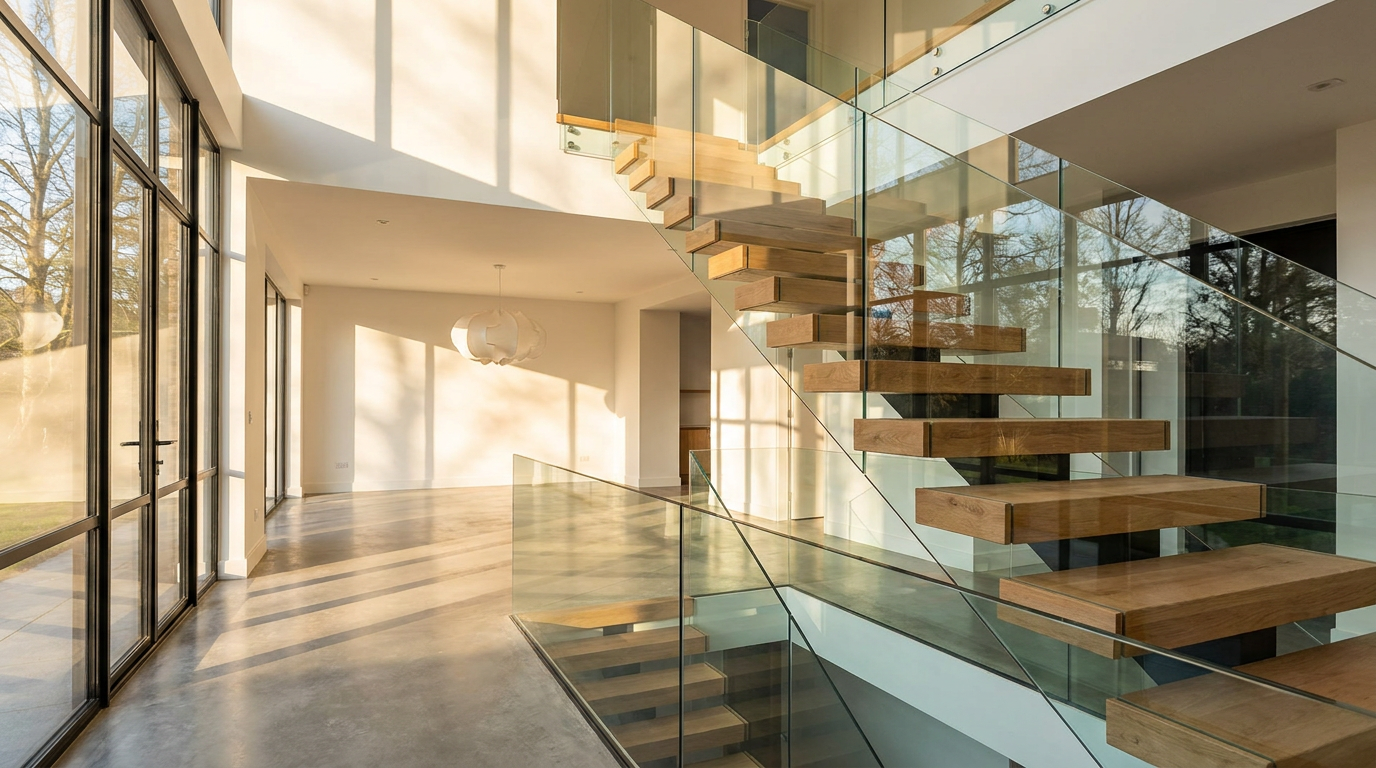
Few details modernize a stair or mezzanine as decisively as a glass railing. Whether framed minimally or installed with a near-frameless expression, it allows sight lines to continue and lets architectural features remain visible. This makes staircases feel less crowded and more sculptural. Kingsgate brought this exact feature to life on a recent custom build in North York, pairing a glass-railed, open-tread oak staircase with a stone facade and walnut accent walls — see the full build here.
Because railings exist in impact-prone locations, safety is essential. Tempered or laminated safety glass is often required or strongly recommended depending on code, location, and structural conditions. Installation details matter as much as the finish. Beauty in this context is inseparable from engineering, certification, and careful execution.
Shower Enclosures
Shower glass has become a signature of contemporary bathroom design because it contributes to a calm, open, spa-inspired atmosphere. Larger-format panels and minimal hardware are especially sought after for their seamless effect. In smaller bathrooms, clear glass can make the room feel notably larger, while frosted or partially obscured panels can offer discretion without visual heaviness.
Here too, maintenance and quality should guide the choice. Water spots, cleaning practices, coatings, and edge detailing all influence long-term satisfaction. A beautiful enclosure is not simply one that photographs well on installation day. It is one that still feels graceful and easy to live with months and years later.
Cabinetry, Doors, and Inserts
Glass inserts in cabinetry bring airiness and depth to kitchens, dining spaces, and dressing rooms. They can display objects, blur them softly, or conceal them behind texture. In many homes, this is a subtle but effective way to break up solid millwork and introduce a lighter rhythm into the composition.
Interior doors are another promising canvas. A glazed pantry door, laundry door, or study door can improve circulation of light while adding sophistication. This is especially useful in narrow plans or urban homes where natural daylight may be limited to only a few exposures.
Glass Brick and Translucent Blocks
Glass brick has re-emerged with surprising freshness. Once associated with a previous era, it is now being reinterpreted in cleaner, more architectural ways. Its appeal lies in the unique combination of translucency, privacy, durability, and bold decorative presence. It can feel sculptural, tactile, and full of character.
Used thoughtfully, glass brick introduces a strong design statement while still supporting daylight. It works beautifully in bathrooms, entry walls, bar areas, and accent partitions where a space benefits from both privacy and glow. This renewed interest reflects a larger trend toward materials that offer atmosphere as much as function.
Safety, Standards, and Why Specification Matters
One of the most important truths about glass finishes is that they are never only aesthetic. In many interior locations, the glass must meet safety requirements related to impact, breakage, and code compliance. This is particularly true for railings, doors, partitions near circulation paths, stair enclosures, and other areas where people may lean, collide, or fall against the surface.
North American standards help bring clarity to these decisions. ASTM C1036 is a commonly referenced flat-glass specification for architectural applications, and related glazing standards establish expectations for quality and performance. In Canada, building code guidance and the National Building Code framework emphasize safe use of glass in interior conditions. For homeowners, this means a decorative decision can quickly become a technical one, and that is not a disadvantage. It is what protects the integrity of the design.
Tempered glass is often selected for its strength and break pattern, while laminated glass offers advantages that may include impact resistance and retention of fragments if breakage occurs. Depending on the application, one may be more appropriate than the other, or both may be part of the discussion. The finish applied to the glass does not erase these structural realities. A beautiful pane still has to perform.
This is why collaboration matters. Designers, fabricators, installers, and code-aware professionals all contribute to a successful result. When glass is specified thoughtfully, it can be exquisitely refined and reassuringly durable at the same time. That union is the essence of luxury. It is not fragility disguised as elegance, but performance shaped into beauty.
Common Misconceptions About Glass Finishes
Because glass appears simple, it is often oversimplified. Several common misconceptions can lead to poor decisions, disappointing results, or missed opportunities. Understanding these assumptions is essential for anyone considering glass in a renovation or new build.
- Glass is only decorative. In reality, it affects daylighting, glare, privacy, safety, and the practical use of a room.
- All glass is equally safe. Different locations may require tempered safety glass, laminated glass, or other code-compliant assemblies.
- The clearer the glass, the better. Maximum transparency can increase glare and discomfort in certain spaces.
- Frosted glass blocks light. Most privacy finishes still transmit generous diffused daylight.
- Glass is maintenance-free. Fingerprints, edge care, compatible cleaners, and scratching should all be considered.
- Any decorative glass can be used anywhere. Structural conditions, impact risk, and installation details can limit where a product is suitable.
These misconceptions tend to dissolve once glass is understood as part of a broader interior performance system. It is not an isolated decorative gesture. It is a material with visual, environmental, and technical consequences. Seen this way, glass becomes far more interesting and far more powerful.
Designing with Glass Finishes: A More Thoughtful Approach
The most elegant interiors rarely use glass everywhere. Instead, they use it precisely. This distinction matters. A room feels sophisticated when glass appears where it improves light, function, or spatial clarity rather than where it is merely fashionable. Thoughtful placement always outperforms excess.
Before choosing a finish, consider what the space truly needs. Does it need openness, privacy, glare control, acoustic separation, or a stronger architectural focal point? Is the goal to make a room feel larger, or to soften a transition between zones? These questions help determine not only the finish but the form, thickness, hardware, detailing, and installation method.
Material pairing also deserves care. Glass becomes especially beautiful when balanced with tactile surfaces such as natural wood, stone, limewash, plaster, metal, or woven textiles. These combinations prevent an interior from feeling cold. They remind us that modernity need not be austere. In fact, some of the most memorable glass interiors are the warmest ones, where translucency is softened by texture and natural tone.
Scale is another quiet but decisive factor. Larger-format glass panels can feel serene and expansive, while smaller divided panes may introduce rhythm and intimacy. Framing changes the mood as well. Minimal frames support a seamless contemporary effect, while dark metal frames can lend graphic structure and industrial charm. Neither approach is inherently superior. The right one is the one that aligns with the architecture and the life taking place inside it.
Maintenance, Durability, and Long-Term Grace
A beautiful finish should remain beautiful in daily use. This is where practical foresight becomes part of the design language. Glass railings may show handprints, shower enclosures may collect mineral residue, and textured surfaces may require specific cleaning methods. These realities are not reasons to avoid glass. They are reasons to choose well and maintain intelligently.
Protective coatings, proper edge detailing, and high-quality installation all contribute to longevity. Decorative laminated glass and enamel-coated products are also receiving increasing industry attention for durability under weathering and radiation, a sign of how seriously performance is now being treated even in expressive applications. While many interior surfaces are sheltered from the harshest conditions, durability still matters because wear, cleaning, and use accumulate over time.
When specifying a finish, ask practical questions as confidently as aesthetic ones. What cleaners are recommended. Will the finish show oils or scratches. Are replacement panels easy to source if needed. How visible are hardware and seal lines. These details shape the lived experience of the material and often determine whether a glass installation feels effortless or frustrating.
The most enduring interiors are those that age with poise. Glass can absolutely do this. Its longevity comes from a combination of quality material, appropriate specification, and sensitive care. In that sense, long-term grace is designed from the very beginning.
Emerging Trends in Glass Finishes
The future of glass in interiors is becoming more sophisticated, not less. Designers are embracing minimal-frame and frameless systems that reduce visual clutter while maximizing light. Larger-format shower enclosures and partitions continue to grow in popularity because they produce a cleaner, more architectural expression. Textured privacy panels are also surging, offering a beautiful middle ground between openness and concealment.
Decorative laminated glass, printed surfaces, and enamel-coated products are expanding the creative vocabulary available to architects and interior designers. These technologies allow glass to do more than disappear. It can also become graphic, atmospheric, colorful, or acoustically beneficial. At the same time, evolving standards around durability and performance are helping these products mature into reliable choices for demanding projects.
Smart glass and switchable glass also point toward an exciting future. Though not necessary for every home, they reflect a broader desire for materials that adapt to changing needs. In some environments, the ability to shift from clear to private with the touch of a control introduces a new level of flexibility and technical elegance.
Perhaps most importantly, glass aligns with the sustainability-minded values shaping contemporary design. It supports daylight access, lowers visual heaviness, and fits beautifully into interiors that prioritize fewer but better materials. Even its symbolic quality feels contemporary. In a world of overstimulation, glass offers clarity.
Conclusion: A Material That Balances Beauty and Performance
Glass finishes occupy a rare position in interior design because they satisfy both the eye and the practical life of a space. They allow light to deepen, rooms to expand visually, and boundaries to become more graceful. They can protect privacy without extinguishing brightness, and they can bring a distinctly modern sensibility without feeling trend-driven or cold.
The true beauty of glass lies in its dual nature. It is delicate in appearance yet often highly engineered. It can seem almost invisible, yet it changes everything around it. Whether expressed through frosted panels, textured partitions, frameless railings, decorative laminated features, or revived glass brick, it offers a language of elegance that is inseparable from performance.
For homeowners, designers, and architects alike, the lesson is clear. The best glass finishes are never chosen by style alone. They are selected with attention to daylighting, visible transmittance, glare control, privacy, safety glazing requirements, durability, and the everyday rituals of living. When all of these elements are considered together, glass does what it does best. It transforms space not by overwhelming it, but by letting it glow.
In the end, that may be the most luxurious quality of all. Glass does not merely fill an opening or divide a room. It choreographs light, tempers enclosure, and gives interiors a sense of composure that feels both contemporary and timeless. In homes shaped for modern life, few materials achieve that harmony so beautifully.


No Comment! Be the first one.