

The future of urban growth will be shaped by a difficult reality: many cities will need to perform better under hotter, drier, and more volatile climate conditions than they were ever designed to handle. In arid regions this pressure is already visible, but the implications reach much further. Across North America, places that were once considered temperate are now dealing with longer heat waves, periodic drought, and rising stress on infrastructure, public health, and water supply. That is why the idea of desert smart cities matters today. It is not a niche concept for a handful of desert metros. It is an emerging model for how cities can remain livable as climate stress intensifies.
Table Of Content
- Why Desert Smart Cities Matter Beyond the Desert
- The Core Design Logic of a Desert Smart City
- Water Is the Defining Constraint
- Designing for Heat Is Designing for Public Health
- Energy, Buildings, and the Logic of Lower Demand
- The Public Realm as Climate Infrastructure
- Digital Twins, Data, and Smarter Urban Operations
- Governance, Equity, and the Politics of Adaptation
- What North American Cities Can Do Now
- Conclusion: The Future City Will Be Climate Literate
A desert smart city is often misunderstood as a futuristic landscape filled with sensors, automated systems, and striking architecture. Technology is part of the picture, but it is not the foundation. The real work begins with urban form, water systems, passive cooling, social infrastructure, and governance. A successful desert smart city reduces dependence on scarce resources, lowers heat exposure, improves access to mobility and services, and builds resilience into the fabric of daily life. It is a city where planning decisions are aligned with climate realities rather than working against them.
This shift is increasingly relevant in Canada and the United States. Federal guidance in Canada shows that urban heat islands can make large cities 1 to 3°C warmer on average than nearby rural areas, and under dense nighttime conditions the gap can reach as high as 12°C. Those numbers reveal something critical: climate stress is not only a regional issue, but also a design issue. Heat is amplified by hard surfaces, weak tree canopy, poor building orientation, and disconnected land use patterns. When those conditions combine with growth, inequality, and strained infrastructure, the city itself becomes part of the risk.
Desert smart cities offer a more strategic path forward. They combine people centered digital systems with compact planning, high performance buildings, circular water infrastructure, and streets designed for thermal comfort. They treat shade as infrastructure, water reuse as an essential utility, and public space as a health system. In that sense, desert urbanism is not about conquering nature. It is about respecting constraints and designing with them intelligently.
The most successful future cities in hot and water stressed regions will not be defined by flashy gadgets. They will be defined by how well they conserve resources, protect public health, and make daily life workable in a harsher climate.
For planners, developers, and public leaders, the opportunity is significant. Cities that adapt early can reduce long term infrastructure costs, unlock land value more responsibly, and create more stable conditions for housing and investment. Cities that fail to adapt will face rising cooling demand, public health emergencies, water insecurity, and declining urban performance. The stakes are economic as much as environmental. The conversation about desert smart cities is therefore a conversation about development feasibility, resilience, and the future of urban living itself.
Why Desert Smart Cities Matter Beyond the Desert
It is easy to assume that desert smart city design applies mainly to Phoenix, Las Vegas, or parts of inland California. That view is now too narrow. Climate change is pushing many regions toward more desert like conditions, even if they do not fit the traditional image of a desert landscape. Western North American cities are confronting hotter summers, more frequent drought, and increasing tension between growth and water supply. At the same time, urban heat islands are worsening the experience of extreme heat at the neighborhood level.
Canada is a useful example. While much of the country is not arid, federal adaptation guidance has pointed to a major planning gap: many municipalities still do not fully integrate urban heat island reduction into land use planning. That matters because heat is not distributed evenly. Dense districts with low canopy cover, extensive asphalt, poorly designed buildings, and weak access to cooling infrastructure can become far more dangerous than other parts of the same city. Statistics Canada has also reported that extreme heat events from 2000 to 2020 caused substantial excess deaths across the country’s largest cities. That turns heat mitigation from a design preference into a public safety imperative.
The lesson is broader than geography. Desert smart principles apply anywhere a city must lower cooling demand, conserve water, and maintain livability under stress. As aridity expands, the distinction between a desert city and a climate stressed city begins to blur. The cities best positioned for the future will be the ones that redesign around resource efficiency before the emergency becomes permanent.
This is also where the “smart” part of the conversation has matured. Global urban policy has been moving away from technology for its own sake and toward systems that are interoperable, equitable, and useful to residents. UN Habitat’s recent smart city framing emphasizes people centered governance, digital inclusion, privacy, and better access to services. In extreme climates, that means digital tools must support the physical city rather than distract from it. Data should help planners map heat, optimize water use, monitor infrastructure performance, and direct resources where need is greatest.
In other words, a desert smart city is not just a hot city with more software. It is a city that uses strategy, design, and digital management together to create better outcomes under difficult environmental conditions.
The Core Design Logic of a Desert Smart City
The design logic of desert urbanism begins with a simple premise: the most sustainable unit of energy or water is the one a city does not have to use in the first place. That pushes planners and architects toward an integrated model where urban form, building design, mobility, landscape, and utility systems all work together. The goal is not only to make buildings efficient, but to make entire districts inherently less resource intensive.
Compact mixed use form is a major part of that strategy. Sprawling development patterns increase exposed pavement, lengthen travel distances, expand infrastructure costs, and intensify cooling demand. A more compact city can reduce those pressures if it is designed carefully, with shaded streets, accessible services, active transportation, and enough green infrastructure to reduce heat concentration. Density alone is not the answer. Density without shade, permeability, or climate responsive design can be punishing in hot weather. The opportunity lies in combining compactness with comfort.
Buildings also need to be treated as climate devices. In desert environments, architecture has to manage solar gain, ventilation, thermal mass, and material performance with far more discipline than in milder climates. Deep overhangs, recessed windows, reflective surfaces, high performance insulation, narrow floor plates where appropriate, and strategic orientation can cut cooling loads significantly. These are not nostalgic design gestures. They are essential tools for development feasibility in a hotter future.
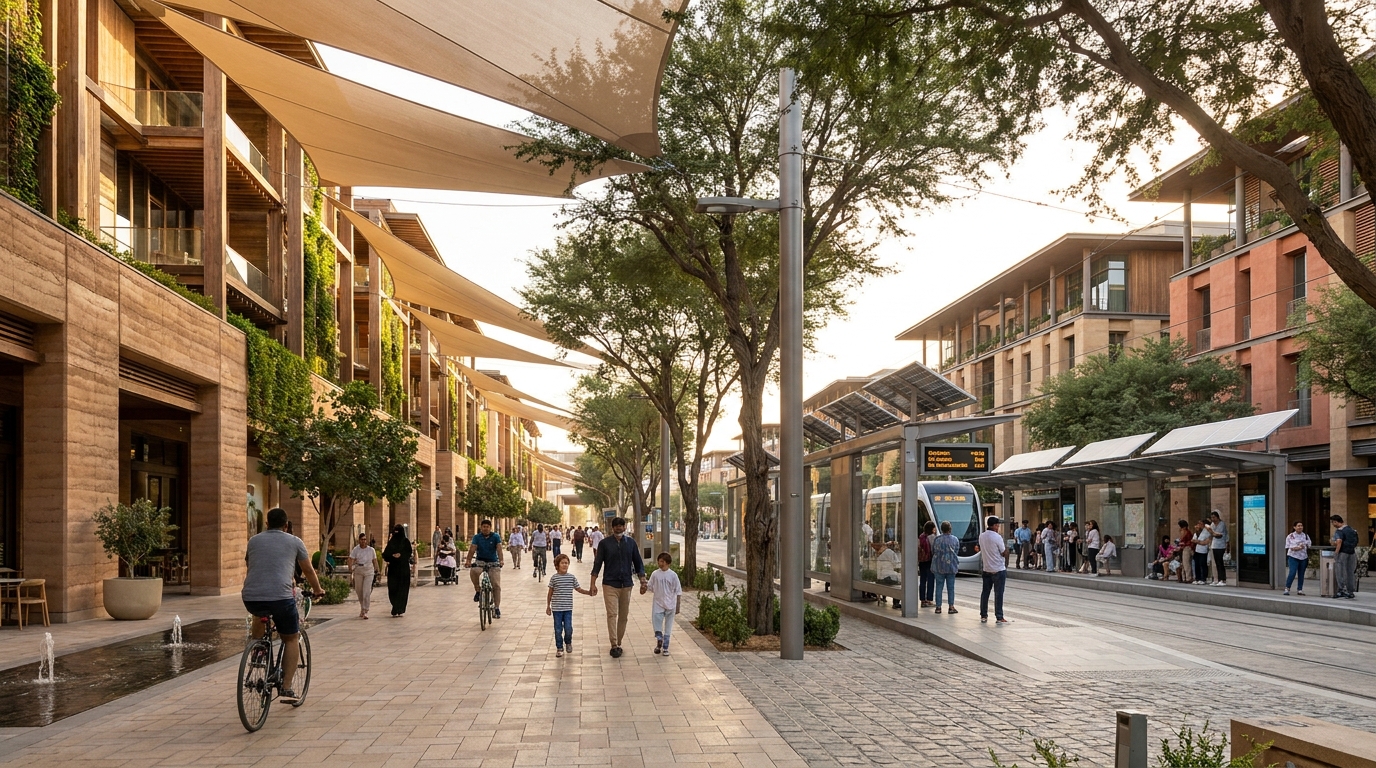
Street design is equally important. In a conventional heat exposed urban environment, walking even short distances can become physically taxing or unsafe during peak summer periods. A desert smart city reverses that condition through layered shade systems, narrower travel lanes where appropriate, cooler paving materials, integrated planting, and public spaces positioned for airflow and refuge. Sidewalks, transit stops, courtyards, and school routes all become part of a thermal comfort network. The city starts to operate as a system of microclimates rather than a collection of disconnected parcels.
This integrated logic can be summarized in several core principles:
- Reduce demand first through passive cooling, compact form, and efficient materials.
- Use water circularly with reuse, stormwater capture where possible, and low loss distribution systems.
- Protect health by designing for shade, access to cooling, and lower heat exposure.
- Digitally optimize systems using data to manage heat, energy, mobility, and water in real time.
- Keep the model inclusive so resilience is delivered across neighborhoods rather than concentrated in premium districts.
When these principles are missing, smart city investments can become superficial. A sensor rich district with inefficient buildings, heat trapping streets, and weak water planning is not truly smart. It is simply more complex. Real intelligence in city building is measured by performance, resilience, and public value.
Water Is the Defining Constraint
If there is one issue that most clearly defines desert smart city planning, it is water. Every conversation about future growth in arid regions eventually returns to the same question: where will reliable water come from, and how can the city use it more responsibly? Climate change is expected to reduce freshwater availability for many cities, and continued growth places additional strain on already stressed systems. In this context, conventional linear water models are increasingly difficult to defend.
For decades, many growing regions depended on importing water over long distances, tapping finite sources, or expanding supply through expensive infrastructure with significant ecological and political implications. That model is becoming more fragile. A desert smart city instead moves toward a circular urban water system, where wastewater is treated as a recoverable resource, distribution losses are reduced, end uses are matched with water quality, and demand is managed with precision.
This is no longer theoretical. In North America, advanced water reuse is already being built at meaningful scale. The U.S. Environmental Protection Agency has highlighted projects such as San Diego’s Pure Water program, which aims to supply one third of the city’s water by 2035 through advanced purification of recycled water. Oceanside has also expanded recycled water systems to support drought resilient supply. These projects reflect a significant strategic transition. Rather than viewing wastewater as something to discard, cities are increasingly treating it as a local source of resilience.
The implications for urban planning are profound. Water reuse changes how a city thinks about district design, utility corridors, building systems, industrial uses, landscape standards, and long term growth allocation. It also requires public trust, clear regulation, and strong communication. One persistent misconception is that recycled water is inherently lower quality or less safe. In reality, advanced purification can produce potable grade supply when properly regulated and monitored. The challenge is not technical impossibility. The challenge is governance, investment, and implementation at scale.
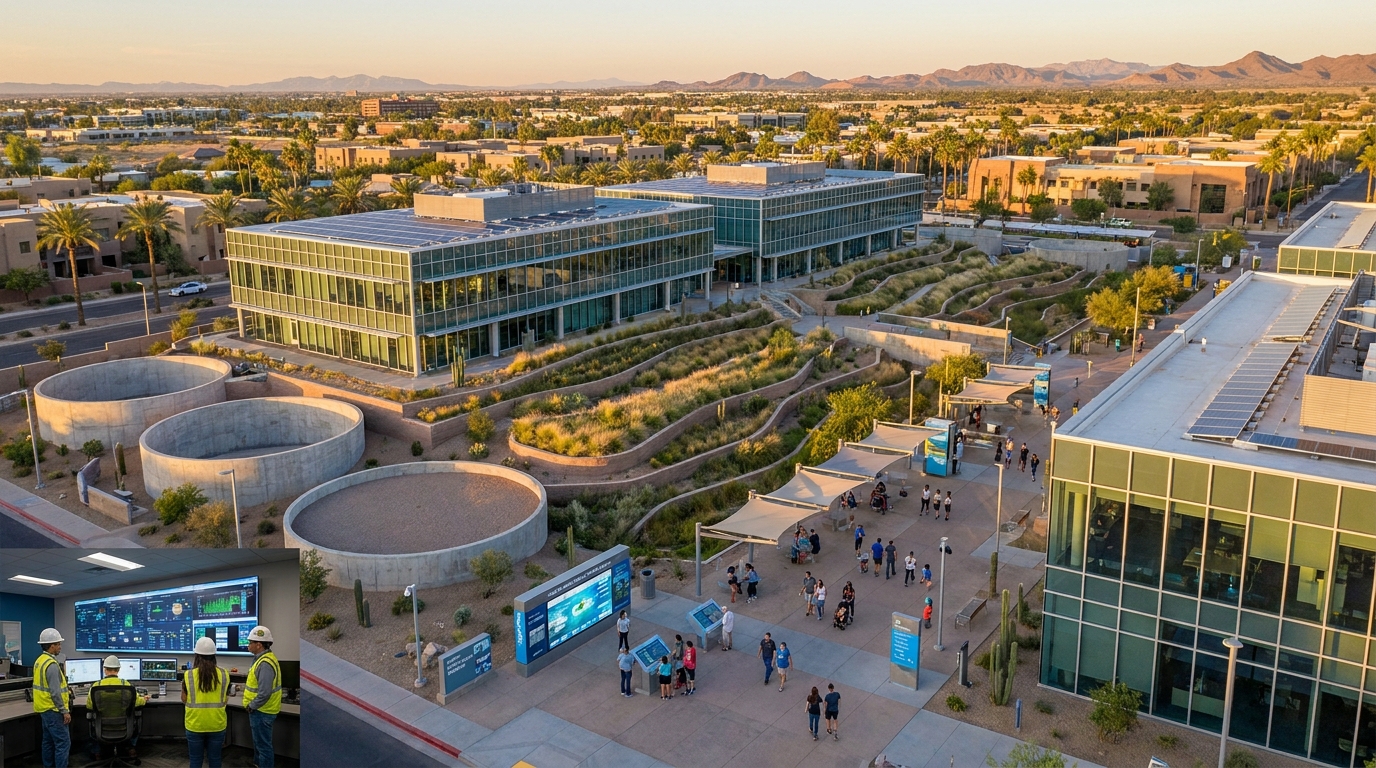
Water sensitive design must also extend beyond treatment plants. It includes leak detection, smart metering, drought tolerant public landscapes, permeable surfaces where feasible, and building codes that support efficient fixtures and on site reuse systems. In some contexts, district scale greywater loops and non potable networks can reduce demand on drinking water systems dramatically. That kind of layered planning is central to desert smart urbanism because every litre saved improves long term development resilience.
The strategic value of this approach is difficult to overstate. Cities that can diversify supply through reuse are less exposed to drought volatility, interregional competition, and escalating infrastructure costs. They gain flexibility in land use planning, greater confidence in approving growth, and stronger long horizon resilience. In development terms, water security increasingly shapes where growth can occur, how much can be supported, and what kind of density is viable. Water is not simply an engineering issue. It is a land use issue, a housing issue, and a city building issue.
Designing for Heat Is Designing for Public Health
Extreme heat is often discussed in energy terms, but its most immediate impact is human. Heat affects mortality, emergency response, labor productivity, transit comfort, school safety, and everyday quality of life. In dense urban settings, the built environment can amplify these risks dramatically. Hardscape stores heat, dark surfaces absorb solar radiation, limited canopy reduces shade, and poorly designed buildings trap warmth well into the night. The result is an urban landscape that can remain dangerous even after sunset.
Canadian federal health guidance has long linked heat exposure to urban design choices, and the data now reinforces the urgency. Statistics Canada reports that extreme heat events between 2000 and 2020 produced hundreds of excess non accidental deaths on average across the country’s 12 most populated cities, including excess cardiovascular and respiratory deaths. These are not abstract figures. They represent a failure of environmental conditions, planning systems, and social protection. A desert smart city treats heat mitigation as a core public health function.
The first line of defense is passive design at the neighborhood scale. Street trees, shade structures, cool roofs, lighter paving materials, courtyards, building spacing that enables airflow, and reduced surface parking all help lower ambient temperatures. The cumulative effect can be substantial. A shaded, permeable, walkable block feels fundamentally different from a heat exposed one. That difference matters not only for comfort, but also for who can safely occupy public space, wait for transit, or walk to school during hot periods.
The second line of defense is social infrastructure. Cooling centers, shaded community hubs, splash features where appropriate, libraries, and air conditioned public buildings become essential resilience assets in a hot climate. Yet access is uneven in many cities. Lower income communities, renters, seniors, and people with existing health conditions often face the highest exposure and the lowest adaptive capacity. A desert smart city therefore has to be equitable by design. Heat resilience cannot be treated as a premium amenity for newly developed districts while older neighborhoods are left behind.
Operational tools matter as well. Heat health warning systems, real time heat mapping, and targeted outreach can help municipalities deploy resources more effectively during extreme events. This is where the digital side of smart city thinking proves its value. Sensors, satellite data, and predictive models can identify where nighttime heat retention is highest, which transit stops lack adequate shade, and which neighborhoods may require more emergency support. Technology should serve practical intervention, not symbolic innovation.
In a hot future, shade is not decoration and cooling is not a luxury. They are forms of public infrastructure with direct implications for health, equity, and economic resilience.
There is also a longer term development lesson here. Heat resilient design increases the usability of the public realm, supports active transportation, and improves the attractiveness of denser urban living. That makes it easier to align climate adaptation with housing and growth objectives. A well designed hot climate district can support density without sacrificing comfort. A poorly designed one will push people back toward auto dependence and private cooling solutions, raising costs for everyone.
Energy, Buildings, and the Logic of Lower Demand
Desert smart cities cannot be sustainable if they simply replace every climate problem with a larger mechanical system. In hot regions, electricity demand is driven heavily by cooling loads. If urban growth continues with inefficient envelopes, heat absorbing materials, and auto dependent land use patterns, the result will be escalating peak demand, stressed grids, and higher operating costs. The strategic answer is not just to produce more energy, but to require less of it.
Climate responsive architecture has always been one of the most effective tools in desert settings. Thick walls, shaded openings, courtyard forms, orientation sensitive massing, and ventilation strategies have deep historical roots because they work. Contemporary design can build on those principles using advanced materials, performance modeling, and district energy coordination. The point is not to romanticize the past, but to recognize that passive cooling remains one of the most durable and economical forms of resilience available to modern cities.
District cooling systems are also gaining relevance in large scale developments. Rather than each building operating as a separate thermal island, district systems can centralize cooling production and distribute it more efficiently, especially when paired with thermal storage and renewable power. In high growth desert environments, this model can support lower peak energy demand and more stable long term operations. It works best when planned from the outset, which again underscores the importance of early integrated planning rather than retrofit after the fact.
Solar generation is an obvious complement in sunny regions, but generation alone is not enough. Smart grids, battery storage, demand response, and building level controls all help align consumption with available supply. In a well designed desert smart city, buildings can pre cool at optimal times, shift noncritical loads, and coordinate with district systems to reduce stress during peak heat events. These are not futuristic luxuries. They are increasingly practical tools for maintaining affordability and reliability as temperatures rise.
What matters most is the order of operations. Cities should first reduce energy demand through design, then improve system efficiency, and only then scale generation and storage to meet the remaining load. That sequence produces better economics, lower emissions, and more resilient urban performance. If the order is reversed, cities risk locking in expensive and inefficient patterns that are difficult to unwind later.
The Public Realm as Climate Infrastructure
One of the most important shifts in desert smart city thinking is the recognition that streets, plazas, parks, and public corridors are not leftover spaces between buildings. They are active climate systems. The design of the public realm shapes thermal comfort, mobility choice, social cohesion, and commercial vitality. In extreme climates, a successful public realm makes urban life possible during more hours of the day and more months of the year.
This requires a different hierarchy of priorities. Wide exposed roads, oversized intersections, and minimally landscaped setbacks may have worked under older planning assumptions, but they perform poorly in hot environments. Desert smart cities instead favor shaded walking routes, transit corridors designed for comfort, and public spaces calibrated for human occupancy. Tree canopy remains valuable, but planting strategies need to be adapted to local water realities and supported by healthy soil, appropriate species selection, and efficient irrigation. Nature based solutions in desert regions must be carefully designed, not copied from wetter climates.
Cooling the public realm does not always mean lush landscaping. It can involve colonnades, arcades, pergolas, fabric canopies, narrow street sections, and strategic building placement that creates shadow through the day. Material choice matters as well. Cooler pavements and surfaces with lower heat absorption can reduce local temperature intensity and improve pedestrian experience. These interventions become even more effective when combined rather than applied individually.
For developers and municipalities, this is a value proposition as much as a climate strategy. Comfortable public spaces support retail activity, higher foot traffic, better transit ridership, and stronger neighborhood identity. They also make compact urban form more acceptable to residents because density feels more livable when streets are inviting rather than punishing. In other words, climate infrastructure and place quality are not competing goals. In the best future cities, they are the same agenda.
Digital Twins, Data, and Smarter Urban Operations
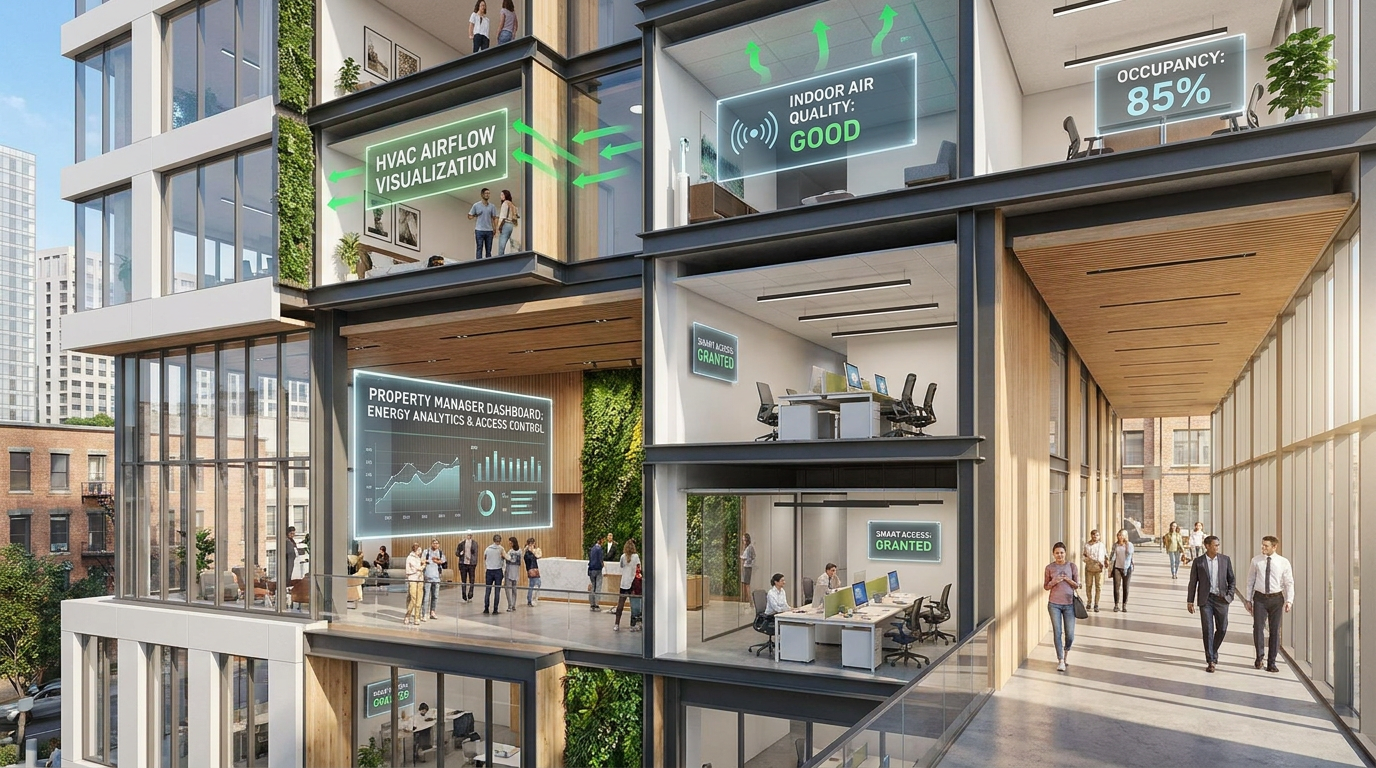
The term “smart city” became popular partly because digital systems promised more efficient urban management. In desert smart cities, those tools are genuinely useful when tied to measurable resilience goals. Heat mapping, water demand forecasting, leak detection, energy monitoring, and transit optimization all become more valuable in places where environmental margins are tighter. Data does not replace urban design, but it can make city systems far more adaptive.
One of the most promising tools is the urban digital twin, a dynamic digital model that helps planners and operators simulate how a city performs under different conditions. In a hot and dry environment, a digital twin can model heat exposure by block, test the impact of added canopy or reflective surfaces, estimate water demand under drought scenarios, and identify infrastructure vulnerabilities before they become emergencies. This supports better capital planning and better day to day management.
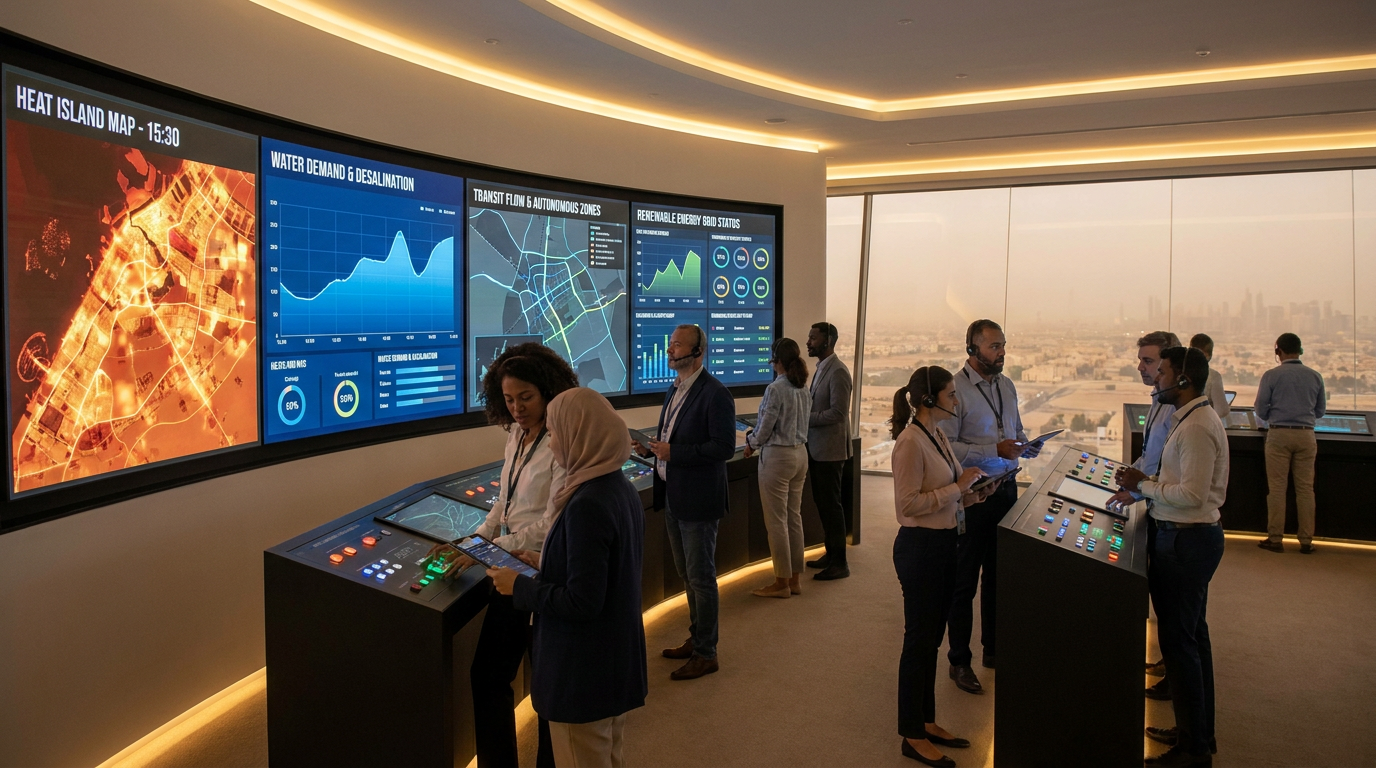
Remote sensing and real time monitoring can also make adaptation more targeted. Municipalities can identify hotspots where nighttime temperatures remain dangerously elevated, direct tree planting and shade investments more effectively, and detect abnormal water losses before they escalate. Building operators can fine tune cooling systems while preserving occupant comfort. Transit agencies can adjust services and stop amenities based on exposure patterns. The result is a city that learns from its own performance.
Still, the governance questions are essential. UN Habitat’s people centered smart city approach is particularly relevant here because digital systems can deepen inequality if they are deployed without transparency or public value. Data privacy, digital access, and institutional capacity all matter. A smart desert city should not become a city where only affluent neighborhoods benefit from advanced systems or where data collection expands without accountability. Technology must be trusted, governed clearly, and tied to equitable service delivery.
The strongest model is one where digital tools remain largely invisible to the resident because they simply make daily life work better. Water arrives reliably. Public alerts are timely. Streets are cooler. Transit is easier to use. Energy bills are lower. That is the real test of intelligence in city management.
Governance, Equity, and the Politics of Adaptation
No city becomes resilient through design and infrastructure alone. Governance determines whether adaptation is coordinated, funded, maintained, and distributed fairly. This is especially true in desert smart cities because many of the required interventions cross departmental and political boundaries. Water planning affects land use. Heat mitigation affects public health. Housing policy affects exposure. Utility regulation affects affordability. Without integrated governance, the city can invest heavily and still produce fragmented results.
Equity has to be part of this framework from the beginning. Hotter neighborhoods are often the same places with lower canopy cover, older housing stock, weaker infrastructure, and more vulnerable populations. If adaptation is delivered only through premium master planned communities, the broader city becomes more divided. A credible desert smart strategy includes retrofit programs for existing neighborhoods, support for renters and low income households, and public investment in cooling infrastructure where the need is greatest.
Public trust is also central, particularly around water reuse, digital systems, and changes to urban standards. Residents need clear information about how systems work, what safeguards exist, and how benefits are shared. In many cities, adaptation fails not because the technology is unavailable, but because implementation is politically fragmented or socially mistrusted. Strong institutions, transparent metrics, and visible early wins can help build the confidence required for larger transformation.
There is a development dimension here as well. Investors and builders operate more effectively in places with clear policy direction. If municipalities establish coherent standards for water efficiency, heat resilient design, district energy, and digital interoperability, the market can respond with greater certainty. If rules remain inconsistent or reactive, projects become more difficult to finance and deliver. Good governance is therefore part of project feasibility, not separate from it.
What North American Cities Can Do Now
For cities across North America, the value of desert smart thinking lies in its immediacy. This is not a distant future agenda. Many of the principles are already relevant in places facing hotter summers, drought pressure, and aging infrastructure. The most productive question is not whether a city is officially a desert city. The real question is whether its current development model can remain livable and resource efficient under more arid conditions.
Several practical moves stand out. Municipalities can embed urban heat island reduction into planning policy rather than treating it as optional guidance. They can require stronger passive design performance in building approvals, create standards for shaded transit access, and prioritize tree canopy and cool surface investments in the hottest neighborhoods. Water plans can shift toward reuse, metering precision, leak reduction, and district scale efficiency. Public agencies can begin building digital heat maps and infrastructure dashboards that support smarter allocation of capital.
Developers can also play a more strategic role. New projects can integrate orientation, shade, material performance, water reuse readiness, and district energy compatibility from the beginning. These choices improve long term operating resilience and make communities more marketable in a hot climate. Over time, climate performance will influence value more directly. Neighborhoods that remain comfortable, water secure, and mobility rich will outperform those that rely only on private cooling and long car trips.
For older urban areas, retrofit will be just as important as new construction. Much of the future city already exists, and many of the highest risk areas are established neighborhoods rather than greenfield sites. That means adaptation funding, public realm redesign, building upgrades, and infrastructure renewal must be coordinated at scale. The desert smart city is not only a new district model. It is also a retrofit strategy for preserving livability across the existing urban fabric.
Conclusion: The Future City Will Be Climate Literate
The rise of desert smart cities signals a broader change in how we think about urban success. For much of the last century, growth was often measured by expansion, speed, and engineering reach. In the decades ahead, success will be measured more by efficiency, resilience, and the ability to deliver quality of life within environmental limits. Hotter climates and tighter water conditions are forcing that transition into view.
The cities that respond well will not be the ones that simply add more technology to old models. They will be the ones that redesign the fundamentals. They will shape streets for shade, buildings for lower demand, infrastructure for circular water use, and governance for equitable adaptation. They will use digital tools to improve operations and planning, but they will remain grounded in the physical realities of land, climate, and human health.
That is why desert smart cities deserve serious attention from planners, developers, policymakers, and residents alike. They offer a framework for urban growth that is not only more sustainable, but also more realistic about the world ahead. As climate stress expands, desert smart principles will increasingly define what responsible city building looks like in North America. The future city will need to be climate literate, resource disciplined, and socially inclusive. In many ways, the work of building that future has already begun.

No Comment! Be the first one.