



Innovative Housing Systems for Sustainable Urban Growth
Cities are under pressure from two directions at once. They need to add housing at a pace that matches population growth, migration, and changing household needs, while also reducing emissions, strengthening resilience, and making urban life more affordable. That challenge is now shaping policy, investment, and development strategy across Canada and North America. It is also changing the definition of housing innovation. What once sounded like a narrow conversation about modular buildings or smart home technology has become a much broader discussion about how the entire housing system works.
Table Of Content
- Why housing innovation matters now
- What counts as an innovative housing system
- Industrialized construction and faster delivery
- The rise of missing middle and urban infill
- Retrofits are as important as new construction
- Climate resilience is part of housing affordability
- Finance and public investment as system catalysts
- Transit oriented development and the value of location
- Community based models and social resilience
- What cities get wrong about housing innovation
- A strategic framework for sustainable urban housing
- The long term opportunity
Innovative housing systems are best understood as ecosystem solutions. They include construction methods, land-use policy, approval timelines, infrastructure planning, financing tools, retrofit programs, building standards, tenure models, and community services. When these elements are aligned, cities can deliver housing faster, lower lifecycle costs, reduce environmental impact, and support more inclusive growth. When they are not aligned, even promising ideas can stall under the weight of high land costs, fragmented regulation, weak supply chains, or poor location decisions.
The urgency is clear. CMHC estimated in June 2025 that Canada would need roughly 430,000 to 480,000 new housing units annually for a decade to restore affordability to 2019 levels. That is about double the country’s recent pace of construction. This is not simply a matter of building more of the same. It is a productivity challenge, a climate challenge, and an infrastructure challenge. Housing has to be delivered in ways that are repeatable, scalable, and connected to long term city building goals.
The sustainability case is just as important. According to the International Energy Agency, the residential sector accounts for about 70% of total energy demand in buildings globally. That means housing performance is one of the biggest levers available for cutting urban emissions. It also means the quality of the housing stock matters far beyond aesthetics or resale value. Insulation, building envelopes, electrification, cooling strategies, flood protection, and location efficiency all influence how sustainable and affordable a home really is over time.
This is why the conversation about sustainable city growth must treat housing as infrastructure. Homes shape transportation demand, utility systems, labor mobility, health outcomes, local business activity, and social stability. They determine whether people can live near jobs, schools, healthcare, and transit. They influence household budgets every month through rent, mortgage costs, energy bills, maintenance needs, and insurance premiums. In practical terms, the future of urban development depends on whether cities can modernize the full housing delivery system rather than focus on isolated projects.
Housing innovation is not a single product or building type. It is the coordinated redesign of how housing is financed, approved, built, retrofitted, and integrated into the life of a growing city.
Why housing innovation matters now
The affordability crisis has exposed the limits of traditional delivery models. In many high demand urban regions, years of underbuilding, restrictive zoning, expensive land, labor shortages, and slow approvals have combined to constrain supply. Even when new projects move ahead, they often face cost escalation that makes final rents or sale prices difficult for households to absorb. This is one reason innovation is increasingly tied to system performance. Faster delivery, standardized processes, financing certainty, and lower operating costs can all matter as much as architectural design.
The data shows how broad the pressure has become. CMHC reported that Canada’s housing starts rose 6% in 2025, with record rental construction and growing missing middle activity helping shape supply. That is a positive sign, especially in markets where gentle densification and infill are beginning to expand the range of housing options. Still, gains in starts do not erase the scale of the deficit. Cities need not only more units, but more diversity in building type, tenure, affordability level, and location.
Affordability also cannot be measured by rent or mortgage payments alone. In the United States, the Census Bureau reported that 49.7% of renter households in 2023 were cost burdened, spending more than 30% of income on housing. Once utility costs, repairs, transportation expenses, and climate related disruptions are factored in, the financial picture becomes even more strained. A poorly insulated apartment far from transit may appear cheaper on paper, yet impose higher real costs over time than a well designed home in a connected neighborhood.
That is why innovative housing systems must address both upfront delivery and long term performance. A city that approves units quickly but neglects resilience, energy efficiency, and access to services is solving only part of the problem. A city that champions green building but delivers too little housing is also falling short. Sustainable urban growth requires the ability to increase supply in ways that lower total household cost, reduce environmental impact, and strengthen the capacity of communities to absorb change.
What counts as an innovative housing system
One of the biggest misconceptions in this field is that innovation means modular or prefab construction and little else. Those technologies matter, but they are only one part of the picture. In reality, an innovative housing system combines physical delivery methods with policy reform, financing, and community planning. It is the interaction among these elements that determines whether good ideas become reliable outcomes at scale.
Consider how a successful housing system functions. Land has to be available for the right kinds of homes in the right places. Approval pathways must be predictable enough to support investment. Infrastructure must be able to accommodate growth. Design standards should support energy efficiency and climate adaptation. Builders need access to labor, materials, and manufacturing capacity. Financing must reward both affordability and performance. Existing housing stock also needs pathways for repair and retrofit, since most of the homes that will exist in 2050 are already standing today.
From a strategic perspective, the strongest housing systems are those that reduce friction across the full development cycle. They shorten the time between concept and occupancy, improve quality control, lower waste, and support repeatable forms of construction. They also expand the range of housing choices available to households, whether through rentals, co ops, community land trusts, missing middle housing, or supportive housing models. Innovation is valuable when it solves urban problems, not simply when it introduces novelty.
Industrialized construction and faster delivery
Construction system innovation has become one of the most visible trends in the sector. Modular housing, prefabrication, panelized systems, and industrialized construction are attracting attention because they offer a path to faster delivery, better quality control, and lower material waste. In an environment where every month of delay can raise project costs, these methods can materially improve feasibility. They are especially relevant for rental housing, student housing, supportive housing, and repeatable multifamily forms where standardized design can create efficiencies.
What makes these approaches compelling is not simply that components are built off site. It is that they shift part of housing production from an artisanal model toward a manufacturing model. That can improve precision, reduce weather related disruptions, and help stabilize schedules. It can also support safer working conditions and more consistent inspection processes. For urban growth strategy, the larger benefit is that industrialized construction can increase system capacity if supported by local supply chains and predictable demand.
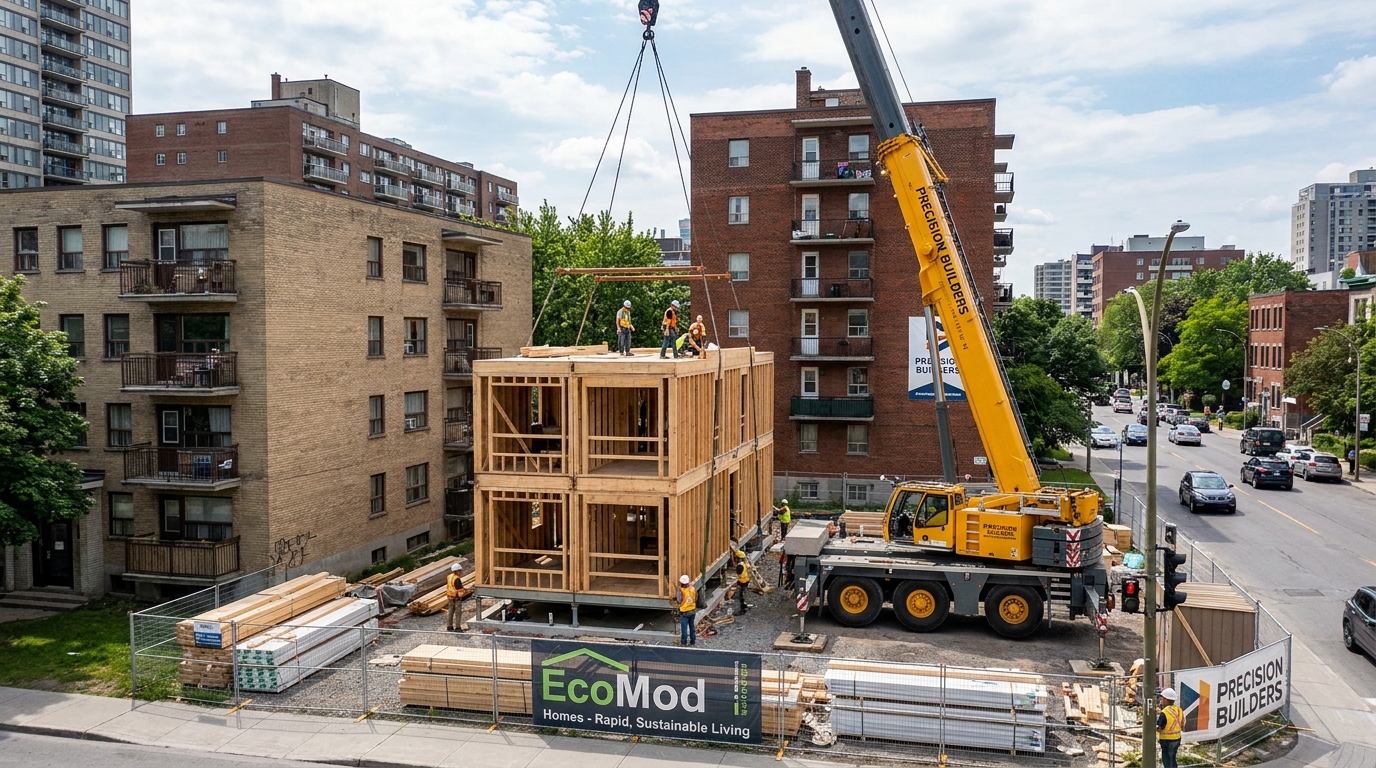
Still, modular and prefab should not be romanticized. Some projects fail because they are treated as one off experiments rather than part of a scalable production ecosystem. Factories need volume. Standardized components need market acceptance. Municipal approvals need to recognize alternative delivery methods without creating extra uncertainty. Transportation logistics, crane access, design integration, and local code compliance all have to work together. Innovation succeeds when it becomes routine, not when it remains exceptional.
Mass timber and other low carbon systems also belong in this conversation. In selected building types, mass timber can reduce embodied carbon while supporting faster assembly and high quality design. Panelized walls and floor systems can improve envelope performance and reduce waste. Bio based materials may also play a larger role over time. Yet the strategic lesson remains the same. Materials innovation works best when it is paired with code modernization, procurement confidence, skilled labor, and a market structure that supports repetition at scale.
The rise of missing middle and urban infill
For many cities, innovation is not only about taller towers or advanced factories. It is also about enabling the kinds of housing that fit more naturally into established neighborhoods. Missing middle housing includes duplexes, triplexes, fourplexes, townhouses, courtyard apartments, laneway suites, and small apartment buildings. These forms can increase supply, support affordability, and make better use of existing infrastructure without requiring dramatic physical change everywhere.
This approach matters because sustainable growth is often most effective when it builds on urban land that already has roads, transit, utilities, schools, and services. Infill and gentle densification can reduce pressure for outward sprawl while creating new options for families, seniors, workers, and first time renters. It can also support more walkable communities and improve the customer base for local retail and transit systems. From a city building perspective, this is one of the clearest examples of how land use and housing delivery reinforce one another.
CMHC’s 2025 reporting pointed to record rental construction and growing missing middle activity helping shape supply. That trend is significant because it suggests policy reform is beginning to influence market behavior. Where cities reduce exclusionary zoning, permit accessory dwelling units, streamline approvals for infill, and clarify design standards, smaller scale housing can become easier to deliver. These changes do not solve the crisis alone, but they widen the pipeline and create more distributed patterns of growth.
There is also an important equity dimension here. Large tower projects remain essential in many urban centers, but a healthy housing system needs a continuum of forms. Missing middle housing can support multigenerational living, incremental ownership, and neighborhood diversification. It can help people stay in communities as their needs change over time. In strategic terms, it creates resilience by reducing dependence on a single product type or tenure model.
Retrofits are as important as new construction
One of the most persistent myths in housing policy is that sustainability is mainly a question of how future buildings are designed. In North America, that is incomplete at best. Most homes that will exist in 2050 are already built. If cities want to lower emissions, reduce utility burdens, and strengthen resilience, they need deep energy retrofits across a very large share of the existing housing stock.
This includes better insulation, upgraded windows, airtightness improvements, modernized ventilation, electrification, heat pump adoption, and building envelope renewal. In multifamily properties, common area systems, hot water equipment, and rooftop upgrades can also make a substantial difference. For social and community housing, repair and retrofit programs are especially important because deferred maintenance often undermines both quality of life and long term affordability. A low rent unit with high utility bills, mold risk, and poor summer cooling is not truly secure housing.
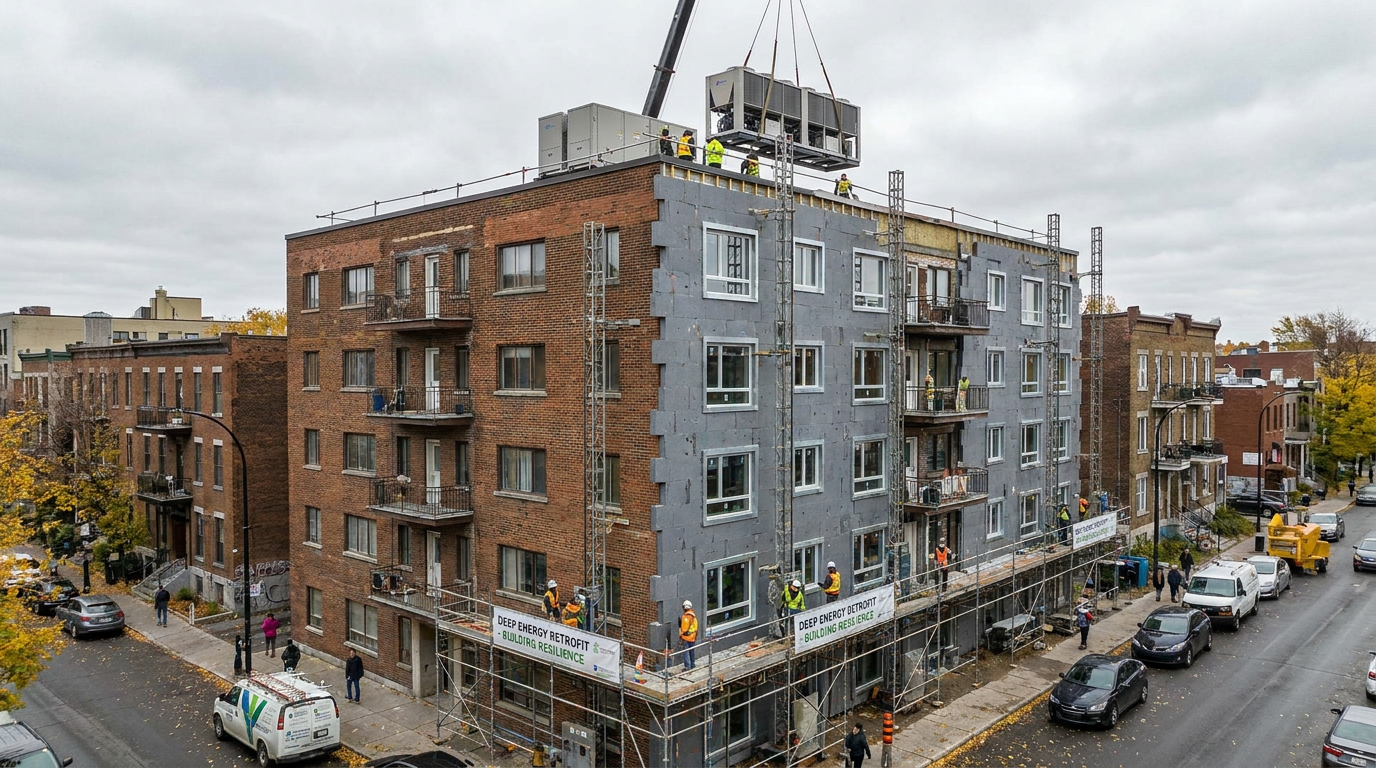
The policy trend is moving in this direction. CMHC reported $14 billion through the Affordable Housing Fund, supporting 57,000 homes and 174,000 repaired community units, along with $1.21 billion through the Co op Housing Development Program for more than 2,700 homes. Those figures reflect a growing recognition that housing system performance includes repair and preservation, not only new supply. Retrofitting aging affordable housing is often one of the fastest ways to protect vulnerable households from displacement and rising operating costs.
The climate rationale is equally compelling. The IEA has consistently shown that efficiency, electrification, and retrofit activity are essential to emissions reduction pathways. Retrofitting homes can cut operational carbon, reduce peak energy demand, and improve indoor comfort during heat waves and cold snaps. It can also lower exposure to volatile utility prices. From a development strategy standpoint, retrofit systems deserve the same level of attention as new build systems because they shape the environmental and social performance of the entire urban fabric.
Climate resilience is part of housing affordability
Housing affordability is often framed too narrowly. Monthly shelter cost matters, but so does exposure to flood damage, overheating, wildfire smoke, grid outages, and rising insurance premiums. In an era of climate volatility, resilience is no longer a premium feature. It is a core part of whether housing remains stable and affordable over the life of the asset. A home that repeatedly exposes residents to disruption creates hidden costs for households, insurers, municipalities, and health systems.
That is why the growing emphasis on climate resilient housing is so important. Canada’s National Research Council has reported that it is developing climate resilient codes, standards, and guidance to improve infrastructure resilience to climate risks. This signals a broader shift in thinking. Building performance is not just about efficiency metrics. It is about durability, hazard resistance, passive survivability, and the ability of housing to continue supporting daily life under stress.
For cities, resilience planning affects where and how housing should grow. Some sites may need stronger stormwater infrastructure or flood mitigation. Others may require cooling strategies, shaded public space, better air filtration, or backup power for vulnerable populations. Design standards may need to evolve to reflect changing rainfall intensity, fire risk, and heat conditions. Over time, the line between climate policy and housing policy is disappearing because the same decisions increasingly determine both outcomes.
When viewed through this lens, sustainable housing is not an environmental add on. It is an economic and public safety strategy. Homes that perform well in extreme conditions protect residents, lower lifecycle costs, and reduce pressure on emergency systems. They also preserve asset value and improve financing confidence. In other words, resilience strengthens feasibility as much as it supports social outcomes.
Finance and public investment as system catalysts
Even the most advanced housing technologies cannot scale without capital structures that support them. Financing determines what gets built, where it gets built, and under what affordability conditions. This is one reason recent public sector programs matter so much. They are not just subsidies. They are market signals that can help shape the direction of supply, tenure, and performance.
CMHC’s 2025 annual reporting stated that the Apartment Construction Loan Program had committed more than $29 billion to help build more than 74,500 new purpose built rental units. That is a significant intervention in a market where rental delivery has often been constrained by high costs and uncertain economics. By lowering financing barriers for rental housing, governments can support a more stable pipeline of homes that align with long term urban needs.
Financing innovation also includes tools tied to affordability, energy performance, and community ownership. Co operative housing, land trusts, public land strategies, revolving retrofit funds, green bonds, and blended finance structures can all play a role. The strategic goal is to reduce the mismatch between what cities need and what conventional capital alone is willing to provide. In many cases, market rate development and public interest development need to coexist within the same ecosystem rather than be treated as separate worlds.
The deeper lesson is that affordability and sustainability often improve when risk is better distributed. Predictable approvals, clear zoning, utility coordination, infrastructure planning, and stable financing reduce uncertainty for developers and lenders. At the same time, performance standards and affordability requirements help ensure public value. A stronger system is one where private expertise, public policy, and community outcomes are aligned through design rather than through constant negotiation after the fact.
Transit oriented development and the value of location
Dense housing is not automatically sustainable. The location of that housing matters enormously. If residents have to rely on long car commutes to reach work, school, groceries, and healthcare, the environmental and financial benefits of density can quickly erode. This is why transit oriented development remains one of the most powerful frameworks for sustainable urban growth. Housing near reliable transit creates a multiplier effect across affordability, mobility, emissions, and public realm quality.
Well planned transit oriented communities combine residential density with access to jobs, services, parks, and daily necessities. They support walking and cycling, reduce transportation cost burdens, and make public investments in transit more productive. They can also help cities concentrate growth where infrastructure can serve it efficiently. From a land value perspective, transit access can support higher intensity development, but that value must be managed carefully so that affordability is not priced out of the very locations where it matters most.
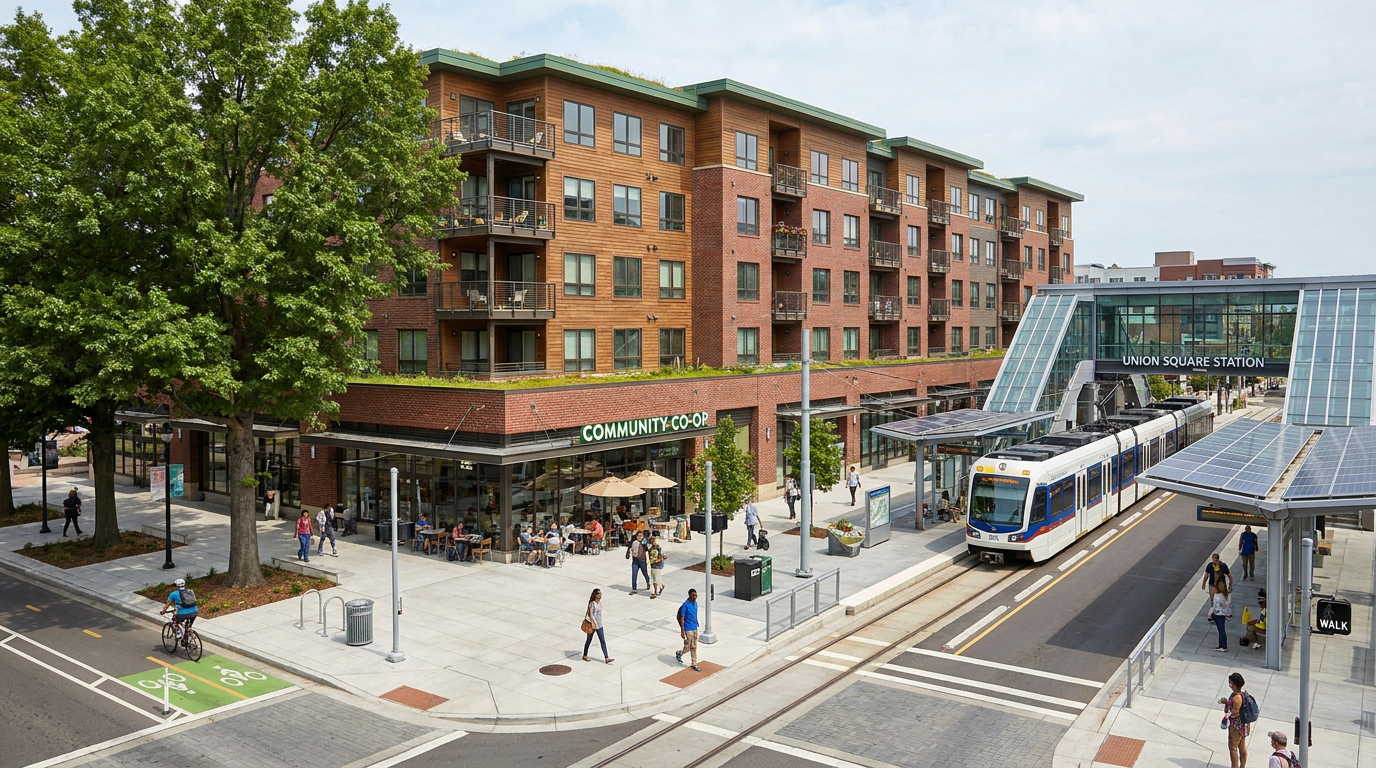
Successful transit oriented housing systems usually involve more than rezoning around stations. They require coordinated planning for public space, schools, utilities, active transportation, and community services. They may also require inclusionary measures, land assembly tools, or public land partnerships to ensure mixed income outcomes. Otherwise, the result can be growth that is efficient on paper but exclusionary in practice. Sustainable cities need location efficient housing for a broad range of households, not just those able to absorb premium rents.
This is where the notion of housing as infrastructure becomes especially useful. Transit and housing should not be planned in separate silos. They shape one another’s performance. A rail line without enough nearby housing underperforms its potential. A major housing district without strong transportation links creates congestion and cost burdens. The most effective urban strategies align both systems from the outset.
Community based models and social resilience
Innovation in housing systems also includes tenure and governance models that keep homes affordable over time. Co operative housing, community land trusts, mixed income developments, and nonprofit ownership structures can stabilize neighborhoods and reduce exposure to speculative price escalation. These models are not replacements for market housing, but they are essential complements in a balanced ecosystem. They preserve social diversity, support long term affordability, and create forms of community stewardship that purely transactional models often lack.
UN Habitat’s 2026 World Cities Report emphasizes that adequate housing is central to sustainable urban development, climate action, and urban resilience. That framing is important because it places housing within a wider social contract. A city is not sustainable if large segments of its population are excluded from secure shelter, pushed into long commutes, or left in deteriorating buildings that compromise health and safety. Social resilience is inseparable from physical resilience.
Community based housing models can be especially valuable in high cost cities where land appreciation outpaces wages. By separating land value from speculative resale or by embedding affordability rules into governance structures, these models help protect housing from permanent loss. They can also create stronger resident participation, improve stability for families, and reduce turnover that weakens neighborhood cohesion. In strategic terms, they build a layer of permanence into urban systems that are otherwise highly exposed to market cycles.
Supportive and transitional housing also deserves attention within an innovation framework. Housing systems fail when they ignore the needs of people facing disability, mental health challenges, family instability, or homelessness. A complete urban strategy recognizes that housing supply, support services, healthcare access, and local coordination all affect outcomes. Innovation here often comes from integrated delivery models rather than new building technologies alone.
What cities get wrong about housing innovation
There are several misconceptions that continue to distort housing debates. The first is that new housing alone will solve affordability. More supply is essential, but affordability also depends on incomes, land cost, permitting timelines, infrastructure charges, household energy burdens, and transportation access. A system that delivers many expensive units far from jobs and services may improve raw numbers without solving lived affordability.
The second misconception is that dense housing is inherently sustainable. Density can support sustainability, but outcomes depend on materials, energy performance, resilience, and location. A poorly designed building with weak thermal performance and no transit access can lock in high emissions and household costs for decades. True sustainability comes from integrated planning, not just from unit count per acre.
The third misconception is that sustainability competes with affordability. In practice, many of the best strategies advance both goals together. Better envelopes, electrification, efficient systems, and resilient design can reduce operating costs over time. Transit oriented growth can cut transportation expenses. Retrofitting community housing can preserve affordability while improving comfort and performance. The challenge is not whether these goals align. It is whether policy and financing frameworks are structured to capture their shared value.
Finally, some cities treat innovation as a branding exercise rather than a delivery discipline. Pilot projects, design competitions, and isolated showcases can be useful, but they do not by themselves transform the housing system. What matters is the ability to standardize success, build capable institutions, align codes and approvals, and create enough market confidence for repetition. The future belongs not to the most experimental idea, but to the most scalable one.
A strategic framework for sustainable urban housing
If cities want innovative housing systems to support sustainable growth, they need a framework that connects ambition to execution. The strongest model is one that integrates land use, infrastructure, construction productivity, climate performance, and affordability policy into a single operating logic. Housing cannot be treated as a downstream result of growth. It has to be one of the primary tools through which growth is organized.
That framework should include several core priorities. Cities need zoning and approval reform that expands capacity for missing middle housing, rental projects, infill, and transit oriented development. They need industrialized construction pathways that are compatible with code compliance and repeatable financing. They need retrofit strategies for existing buildings, especially aging affordable and community housing. They need resilience standards that reflect the realities of heat, flooding, smoke, and severe weather. They also need financing mechanisms that support both market delivery and long term affordability preservation.
- Speed with quality so that more housing can reach occupancy faster without sacrificing safety, durability, or livability.
- Lower lifecycle cost through efficient design, electrification, and resilient building systems that reduce long term household expenses.
- Location efficiency by concentrating growth where transit, services, and infrastructure can support it sustainably.
- Diverse tenure and building types to reflect the realities of different incomes, household structures, and community needs.
- Scalability so that successful models move beyond pilot status and become part of normal city building practice.
For public leaders, the central question is not whether innovation is necessary. It is how to govern for it. That means coordinating departments that often work separately, including planning, transportation, housing, environment, utilities, and finance. For the development industry, it means designing projects within a wider urban system rather than treating each site as an isolated transaction. For communities, it means moving the conversation from abstract resistance or abstract optimism toward concrete performance standards that define good growth.
The long term opportunity
The long term opportunity is larger than solving a temporary housing shortage. Cities that build strong housing systems can become more productive, more inclusive, and more climate resilient. They can reduce sprawl, support labor mobility, improve household stability, and make infrastructure investments work harder. They can also create a more credible path toward emissions reduction because homes are a major part of the urban carbon equation. In this sense, housing innovation is one of the most important economic development strategies available to metropolitan regions.
Canada and North America are at a pivotal moment. The pressure to add supply is intense, but so is the need to future proof what gets built and what already exists. CMHC’s affordability targets, record rental activity, large scale public financing commitments, retrofit investments, and policy attention to missing middle growth all point in the same direction. The system is beginning to change, but not yet at the speed or scale required. That gap is where leadership matters most.
The strongest evidence today suggests a broad consensus. Without innovation in how housing is financed, approved, built, and maintained, cities will struggle to meet both housing demand and climate targets. Yet the reverse is also true. With the right systems in place, housing can do far more than shelter people. It can anchor resilient neighborhoods, strengthen social equity, support decarbonization, and guide urban growth toward a more sustainable future.
Innovative housing systems are not optional for growing cities. They are the operating framework through which affordability, sustainability, and resilience can finally move in the same direction. The task ahead is to stop treating housing as a fragmented issue and start treating it as the foundational infrastructure of urban life.



No Comment! Be the first one.