



The rental market in 2026 is not collapsing, overheating, or moving in one uniform direction. It is becoming more balanced, more segmented, and more dependent on execution. For several years, landlords and investors operated in a market shaped by rapid household formation, strong immigration, tight vacancy, and unusually fast rent growth. That phase has now given way to a more nuanced environment in which supply has arrived, demographic momentum has cooled, and technology is becoming central to how rental housing is marketed, leased, and managed.
Table Of Content
- A More Balanced Market Does Not Mean a Uniform Market
- Demographics Are Now the Core Demand Variable
- Supply Has Arrived, and That Changes the Rules
- Technology Has Moved from Convenience to Competitive Necessity
- Why Asking Rents and Occupied Rents Are Telling Different Stories
- Segment Selection Is Now the Real Investment Strategy
- What Renters Need to Know in 2026
- What Investors Should Watch for in the Second Half of 2026
- The Outlook: Moderation, Not Weakness
- Key Takeaways for 2026
As of mid-2026, the most important shift is that rental demand is no longer strong everywhere at once. In Canada, CMHC has made it clear that increased rental completions and slower population growth have eased market pressure in several major centres. Asking rents have softened in some segments, especially where new supply is concentrated, even as average rents for occupied units continue to rise. That distinction matters because it shows how headline narratives can miss what is actually happening on the ground. A renter renewing in place may still face higher costs, while a renter shopping among newly completed buildings may find incentives, concessions, and more negotiating power than they would have had two years ago.
Across North America, the broader pattern is similar. The U.S. multifamily market has also moved away from peak scarcity toward a more normalized phase. Financing remains active, supply has continued to come online, and rent growth has moderated rather than disappeared. At the same time, affordability constraints still limit the shift from renting to owning, even if mortgage rates ease somewhat. The result is a market where renters remain essential, but landlords can no longer assume that broad market momentum will solve weak operations, poor product positioning, or overambitious underwriting.
This is why 2026 is such an important year to understand clearly. It is the year when technology and demographics are reshaping rental performance more than simple macro scarcity. The winners are increasingly the properties and operators that match the right product to the right renter profile, price effectively, manage costs tightly, and respond faster than the competition. For investors, that means segment selection matters more than broad exposure. For renters, it means opportunities and pricing can vary dramatically depending on unit type, building age, and local demand drivers.
In practical terms, the rental market of 2026 is less about whether housing is generally tight or loose and more about which renters are still forming households, which buildings are meeting their needs, and which landlords are using technology well enough to preserve occupancy and margins. That is the real story behind current rental trends.
A More Balanced Market Does Not Mean a Uniform Market
One of the biggest misconceptions in the current discussion is the idea that rising vacancies automatically mean rents are falling everywhere. That is not what the data show. CMHC reports that the average vacancy rate for purpose-built rental apartments in Canada’s largest census metropolitan areas rose to 3.1% in 2025 from 2.2% in 2024. On the surface, that looks like a broad loosening of conditions. But the internal structure of that loosening matters far more than the headline number.
Vacancy increases are being driven mostly by newer supply that entered the market after a long period of development and construction activity. In many cases, these units are positioned at the higher end of the rent spectrum. They are competing not just with other new buildings, but also with renter budgets that have become more constrained. As a result, some of the most visible softness is showing up in newer, relatively expensive product where concessions and incentives are helping lease-up. Free rent periods, move-in credits, and flexible lease terms are increasingly part of the competitive toolkit.
At the same time, lower-priced and older units often remain relatively tight. This is especially true in areas where renters are still priced out of ownership and where replacement supply is too expensive to serve the same customer base. So while asking rents in some premium segments may soften, the effective demand for more affordable stock can remain resilient. Investors who treat the rental market as a single asset class risk missing this critical divergence.
Balanced conditions also do not mean weak conditions. In a truly overheated market, almost any available unit can absorb quickly. In a balanced market, however, performance is earned. Properties must be priced correctly, marketed efficiently, maintained consistently, and aligned with the needs of actual renter cohorts. That is a healthier market structure from a long-term investment perspective, but it requires much sharper management discipline.
In 2026, the question is no longer whether rental housing is needed. The question is which type of rental housing is needed most, at what price, and for which renter segment.
This distinction is what separates tactical opportunities from broad market assumptions. If a building depends on aggressive annual rent growth to justify its returns, 2026 is a tougher environment. If a property offers relative affordability, strong location fundamentals, and operational upside, the current market may actually improve entry conditions and reduce speculative risk.
Demographics Are Now the Core Demand Variable
If the early 2020s were driven by supply shortage narratives, 2026 is increasingly shaped by demographics. CMHC attributes weaker rental demand in 2025 and 2026 to slower population growth following immigration policy changes, along with declines in the 15 to 34 age cohort that typically drives a large share of renter household formation. That matters more than many investors initially appreciate, because rental demand is highly sensitive to population segments that are disproportionately likely to rent.
Younger adults, new immigrants, international students, and work-permit holders play an outsized role in lease-up velocity and occupancy in many urban rental markets. When those groups grow quickly, demand can look almost endless, especially in gateway cities and education hubs. When those groups slow, the impact appears first in vacancies, concession pressure, and slower absorption of newly delivered units. This has been visible in parts of Ontario, British Columbia, and Ottawa, where fewer students and temporary workers have translated into softer near-term demand.
The demographic shift also helps explain why market softening is selective. If a building is heavily oriented toward renter profiles that are currently growing more slowly, the owner may feel much more pressure than a landlord serving stable local households, families, or essential workers. In other words, demand has not disappeared. It has become more concentrated and more conditional.
There is also a timing issue that matters. Demographic trends do not hit all neighborhoods or asset classes at once. Downtown micro-units near student corridors may feel the shift earlier than suburban family rentals. Buildings designed around short-stay mobility may see more friction than assets serving longer-term tenants. This is one reason broad city-level data can be misleading without submarket and segment-level interpretation.

For renters, these demographic changes can improve negotiating leverage in some parts of the market. A building that expected constant inflow from students, young professionals, or newcomers may now need to compete harder to convert prospects. For investors, the implication is more strategic. Rather than underwriting growth based on citywide population headlines alone, it is increasingly necessary to understand who is moving into a market, who is slowing, and which buildings are positioned to capture the most reliable tenant base.
This is why household formation remains the key operating concept beneath rental demand. Population size matters, but household formation matters more. A city can still grow while rental demand moderates if the most rent-intensive cohorts slow, delay moving out, double up, or shift locations. Likewise, even a slower-growth market can support strong rental performance if a property aligns well with durable needs such as affordability, commute access, school proximity, or stable employment clusters.
Supply Has Arrived, and That Changes the Rules
After years of strong development activity, rental supply is finally catching up in several major Canadian markets. Projects that were launched during a period of intense demand and favorable assumptions are now being completed into a more measured environment. That does not eliminate the long-term need for housing, but it changes near-term pricing power. The market is moving from shortage-driven momentum to supply-sensitive competition.
CMHC’s mid-2026 view suggests that rental conditions are moving closer to a balanced range where inflation-adjusted rent growth is near zero. This is a major change in tone compared with the earlier phase of the cycle, when rent increases often outpaced income growth and outstripped normal operating assumptions. For investors, that means the easy gains from broad rent escalation are less dependable. Future performance is more likely to come from local market selection, expense control, tenant retention, and operational precision.
New buildings are not failing, but they are facing a tougher lease-up reality. More supply means more choice, and more choice means renters can compare amenities, finishes, and incentives more aggressively. A building that enters a market with premium rents and limited differentiation may need to use concessions to maintain absorption targets. This is especially true in submarkets where several projects are delivering at the same time.
Older properties are therefore becoming more interesting again, particularly when they are well located and have sensible renovation upside. If a landlord can improve common areas, modernize units selectively, and enhance operations without pushing rents beyond the practical reach of local households, that asset can compete effectively against new stock without bearing full development risk. In 2026, value-add is becoming more attractive not because new supply is irrelevant, but because price-sensitive demand remains deeper than luxury demand in many locations.
This supply wave also exposes the difference between occupancy and rent growth. An owner may preserve occupancy by adjusting pricing, offering incentives, or improving the leasing process, but that does not necessarily translate into strong net operating income growth if expenses rise at the same time. This is one reason technology and efficiency matter so much in the current cycle. If revenue growth is moderating, cost discipline becomes a bigger driver of returns.
Technology Has Moved from Convenience to Competitive Necessity
Perhaps the most important operating shift in the 2026 rental market is the rise of technology as a genuine performance lever. In earlier years, digital touring, online applications, automated communication, and AI-assisted property workflows were often described as convenience features. In the current market, they are increasingly tied directly to conversion rates, leasing efficiency, maintenance response times, and margin protection.
CMHC’s research agenda and corporate planning acknowledge the growing relevance of AI, automation, and emerging technology in housing. Industry groups such as the National Apartment Association have also reported increasing use of AI for prospect research, model checking, leasing support, and operational analysis. This is not just about replacing staff tasks. It is about responding to a rental environment in which every lost lead, every delayed maintenance ticket, and every poorly timed renewal offer can affect occupancy and profitability.
Renters have also changed their expectations. In many markets, digital-first leasing is now the baseline. Prospective tenants expect to browse inventory online, take virtual or self-guided tours, apply digitally, upload documents securely, and receive prompt follow-up. A building that still relies on slow, manual leasing processes risks losing qualified renters to more responsive competitors, especially when supply is more available and switching costs are low.
On the operational side, technology can improve everything from lead scoring to staff scheduling to predictive maintenance. A property manager using analytics effectively can identify which channels produce the strongest leases, which floor plans are underperforming, which concessions actually convert prospects, and which tenants are at greatest risk of non-renewal. In a market where headline rent growth is no longer doing all the work, this kind of precision becomes a significant advantage.
There is also an emerging divide between landlords who use technology strategically and those who use it superficially. Installing a resident app or chatbot is not enough by itself. The real value comes from integrating systems so that leasing data, maintenance workflows, renewals, pricing, and resident communication reinforce each other. A fragmented digital stack can create friction. A well-implemented one can lower vacancy loss and improve retention.
For renters, the best technology adoption shows up as speed, transparency, and reliability. For investors, it shows up as better operating ratios and more resilient cash flow. In 2026, those two outcomes are increasingly linked.
Why Asking Rents and Occupied Rents Are Telling Different Stories
One of the most important analytical points in the current market is the distinction between asking rents and rents paid by existing tenants. CMHC notes that increased supply and slower population growth have eased asking rents in some markets, while average rents for occupied units are still rising. This can look contradictory at first, but it is actually a normal feature of a market that is cooling from a very tight level rather than collapsing.
Asking rents reflect the price of units currently available for lease. These are the rents most affected by concessions, new supply, and competitive positioning. If a new tower delivers hundreds of units into a submarket at once, asking rents may soften or become negotiable as the operator works to fill suites. Existing tenants, however, are on a different timeline. Their rents are shaped by lease renewals, rent control frameworks where applicable, and the practical frictions of moving.
This means a city can show softer advertised rents without producing broad relief for all renters. Households already in place may still experience increases, while households searching among newly available stock may find better options. For analysts and investors, this is a reminder that average rent statistics must be interpreted carefully. The most investable insight often lies not in the citywide average, but in the gap between in-place economics and market-facing pricing.
That gap also affects acquisition strategy. A property with below-market in-place rents may still offer upside over time, but only if tenant incomes, regulation, and local competition allow those rents to reset responsibly. Meanwhile, a newly delivered asset showing attractive asking rents may not yet have proven its stabilized economics if concessions are doing too much of the lease-up work. Investors need to distinguish between nominal rents and durable rents.
In 2026, advertised pricing tells you how much competition exists. Occupied pricing tells you how much embedded revenue remains in the asset. The difference between the two is where underwriting discipline matters most.
For renters, this divergence creates openings. If you are actively searching, especially in segments with recent completions, negotiation is more realistic than it was during the tightest period of the cycle. For owners, it reinforces the importance of retention. Keeping a qualified resident at a sustainable rent is often more valuable than chasing a slightly higher headline rate and risking turnover.
Segment Selection Is Now the Real Investment Strategy
The strongest investment theme in the 2026 rental market is not broad market exposure. It is segment selection. When conditions were extremely tight, simply owning rental inventory in a major market often produced strong outcomes. In a more balanced environment, performance depends much more on whether the asset serves a durable renter need at the right price point.
CMHC’s findings suggest that newer and more expensive rental units are facing the most vacancy pressure and incentive competition, while more affordable units remain in high demand. That points investors toward categories such as workforce housing, stabilized mid-market rentals, and older assets with manageable value-add potential. These segments may not deliver the flashiest leasing headlines, but they often offer stronger risk-adjusted performance because their demand base is broader and less discretionary.
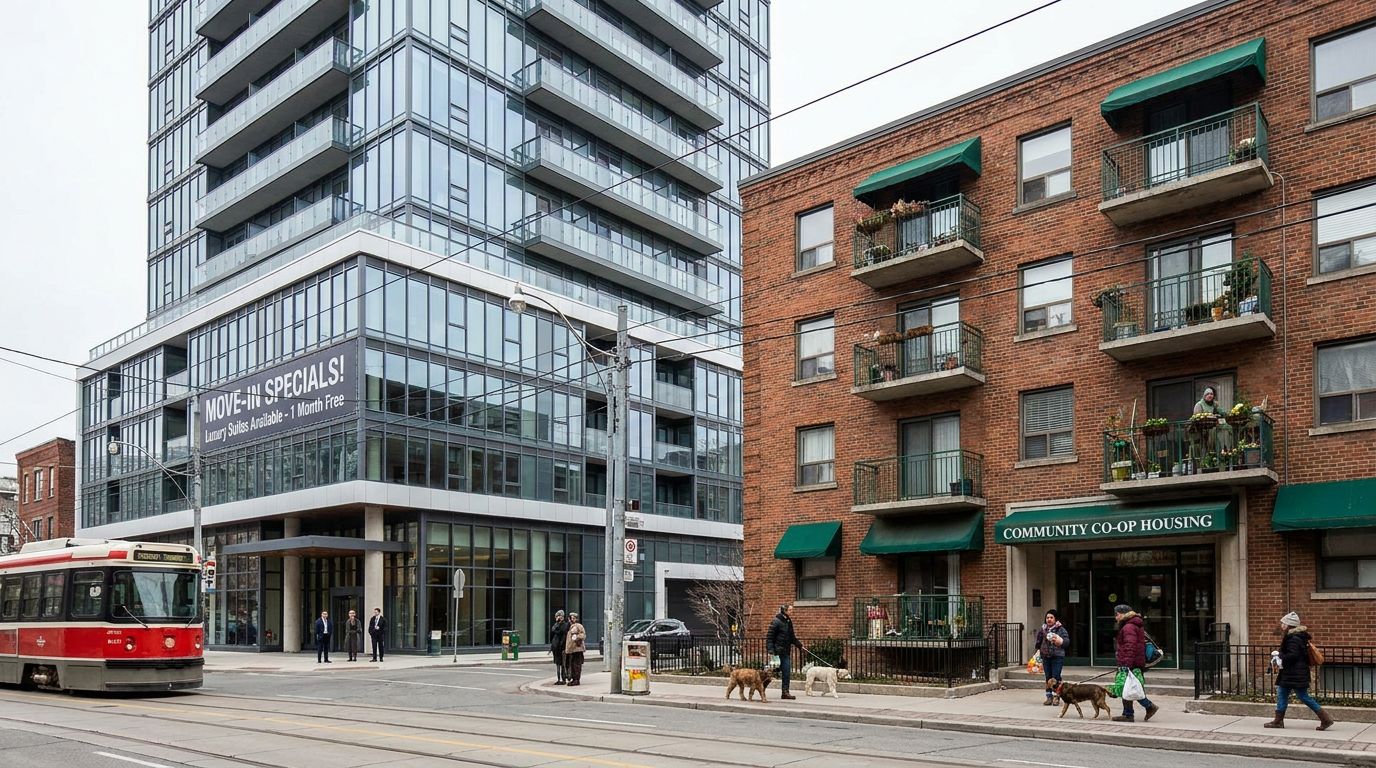
Workforce housing is especially compelling in an environment where homeownership remains unaffordable for many households. Even if mortgage rates ease, purchase prices, down payment requirements, and monthly carrying costs still create a wide barrier to entry. That keeps a large share of middle-income households in the rental pool for longer, which supports demand for well-located, practical, professionally managed rental stock.
Student housing, newcomer-oriented rentals, and assets near employment nodes also remain relevant, but investors need to be more selective than before. Demographic softness does not mean these segments are unattractive. It means performance will vary more sharply by institution quality, local job growth, transit access, and building configuration. The days of assuming every urban rental format benefits equally from migration and household formation are behind us for now.
There is also a renewed case for looking closely at suburban demand. Hybrid work patterns, family formation, and cost sensitivity continue to influence location decisions. In some markets, suburban rental communities with larger units and easier parking may perform well relative to downtown luxury product, especially if they attract longer-tenure households. This does not invalidate urban rental demand, but it does reinforce the idea that investors should think in terms of renter mission rather than simple centrality.
Capital markets are responding to this shift as well. In the U.S., Fannie Mae reported about $74 billion in multifamily loan production volume in 2025, its largest annual multifamily volume since 2020. Financing activity confirms that institutional interest in rental housing remains strong. But strong capital interest does not mean every asset class is equally attractive. It means investors still believe in the sector, while becoming more selective about where and how returns will be generated.
What Renters Need to Know in 2026
For renters, the current market offers a more mixed but potentially more favorable landscape than the one seen during the most competitive years of the early 2020s. The first advantage is choice. In markets where new supply has been delivered at scale, renters may have access to more available units, more flexible move-in dates, and more visible concessions. This is especially true in newer buildings trying to stabilize occupancy.
The second advantage is timing. A balanced market gives renters more room to compare not just rents, but effective rents after incentives, amenity quality, building management standards, and neighborhood trade-offs. In a tighter market, renters often had to make fast decisions with limited negotiating leverage. In 2026, at least in some segments, a more deliberate approach is possible.
That said, renters should not assume relief is universal. Affordable units remain competitive in many cities, and older buildings with lower rents can still see strong demand. The market is more negotiable at the high end than at the affordability-constrained end. So the best strategy is not simply to wait for “the market” to improve, but to understand which submarkets and product types are currently over-supplied and which remain tight.
Technology also gives renters more information, but it requires better filtering. Online platforms make it easier to compare listings, tour remotely, and apply quickly, yet they also create noise. A concession-heavy listing may look attractive but conceal weaker management quality or a difficult location fit. The smartest renters in 2026 are not just searching by price. They are comparing total value, responsiveness, lease terms, and practical livability.
Longer tenant tenure is another notable trend across North America. U.S. data highlighted by the National Apartment Association suggest a meaningful share of renters are staying in place for at least five years. This reflects affordability constraints, slower transitions into ownership, and the rising value of housing stability. For renters, that means the best lease decision may be less about chasing a short-term discount and more about choosing a property that supports multi-year flexibility and quality of life.
What Investors Should Watch for in the Second Half of 2026
Investors evaluating rental opportunities in the second half of 2026 should focus on a short list of indicators that reveal much more than headline rent growth. The first is lease-up velocity. In a market where supply is more available, the speed at which a property converts leads into signed leases tells you whether the product is truly meeting local demand. Slow lease-up is often an early warning sign of mispricing, poor marketing, or segment mismatch.
The second is concession dependence. Incentives are not inherently negative, especially during initial stabilization. But if an asset relies too heavily on ongoing discounts to maintain occupancy, its face rents may overstate durable performance. Effective rent and retention trends matter more than advertised pricing. Investors should underwrite what the building can sustainably earn, not what it hopes to advertise.
The third is operating efficiency. In a moderate rent-growth environment, small improvements in collections, maintenance turnaround, staffing productivity, and resident retention can materially influence net operating income. This is where proptech and AI tools can create tangible value, provided they are implemented with discipline. A building that saves time but frustrates residents is not more efficient. A building that improves both service quality and cost control has a real edge.
The fourth is demographic resilience. Assets that depend on a single transient demand source may face more volatility than those serving a diversified renter base. Investors should pay close attention to local universities, immigration flows, employment sectors, transit connectivity, and barriers to homeownership. These variables help determine whether demand softness is temporary, segment-specific, or structural.

The fifth is asset positioning by age and rent level. CMHC’s observation that vacancy increases are concentrated in newer supply is highly actionable. It suggests that investors should study where a property sits in the local price ladder. A premium building in an incentive-heavy submarket requires different expectations than a well-maintained mid-market property with stable residents and limited direct competition.
Finally, investors should watch how interest rates and homeownership affordability evolve. Even if financing conditions improve, many households will remain renters because the total cost of buying is still high relative to income. This means renter demand is likely to persist, but not with the same pricing urgency seen during the most constrained years. Stable demand does not guarantee fast rent growth. It supports occupancy and long-term relevance, which are different and often more valuable foundations for disciplined investment.
The Outlook: Moderation, Not Weakness
The most accurate way to describe the rental market in 2026 is not weak, and not overheated. It is moderating. That moderation is healthy because it shifts the sector away from scarcity-driven assumptions and toward fundamentals. Balanced conditions reward better product-market fit, stronger operations, and smarter capital allocation. They also create a more transparent environment for renters, who can make decisions with somewhat less urgency and somewhat more leverage in certain segments.
Technology and demographics are at the center of this new landscape. Demographics determine where demand is forming, slowing, or becoming more price sensitive. Technology determines how efficiently landlords respond to that demand, how effectively they lease available units, and how well they preserve margins when revenue growth slows. Together, these forces are reshaping not just rental trends, but the entire operating logic of the sector.
For investors, the lesson is clear. Broad market beta is less reliable than it was during the supply crunch. The strongest opportunities are likely to come from assets that align with resilient renter needs, offer relative affordability, and can be operated with precision. Workforce housing, stabilized properties, and selective value-add strategies deserve serious attention. Luxury exposure can still work, but it requires sharper underwriting, careful submarket analysis, and realistic expectations around concessions and absorption.
For renters, the message is equally practical. Conditions are improving in some parts of the market, especially where new supply has increased choice. But affordability remains uneven, and the best opportunities are not spread evenly across all neighborhoods or price points. Renters who understand segment differences, compare effective rents carefully, and prioritize management quality alongside pricing will be best positioned in 2026.
Ultimately, the rental market is not simply cooling. It is evolving. The era of easy assumptions is ending, and the era of selective strategy is taking its place. That is a positive development for anyone willing to look beyond the headline numbers. In this market, insight matters more than noise, and execution matters more than momentum.
Key Takeaways for 2026
-
Rental markets are becoming more balanced, not uniformly soft. Rising vacancies are concentrated mainly in newer supply, while affordable and older stock can remain tight.
-
Demographics are now the primary demand driver. Slower immigration growth and declines in the 15 to 34 age cohort are reducing renter household formation in some markets.
-
Technology is now a competitive requirement. Digital leasing, AI-assisted workflows, and data-driven operations are increasingly tied to occupancy, cost control, and tenant retention.
-
Asking rents and occupied rents can move differently. Softer advertised rents do not necessarily mean current tenants are seeing lower costs.
-
Investment opportunity lies in segment selection. Workforce housing, well-located older stock, and value-add strategies may offer better risk-adjusted performance than relying on broad rent acceleration.
That is the defining rental market reality of 2026. It is a market shaped less by a single shortage story and more by the interaction between who needs to rent, what they can afford, and how effectively owners deliver the right product to them. For those prepared to think strategically, there is still significant opportunity ahead.



No Comment! Be the first one.