What AI’s Market Premium Means for Real Assets
When capital keeps rewarding technology through volatility, real estate investors should pay attention. Not because every landlord needs to own a tech ETF, but because equity markets often signal where physical demand will follow.
The Motley Fool recently highlighted the iShares Expanded Tech Sector ETF, which gained 27% in the first half of 2026, outperforming the S&P 500, Nasdaq-100, and Dow Jones Industrial Average despite geopolitical tension, oil price pressure, and inflation concerns. The important point for KG Invest readers is not simply the return. It is what is driving it.
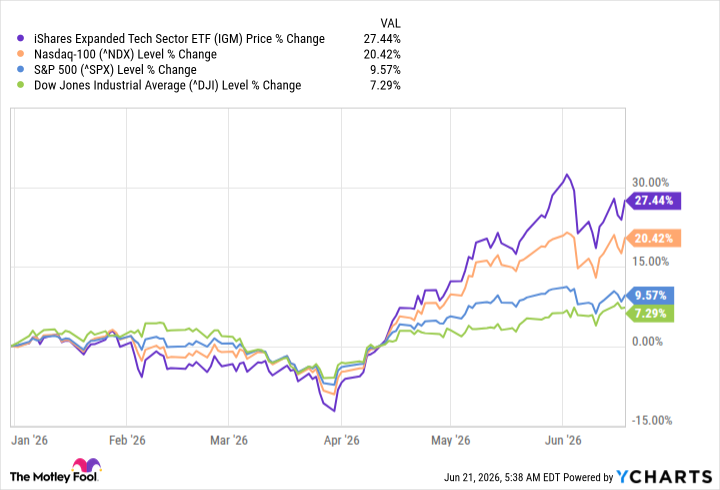
The ETF holds nearly 300 technology stocks, but more than 35% of its assets are allocated to semiconductor companies. Its four largest positions, Nvidia, Broadcom, Alphabet, and Apple, account for roughly 32.8% of the portfolio. That concentration tells us where investors believe the next layer of value is being created: chips, cloud capacity, AI platforms, and consumer distribution.
For real estate, this is not abstract. AI demand is physical. It requires data centers, power infrastructure, cooling systems, fiber connectivity, logistics support, and skilled labour. The more capital flows into AI computing, the more pressure builds around land, utilities, and industrial locations capable of supporting high-density digital infrastructure.

The strongest property signal is the growing premium on power-secured sites. In many markets, access to electricity is becoming more valuable than access to cheap land. Data center operators and cloud providers do not only need square footage. They need grid capacity, redundancy, water or advanced cooling solutions, permitting certainty, and proximity to network routes.
That creates a secondary opportunity set. Industrial land near substations, underused commercial sites with upgrade potential, and regional markets with favourable energy economics may attract stronger institutional attention. Investors should also watch municipalities that actively court digital infrastructure, as zoning cooperation can materially reduce execution risk.
AI may be priced in the stock market, but its demand is increasingly landing in the property market.
There are risks. Technology-led demand can be cyclical, and equity market enthusiasm can move faster than physical absorption. Power constraints, environmental scrutiny, water usage, community opposition, and rising construction costs can all weaken project economics. A site that looks strategic on a map may fail if interconnection timelines stretch beyond investor patience.
The ETF’s long-term performance also carries a broader portfolio lesson. Since its 2001 inception, according to The Motley Fool’s summary, it has compounded ahead of the S&P 500. For property investors, the takeaway is not to chase last year’s winner. It is to understand the structural theme behind the return and then identify where that theme meets real assets.
In practical terms, AI should now be part of location analysis. When assessing industrial, mixed-use, or land opportunities, investors should ask whether the area has power expansion, fiber depth, planning flexibility, and institutional tenant demand. The next premium location may not be defined by foot traffic. It may be defined by megawatts.
Source: The Motley Fool