



Community intelligence is the ability of residents, civic organizations, local governments, and service providers to combine shared knowledge, local experience, and relevant data to understand what is happening in a place and improve outcomes. That can mean better bus routes, faster outreach for people experiencing homelessness, smarter infrastructure decisions, or more responsive neighborhood services. It is not a single app, dashboard, or vendor product. It is a way of making local decisions that is more informed, more collaborative, and ideally more accountable.
Table Of Content
- What community intelligence actually means
- Why the idea is gaining traction now
- The triangle that makes community intelligence work
- Data identifies patterns
- Participation validates priorities
- Governance turns insight into fair action
- Practical examples of communities using community intelligence
- Using transit and accessibility data to improve routing
- Targeting homelessness outreach more effectively
- Guiding public health interventions with local surveillance and community trust
- Using neighborhood feedback tools to prioritize local improvements
- Community intelligence and the social dimension of urban life
- The barriers communities keep running into
- What successful communities do differently
- Why community intelligence is not surveillance
- A practical framework for local leaders
- The future of smarter urban spaces
- Conclusion
That distinction matters because the phrase smart city has often been reduced to sensors, control rooms, and flashy technology. In reality, the most credible forms of urban intelligence are often much smaller and much more grounded. A town may combine resident surveys with public transit data to adjust service frequency. A city may use accessibility measures and cycling data to identify gaps in safe mobility. A regional network may combine administrative records and community input to direct social support where it is needed most. The intelligence is not in the gadget. It is in the feedback loop.
In Canada, this way of thinking has gained institutional support through smart-city programs that emphasized resident-driven ideas, meaningful engagement, and the use of data and connected technologies to solve clearly defined problems. That framing is useful because it moves the conversation away from technology for its own sake. It also reflects an important shift now visible across North America. More communities are moving beyond one-off pilots and toward capacity building, data governance, and long-term implementation support.
There is also a human reason this topic matters now. Statistics Canada treats sense of belonging to the local community as a headline quality-of-life indicator, linking it to social connectedness and well-being. Recent figures show how fluid that sentiment can be. In one snapshot, 48.1% of Canadians reported a very strong or somewhat strong sense of belonging to their local community in the second quarter of 2025, after 53.5% in the fourth quarter of 2024. Another Statistics Canada analysis found a clear rural-urban difference, with rural residents reporting a stronger sense of belonging than urban residents, at 54% versus 46%.
Those numbers tell us something important. Better local decision-making is not only about efficiency. It is also about whether people feel seen, heard, and included in the systems around them. A community can collect a large amount of data and still fail to build trust. It can digitize services and still leave entire groups behind. Strong community intelligence therefore depends on three elements working together: data, participation, and governance. Data reveals patterns. Participation validates priorities. Governance determines whether insights are used fairly, transparently, and effectively.
This article explores how communities are using that triangle in practice, where the barriers tend to appear, and what successful local models do differently. The central argument is simple. Smarter urban spaces are rarely built by technology alone. They are built when communities define the problem first, choose the right data second, and create rules for action that people can trust.
The most useful form of community intelligence is not the one with the most data. It is the one that helps a place solve a real problem in a way residents consider fair and credible.
What community intelligence actually means
Community intelligence refers to a local decision-making culture that combines multiple forms of knowledge. That includes resident experience, administrative data, open data, neighborhood observations, institutional expertise, and digital tools. When these inputs are connected well, communities gain a clearer picture of local conditions and can respond with more precision. When they are not connected, services remain fragmented, duplication increases, and small problems are allowed to become structural ones.
It helps to think of community intelligence as an intelligence layer for place-based decisions. A municipality may already collect data on transit ridership, road maintenance, housing permits, public health trends, and emergency response times. Community organizations may separately hold insight on food insecurity, youth participation, newcomer settlement challenges, or service access barriers. Residents may understand street-level problems that never appear cleanly in official datasets. Community intelligence emerges when these fragments are brought into a shared planning process.
That process works best when communities avoid a common mistake: starting with the tool instead of the problem. If a city begins with the question of which platform to buy, it usually ends up with a dashboard in search of a purpose. If it begins by asking why seniors in one district are missing medical appointments, why bus stops are inaccessible for parents with strollers, or why one neighborhood reports lower trust in local services, then the data strategy becomes more focused and more useful. Problem definition is not a soft opening step. It is the foundation of the whole model.
Canadian federal programs have increasingly reflected that logic. Smart-city support has emphasized that communities of different sizes need different forms of advisory help, especially small, rural, remote, and Indigenous communities. That is a critical point for urban intelligence writing. The best systems are not universally identical. They are adapted to local capacity, local priorities, and local governance realities.
Why the idea is gaining traction now
Several trends have made community intelligence more relevant than it was even a few years ago. The first is the growing availability of usable public data. Federal reporting has highlighted the publication of datasets relevant to urban planning and mobility, including transit, cycling, housing, infrastructure, and access measures. This means communities increasingly have a stronger base layer for analysis without having to build everything from scratch.
The second trend is the shift from pilot culture to implementation culture. For years, smart-city discussions were dominated by prize competitions, innovation labs, and prototype language. Those efforts were useful in drawing attention to the field, but they often produced isolated experiments rather than embedded change. More recent support models point toward capacity building, advisory services, and knowledge sharing. That is a less glamorous story, but it is usually the more durable one.
The third trend is a broader recognition that social outcomes belong in urban intelligence. Belonging, trust, accessibility, inclusion, and service experience are becoming measurable public goals rather than vague aspirations. This is a major evolution. Once a city accepts that social cohesion belongs on the same planning table as transit efficiency or infrastructure utilization, it begins to treat community life as something that can be improved through evidence and shared design.
There is also a financial and operational reason this approach is attractive. Municipal budgets are constrained, service demands are rising, and residents expect responsiveness across digital and physical channels. Community intelligence helps local governments and partners allocate attention more effectively. It does not guarantee lower costs, but it can reduce waste, identify mismatches, and reveal where investment has the highest local value.
The triangle that makes community intelligence work
Data identifies patterns
Data is the most visible element of community intelligence, but it is only one part of the model. Its main value is pattern recognition. Data can show where transit demand spikes, where maintenance requests cluster, where rent pressure is intensifying, or where emergency calls are recurring. It can reveal disparities between neighborhoods and provide a baseline for measuring whether an intervention actually worked.
However, pattern detection is not the same as explanation. A dashboard can show that one area has low service uptake, but it cannot tell you whether the issue is language barriers, lack of trust, inaccessible scheduling, digital exclusion, or simple lack of awareness. This is why data alone rarely delivers actionable intelligence. It needs interpretation from people who understand the local context.
Participation validates priorities
Participation converts information into legitimacy. Residents help verify whether the problem identified by data is the right one, whether the apparent cause matches lived reality, and whether the proposed response is acceptable. This matters especially in urban settings where average-level data can conceal large inequalities between blocks, age groups, tenure types, and cultural communities.
Participation also improves design quality. A transit team may discover through rider data that a route underperforms at certain hours. Residents may then explain that the route technically exists but feels unsafe after dark, or that it misses a major transfer point used by shift workers. Without that input, the city might cut service in the name of efficiency and worsen access for the people most dependent on it.
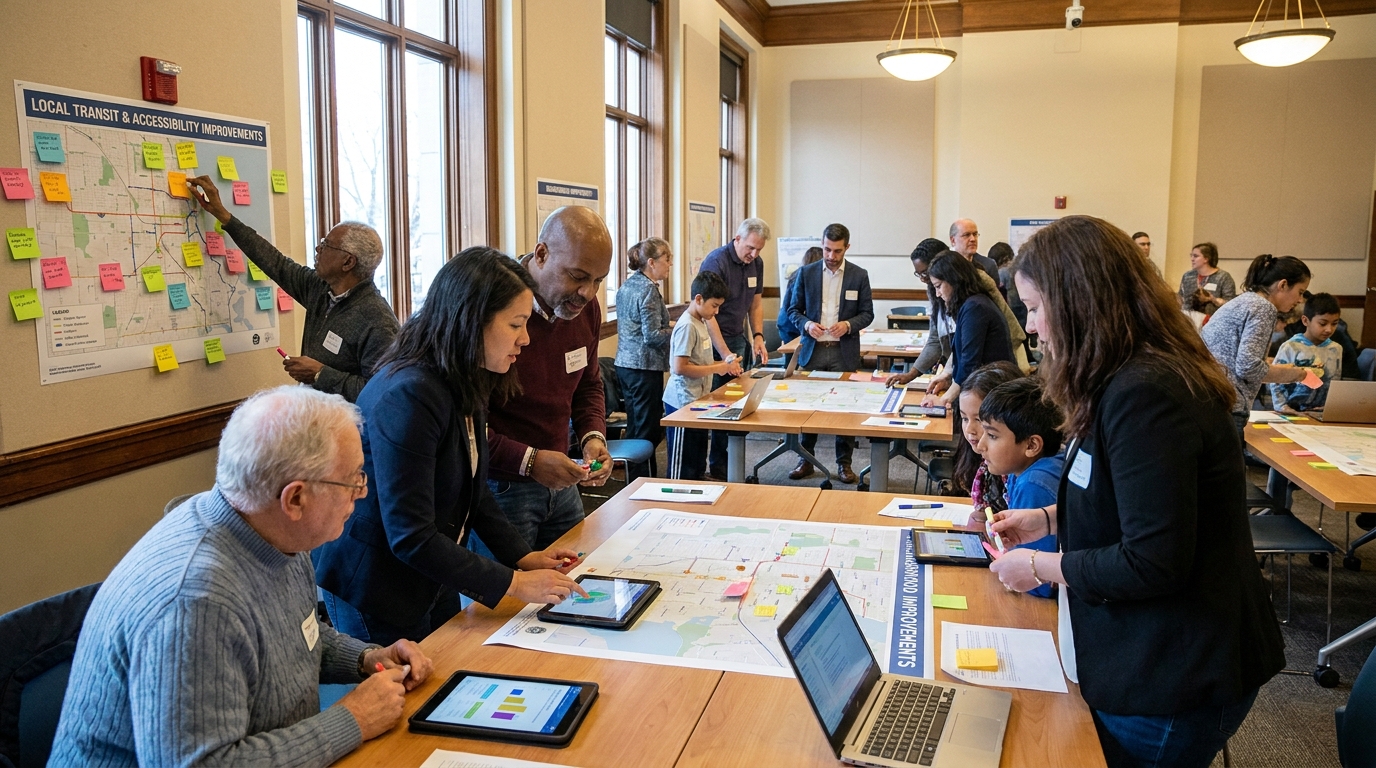
Meaningful participation is not a one-time consultation. The strongest models treat it as a recurring feedback process. They create ways for communities to propose issues, react to findings, test service changes, and see what happened after implementation. This ongoing cycle is what turns civic engagement from ceremony into intelligence.
Governance turns insight into fair action
Governance is often the least visible part of the triangle, yet it is where trust is won or lost. Governance determines who can access data, how privacy is protected, which indicators matter, how trade-offs are made, and how decisions are explained. It also sets the rules for accountability when data is incomplete, biased, or misinterpreted.
Canadian smart-city guidance has explicitly flagged data management, privacy, and security as major issues communities must address. That is not just a technical warning. It is a political and social one. If people do not understand how data is being used, or if they feel watched rather than represented, participation collapses. Community intelligence begins to resemble surveillance, even when its original intention was service improvement.
Good governance therefore includes privacy by design, clear consent practices where appropriate, public communication about data use, transparent metrics, and independent oversight where needed. It also includes internal discipline. Not every available dataset should be linked. Not every pattern should trigger intervention. Smarter systems are often defined by restraint as much as by capability.
Practical examples of communities using community intelligence
Using transit and accessibility data to improve routing
One of the clearest examples of community intelligence in practice is public transportation. Many communities now have access to data on ridership, route timing, stop usage, accessibility conditions, cycling connections, and travel times. On paper, this creates strong analytic potential. In practice, the best outcomes happen when that quantitative information is paired with rider input and neighborhood context.
Imagine a mid-sized city where bus service appears underused in an outer district. A purely data-driven reading might recommend reducing frequency. A community intelligence approach would go further. It would compare travel demand by time of day, review accessibility measures, speak with residents who rely on the route, and map nearby destinations such as schools, clinics, employment zones, and seniors’ housing. The result might show that overall ridership is modest but the route is indispensable for specific users and poorly timed for actual shift patterns. The smarter intervention may be schedule redesign rather than service cuts.
This is where open and public datasets become powerful. When transit, cycling, housing, and infrastructure data are easier to access, communities can make more integrated mobility decisions. A bus route is not just a transport issue. It is an access issue, an employment issue, and sometimes a health issue. Community intelligence allows planners to see those links instead of managing each system in isolation.
Targeting homelessness outreach more effectively
Another practical example comes from homelessness planning. Canada’s 2025 homelessness enumeration reporting covered 75 communities across every province and territory, illustrating how large-scale data collection is increasingly part of local service planning. Enumeration alone does not solve homelessness, of course, but it gives communities a clearer sense of scale, distribution, and urgency.
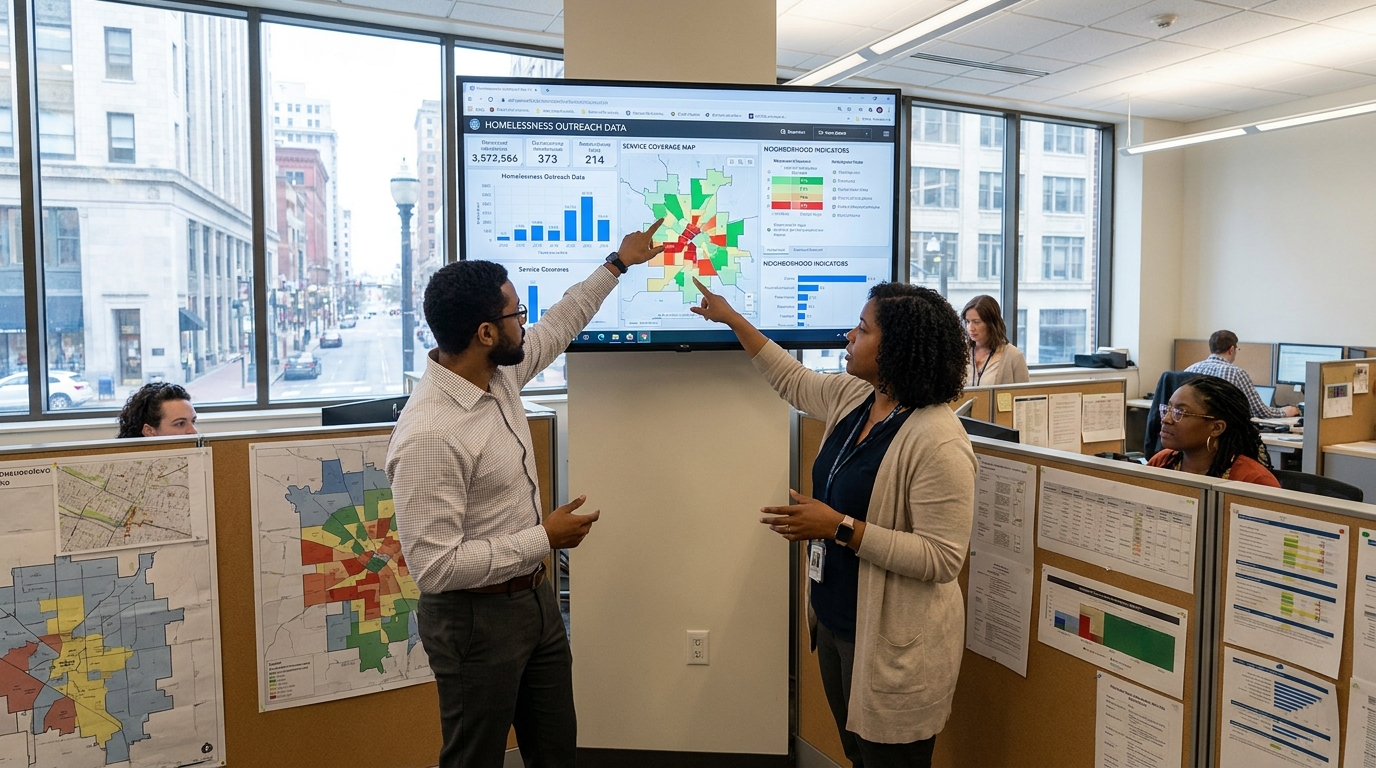
In a community intelligence framework, homelessness data becomes most useful when combined with local outreach knowledge, shelter capacity information, health indicators, weather risk, and resident-level service experience. For example, a city may identify an area with rising unsheltered counts. The response should not be limited to mapping the concentration. It should also ask whether outreach times align with actual need, whether transportation to services is realistic, whether encampment responses are coordinated across agencies, and whether certain groups are being missed entirely.
This kind of data-informed outreach can improve resource allocation, but only if governance is strong. Sensitive data requires strict handling. Communities need rules for who sees what, why the data is collected, and how it will and will not be used. When these safeguards are explicit, service planning can become more humane and more precise at the same time.
Guiding public health interventions with local surveillance and community trust
Public health offers another strong use case because it depends on timely information and local credibility. Community intelligence in this context might include wastewater signals, clinic data, immunization uptake, school absenteeism, environmental conditions, and neighborhood-level communication feedback. The aim is not simply to monitor. It is to intervene earlier and with greater relevance.
Suppose one district shows lower preventive care uptake than neighboring areas. A narrow administrative response might focus on increasing appointments. A smarter community response would ask whether hours are incompatible with work schedules, whether language access is limited, whether transportation is difficult, or whether trust in institutions is weak. Once again, the data identifies the pattern, but local engagement explains the mechanism.
This matters because public health is deeply shaped by behavior and trust. A technically excellent intervention can fail if residents do not view the messenger as credible or the service as accessible. Community intelligence improves effectiveness by joining epidemiological evidence with community-level listening.
Using neighborhood feedback tools to prioritize local improvements
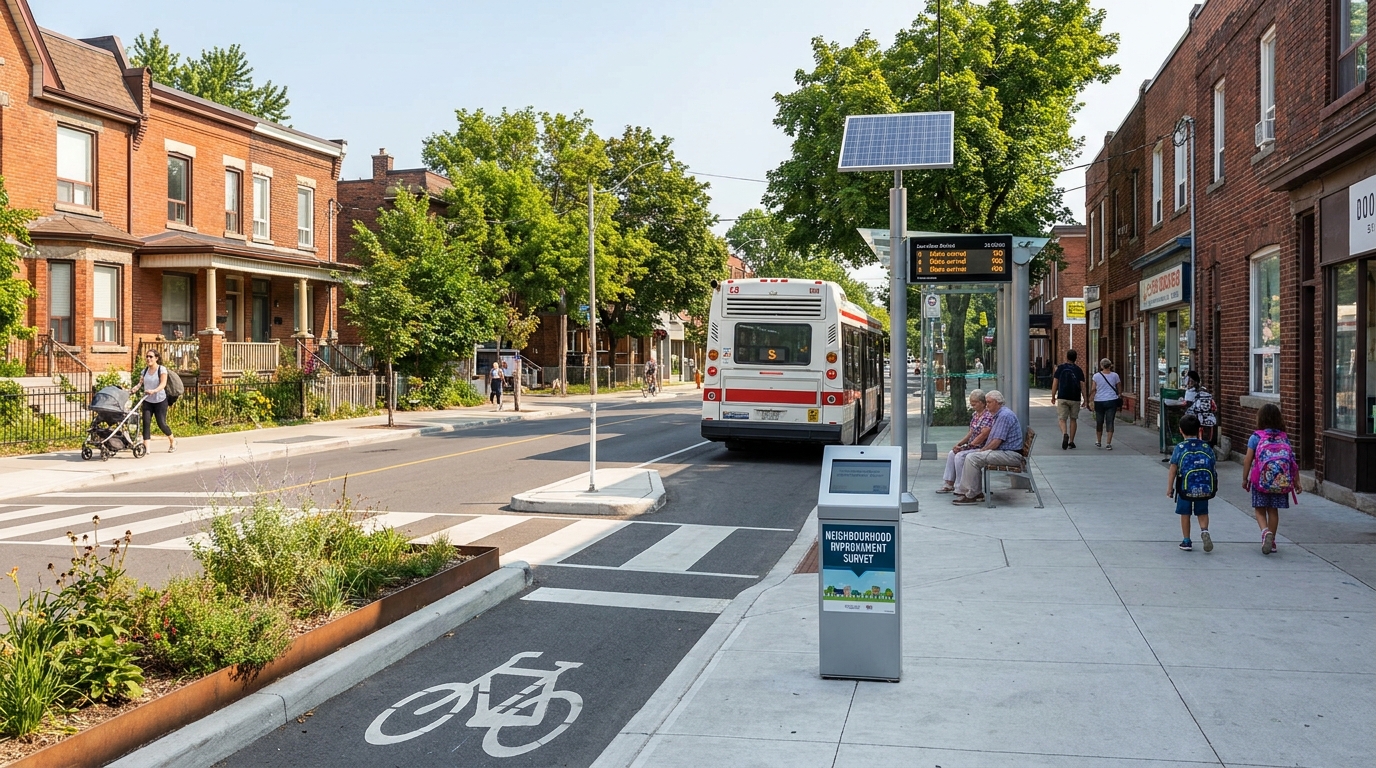
Not every example needs advanced analytics. Some of the most effective forms of community intelligence are modest and continuous. Neighborhood feedback platforms, local reporting apps, participatory mapping sessions, and recurring community check-ins can help municipalities understand which public-space issues matter most to residents. Broken lighting, unsafe crossings, poor snow clearance, inaccessible sidewalks, noise hotspots, and missing benches may look small in policy documents, but they shape daily experience in immediate ways.
The key is to treat these signals as more than complaints. When combined with service logs, demographic information, asset condition records, and accessibility goals, they become a prioritization tool. A city can distinguish between isolated incidents and persistent service gaps. It can also test whether improvements actually changed resident experience over time.
This is especially useful in neighborhoods that have historically felt overlooked. If residents repeatedly report issues and never see visible action, trust declines. When communities see that their feedback is acknowledged, analyzed, and connected to transparent service decisions, engagement becomes more durable. The system starts to feel reciprocal rather than extractive.
Community intelligence and the social dimension of urban life
One of the most important developments in this field is the growing recognition that intelligence should be measured not only by operational performance but by social experience. Sense of belonging is an example. Statistics Canada treats it as a core quality-of-life indicator because belonging reflects whether people feel connected to place and to one another. That is highly relevant for urban policy.
Dense urban environments can deliver opportunity, diversity, and access, yet they can also produce anonymity, fragmentation, and unequal visibility. The fact that rural Canadians report a stronger sense of belonging than urban residents should push urban leaders to ask better questions. Are public spaces welcoming? Are services responsive? Are people invited into decision-making before conflict emerges? Are digital tools helping people connect to local systems, or are they creating another layer of distance?
Youth data is especially instructive here. Statistics Canada found that almost two-thirds of Canadians aged 15 to 19 reported a strong sense of belonging to their local community from 2021 to 2024. That suggests younger people can feel connected when environments support participation, identity, and presence. Community intelligence can reinforce that by making youth feedback visible in planning rather than treating younger residents as passive recipients of adult-designed systems.
The social case for community intelligence is therefore not separate from the operational case. They are linked. A neighborhood with stronger trust may generate better participation. Better participation may improve service design. Better service design may strengthen belonging. Over time, this creates a reinforcing cycle. The opposite cycle is also possible when communities collect information but fail to act on it transparently.
The barriers communities keep running into
If community intelligence is so useful in theory, why is it still uneven in practice? The first barrier is fragmented data. Many local institutions collect relevant information, but they do so in incompatible formats, with different definitions, different timeframes, and different legal constraints. Housing, transit, health, utilities, emergency response, and community organizations may all be looking at related issues through disconnected systems.
The second barrier is uneven technical capacity. Larger cities often have analysts, GIS specialists, digital teams, and procurement leverage. Smaller municipalities may have one overstretched staff member handling multiple roles. This is one reason capacity-building support matters so much. Community intelligence should not become another policy area where only well-resourced jurisdictions can participate meaningfully.
The third barrier is privacy and security. These concerns are not secondary details to be solved after a pilot is launched. They are central design conditions. Sensitive information about movement, service use, health, or social vulnerability must be handled with care. If privacy is treated casually, public trust can be damaged faster than any efficiency gain can justify.
The fourth barrier is interpretation. Raw data does not naturally become action. Communities often have plenty of metrics but lack decision frameworks. Teams may not know which indicators are most important, how to identify causality versus correlation, or how to weigh efficiency against fairness. This is where governance and cross-sector expertise become essential.
There is also a cultural barrier. Some institutions still treat engagement as an obligation to complete rather than an intelligence source to learn from. That mindset produces weak consultations, generic surveys, and reports that vanish after publication. Residents notice when participation has no visible consequence. Once that happens, future engagement becomes harder, and the quality of local information declines with it.
What successful communities do differently
The communities that make progress in this space usually do a few things consistently. First, they define a specific local problem before choosing technology. This sounds obvious, yet it is the point where many initiatives go off course. A clear problem statement narrows the data needs, sharpens stakeholder roles, and makes evaluation possible.
Second, they build cross-sector partnerships early. Universities can support analysis and evaluation. Nonprofits can contribute frontline insight. Utilities can help with infrastructure coordination. Community groups can validate priorities and identify blind spots. Federal and provincial data providers can expand the evidence base. No single actor owns community intelligence. It works because each partner sees a different part of the same system.
Third, successful communities create governance rules that are understandable to the public. Privacy expectations, data-sharing protocols, accountability mechanisms, and decision criteria should not live only in technical documents. They should be explained in plain language. Transparency does not remove every concern, but it significantly improves legitimacy.
Fourth, they measure outcomes that residents can recognize. A dashboard full of internal process metrics may be useful for administration, but communities also need visible indicators like shorter wait times, improved route reliability, safer crossings, better service access, stronger participation rates, or improved neighborhood satisfaction. If people cannot see the connection between data use and lived improvement, support will remain abstract.
Fifth, they treat implementation as iterative. Not every first attempt will be correct. Community intelligence is strongest when leaders are willing to test, learn, adjust, and report back. That feedback discipline is often more important than predictive sophistication. Residents do not expect perfection. They expect seriousness, honesty, and follow-through.
Why community intelligence is not surveillance
One of the most persistent misconceptions in this area is that community intelligence is simply a softer label for surveillance. That fear is understandable because some smart-city narratives have emphasized monitoring tools without enough democratic guardrails. But community intelligence, properly designed, is broader and more grounded than surveillance. It focuses on resident-defined goals, service improvement, and accountable governance.
Surveillance collects information about people primarily to watch, control, or profile. Community intelligence should collect and use information to improve collective outcomes under public rules. The difference lies in purpose, proportionality, consent structures, transparency, and oversight. A city using transit and accessibility data to reduce mobility gaps is not equivalent to a system tracking individuals without clear justification or protection.
That said, the line can blur if governance is weak. This is why communities must be explicit about what they are measuring, why they are measuring it, how long information is retained, and how harms will be prevented. Public confidence depends less on abstract assurances and more on concrete safeguards. Trust is a design feature, not a communications strategy.
A practical framework for local leaders
For communities that want to start or strengthen a community intelligence approach, a simple framework can help. The aim is not to make the work simplistic. It is to make it operational.
- Define the local problem clearly. Describe the service gap or neighborhood issue in plain language before discussing platforms or data architecture.
- Map the knowledge sources. Identify which administrative datasets, open data resources, community organizations, and resident groups can contribute useful insight.
- Set governance rules early. Clarify privacy protections, data-sharing limits, accountability roles, and public reporting expectations from the outset.
- Design participation as an ongoing loop. Ask residents to validate the problem, react to proposed solutions, and review outcomes after implementation.
- Choose metrics that connect to lived experience. Pair technical indicators with service and quality-of-life measures that residents can understand.
- Report back visibly. Publish what was learned, what changed, what did not, and what will happen next.
This framework is intentionally practical because the field often becomes overloaded with abstraction. Community intelligence does not need to begin with a major transformation program. It can start with one route redesign, one service integration challenge, one neighborhood accessibility gap, or one local well-being objective. What matters is whether the process creates a repeatable pattern of evidence-based, participatory decision-making.
The future of smarter urban spaces
The next phase of urban intelligence will likely be less about novelty and more about maturity. Communities already have more data than they did a decade ago. The real challenge now is integration, governance, and trust. That means stronger standards, better training, clearer institutional roles, and more honest conversations about trade-offs. It also means resisting the temptation to confuse digital complexity with public value.
Energy systems offer a good example of this future direction. Natural Resources Canada has noted that smarter community development depends on integrating generation, transmission, loads, storage, and two-way communication across the local grid. That is a reminder that community intelligence increasingly reaches across systems that were once managed separately. Urban spaces are not only social and civic environments. They are infrastructure environments whose interdependencies are becoming more visible.
As those interdependencies become more important, the communities best positioned to adapt will be the ones that have built local intelligence habits early. They will already know how to combine data with participation. They will already have basic governance rules in place. They will already have relationships across government, nonprofits, utilities, and local institutions. In other words, they will not be starting from zero each time a new challenge appears.
For Canada and North America more broadly, this makes community intelligence one of the most useful lenses for thinking about urban improvement. It sits at the intersection of open government, civic engagement, service design, and digital public infrastructure. It is measurable without being narrow, and human without being vague. Most importantly, it aligns with a simple principle that many residents instinctively understand: local systems work better when the people affected by them help shape how they learn and respond.
Conclusion
Harnessing community intelligence is ultimately about building places that can learn. Not in the abstract machine-learning sense alone, but in the civic sense. A learning community notices patterns, listens to residents, protects trust, and adjusts its services based on evidence. It uses data to ask better questions, not merely to automate old assumptions.
The strongest examples are rarely the most futuristic. They are the communities that use transit data to improve access for actual riders, use homelessness data to direct support more humanely, use public health signals to design more relevant outreach, and use neighborhood feedback to fix daily frictions that shape how a place feels. They combine information with participation and then anchor both in governance that people can understand.
That is the real promise of smarter urban spaces. Not cities that simply know more, but cities and communities that decide better. When data, participation, and governance work together, local intelligence becomes a public asset. And when it becomes a public asset, urban life becomes not only more efficient, but more responsive, more equitable, and more worth belonging to.



No Comment! Be the first one.